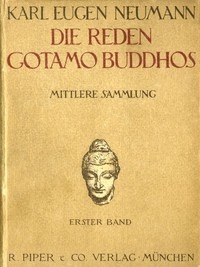
Die Reden Gotamo Buddhos. Mittlere Sammlung, erster Band by Karl Eugen Neumann

(8 User reviews)   4398
By Rebecca King Posted on Dec 22, 2025
In Category - Theology
German
Ever wondered what the Buddha actually said? Not the modern interpretations or simplified quotes, but the original teachings as they were spoken 2,500 years ago? This book is your chance to find out. It's a direct translation of the Buddha's 'Middle Length Discourses,' one of the core collections of his teachings. Reading it feels less like studying religion and more like listening to a brilliant, compassionate friend talk about how to live with less suffering. It's surprisingly practical, tackling everything from managing anger to understanding the mind. If you've ever been curious about Buddhism beyond the pop-culture clichés, start here. It's the real thing.
Share

Read "Die Reden Gotamo Buddhos. Mittlere Sammlung, erster Band by Karl Eugen Neumann" Online

This book is available in the public domain. Start reading the digital edition below.

START READING FULL BOOK
Instant Access    Mobile Friendly

Book Preview

A short preview of the book’s content is shown below to give you an idea of its style and themes.

und mit Hilfe eines vorangestellten Unterstriches versinnbildlicht. Die Wortformen, die in der Vorrede und einigen Fußnoten einem Wurzelzeichen folgen, stellen die Wortwurzel der erklärten Begriffe dar. Diese wurden im Original kursiv gesetzt, in dieser Version werden diese jedoch in normalem Schriftschnitt beispielhaft folgendermaßen wiedergegeben: √(sru). Der vorliegende Text wurde anhand der 1921 erschienenen Buchausgabe erstellt; Interpunktionsfehler wurden dabei stillschweigend korrigiert. Die Rechtschreibung des Originals wurde beibehalten, sofern es sich nicht um offensichtliche Fehler handelt; Änderungen, die sich aus den Corrigenda ergeben, wurden bereits in den Text eingearbeitet. Die folgenden Stellen wurden korrigiert: S. 305: Fußnote [10] → Fußnote [19] S. 502: ‚Saft,‘ eingefügt in: ‚mit dem Geschmacke einen Saft,‘ S. 649: ‚Umrissen‘ → ‚Unwissen‘ ------------------------------------------------------------------------ DIE REDEN GOTAMO BUDDHOS AUS DER MITTLEREN SAMMLUNG MAJJHIMANIKĀYO DES PĀLI-KANONS ZUM ERSTEN MAL ÜBERSETZT VON KARL EUGEN NEUMANN ZWEITE AUFLAGE ERSTER BAND ERSTES HALBHUNDERT MÜNCHEN 1921 * R. PIPER & CO. ALLE RECHTE VORBEHALTEN COPYRIGHT 1921 BY R. PIPER & CO. / G. M. B. H. / MÜNCHEN INHALT Seite VORWORT des Herausgebers IX VORREDE XIX DIE MITTLERE SAMMLUNG DER REDEN GOTAMO BUDDHOS ERSTER BAND ERSTES HALBHUNDERT ERSTER THEIL BUCH DER URART 1. Rede: Urart 3 2. „ Alles Wähnen 13 3. „ Erben der Lehre 22 4. „ Furcht und Angst 29 5. „ Unschuld 42 6. „ Wunsch um Wünsche 54 7. „ Das Gleichniss vom Kleide 61 8. „ Ledigung 69 9. „ Die rechte Erkenntniss 79 10. „ Die Pfeiler der Einsicht 98 ZWEITER THEIL BUCH DES LÖWENRUFS 11. Rede: Der Löwenruf 117 12. „ Das Haarsträuben 124 13. „ Die Leidensverkettung (I) 153 14. „ Die Leidensverkettung (II) 166 15. „ Das Maaß 176 16. „ Die Herzbeklemmungen 192 17. „ Waldeinsamkeit 201 18. „ Der gute Bissen 208 19. „ Zweierlei Erwägungen 221 20. „ Der Erwägungen Eingehn 230 DRITTER THEIL BUCH DER GLEICHNISSE 21. Rede: Das Gleichniss von der Säge 239 22. „ Das Schlangengleichniss 253 23. „ Der Ameisenhügel 276 24. „ Die Eilpost 282 25. „ Das Futter 293 26. „ Das heilige Ziel 303 27. „ Die Elephantenspur (I) 328 28. „ Die Elephantenspur (II) 346 29. „ Das Gleichniss vom Kernholz (I) 358 30. „ Das Gleichniss vom Kernholz (II) 371 VIERTER THEIL ERSTES BUCH DER PAARE 31. Rede: Im Gosiṉgam-Walde (I) 387 32. „ Im Gosiṉgam-Walde (II) 398 33. „ Der Rinderhirt (I) 411 34. „ Der Rinderhirt (II) 419 35. „ Saccako (I) 423 36. „ Saccako (II) 440 37. „ Versiegung des Durstes (I) 467 38. „ Versiegung des Durstes (II) 475 39. „ Vor Assapuram (I) 503 40. „ Vor Assapuram (II) 520 FÜNFTER THEIL ZWEITES BUCH DER PAARE 41. Rede: Die Brāhmanen von Sālā 531 42. „ Die Brāhmanen von Verañjam 540 43. „ Die Erklärungen (I) 540 44. „ Die Erklärungen (II) 553 45. „ Die Lebensführung (I) 563 46. „ Die Lebensführung (II) 570 47. „ Der Forscher 581 48. „ Vor Kosambī 586 49. „ Brahmās Heimsuchung 594 50. „ Māros Verweisung 605 ANMERKUNGEN 617 NACHWEISE. Vom Herausgeber 635 REGISTER 653 ZUR AUSSPRACHE: Die Betonung hält sich, der lateinischen ähnlich, möglichst am Anfang. Verbundene Worte haben, wie im Deutschen, zwei Hebungen. Es heißt also: Gótamo, Pasénadi, Sā́vatthī́ , Aggivéssano, Kápilavátthu u. s. w. ā, ī, ū sind lang auszusprechen, ebenso e, o, ausgenommen vor Doppelkonsonanz, c=tsch, j=dsch, y=j, v=w, s ist stets scharf, h in Verbindung mit Konsonant oder Doppelkonsonant stets hörbar zu sprechen. Punktierte Lettern sind lingual. Es werden durchweg die unverkürzten Nominative gegeben. Eḷu, d. i. weder Saṃskṛt noch Pāli, sind die Endungen -a, -e, -ya. * * * * * Die Zahlen...

This is a limited preview. Download the book to read the full content.

This isn't a storybook in the traditional sense. There's no plot with a beginning, middle, and end. Instead, Die Reden Gotamo Buddhos (The Discourses of Gotama Buddha) is a collection of conversations, lectures, and answers given by the historical Buddha to everyone from kings and monks to farmers and householders. Karl Eugen Neumann's German translation aims to bring us as close as possible to the original Pali texts.

The Story

Think of it as a series of philosophical dialogues. The Buddha walks from village to village, and people ask him questions: 'What is the cause of my unhappiness?' 'How can I find peace?' 'What happens after death?' His answers form the core of Buddhist thought. He explains the Four Noble Truths (the problem of suffering and its solution) and the Noble Eightfold Path (the practical guide to living wisely). Each discourse tackles a specific situation, making abstract ideas feel immediate and personal.

Why You Should Read It

I was struck by how direct and logical the teachings are. The Buddha often uses simple analogies—comparing the mind to a wild monkey or clarity to a still pond—that make complex ideas click. It's not about blind faith; it's an invitation to test his advice through your own experience. Reading it feels quiet and steadying. You're not being preached at; you're being offered tools for understanding your own mind.

Final Verdict

This book is perfect for the curious skeptic, the spiritual seeker tired of fluff, or anyone interested in philosophy and psychology from a foundational source. It's not a quick, easy read—some passages require slow reflection—but it's incredibly rewarding. You don't have to be a Buddhist to get value from it. If you want to engage with one of history's most influential thinkers in his own words, this translation is a profound place to begin.


📜 Public Domain Content

This masterpiece is free from copyright limitations. You do not need permission to reproduce this work.

Susan Wilson
7 months ago

The formatting on this digital edition is flawless.

Anthony Perez
1 year ago

My professor recommended this, and I see why.

Richard Clark
10 months ago

As someone who reads a lot, the atmosphere created is totally immersive. A valuable addition to my collection.

Aiden Lewis
1 year ago

Enjoyed every page.

Linda Martinez
1 year ago

Honestly, the pacing is just right, keeping you engaged. Worth every second.

4.5
4.5 out of 5 (8 User reviews )

Add a Review

Your Rating *
There are no comments for this eBook.
You must log in to post a comment.
Log in


Related eBooks