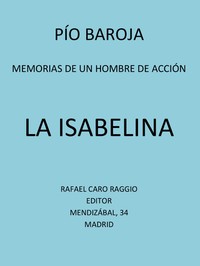
La Isabelina by Pío Baroja

(8 User reviews)   1913
By Rebecca King Posted on Jan 13, 2026
In Category - Theology
Baroja, Pío, 1872-1956 Baroja, Pío, 1872-1956
Spanish
Hey, I just finished this fascinating old Spanish novel called 'La Isabelina' by Pío Baroja. You know how I love stories that feel real, not just pretty? This is one of those. It’s set in the 1830s, right in the middle of Spain’s First Carlist War, but it’s not really about the big battles. It follows this young guy, Martín Zalacaín, who starts as a poor orphan and gets pulled into a dangerous world of smuggling and spies. The real hook is this mysterious woman, 'La Isabelina.' Everyone talks about her, but who is she really? Is she a patriot, a traitor, or something else? The book is like a gritty historical adventure mixed with a quiet character study. The writing is sharp and direct—Baroja doesn’t waste words. It feels authentic, a bit rough around the edges, and completely gripping. If you want a historical novel that’s more about survival and tough choices than royal drama, you should totally check this out.
Share

Read "La Isabelina by Pío Baroja" Online

This book is available in the public domain. Start reading the digital edition below.

START READING FULL BOOK
Instant Access    Mobile Friendly

Book Preview

A short preview of the book’s content is shown below to give you an idea of its style and themes.

--Lo soy. Soy liberal, completamente liberal; pero eso es lo de menos. Usted puede hablar de él con completa confianza. --¿Le interesa a usted el señor Aviraneta? --Sí. Mucho. ¿Usted ha tenido algunas relaciones con él? --Sí. --Me gustaría que me contara usted eso. --Pues yo le contaré a usted lo que sé de él, con una condición. --Veámosla. --Que me convide usted a una cena en una buena fonda de Burdeos. --Muy bien. Acepto. Usted elegirá en qué sitio. El padre Venancio vaciló; no sabía si sería mejor ir a la Fonda de la Paz, de la Cour de Chapeau Rouge, o a la de los Americanos, de la calle del Espíritu de las Leyes. Por fin se decidió por esta última, y dijo que vendría a buscarme al Hotel de Ruan, donde yo paraba. Marchamos a la Fonda de los Americanos, y encargué la cena en un gabinete reservado. El padre Chamizo comió y bebió como un templario. Después de tomar café y unas copas de licor, me dijo: --Ahora, para aligerar la lengua, mi querido señor Leguía, pida usted una botella de vino más. Es una mala costumbre antigua que me queda. --¿Del convento? --No, no. Parece mentira que diga usted eso, señor Leguía. ¿Es que usted también es enemigo nuestro? ¿Será usted un volteriano? --Un tanto. --¡Qué error, amigo mío! ¡Qué error! --¿Y qué quiere usted, otra botella de Burdeos, padre Chamizo? --No; ahora, Jerez...; sí, Jerez...; la beberé por patriotismo. Lejos de la patria, estas cosas se estiman más. La última la bebí en compañía del señor Usoz y Río, el cuáquero. No sé si le conocerá usted. --Sí. ¿Y él bebía? --No, él, no. ¿Adónde vamos a ir a parar? ¡Un cuáquero español! ¡Qué absurdo! Me estuvo hablando mal de los frailes y de España. ¡Hablar mal de un país que produce este vino!--exclamó, llenando la copa de Jerez, mirándola al trasluz y vaciándola de un trago. --Realmente es no tener sentido. --Ninguno, señor Leguía, ninguno. --Comience usted, padre Chamizo, su relato; le oigo con atención. --Mi relato se refiere a los años de 1833 y 1834. No sé si le interesará a usted. --Me interesa, sí, me interesa. --Bueno, pues voy allá. II. EN QUE EL PADRE CHAMIZO COMIENZA SU HISTORIA Y NO LA PUEDE TERMINAR EL padre Chamizo sacó un cuaderno del bolsillo, lo leyó aquí y allá, y, dejándolo entreabierto, dijo: --Bien; comenzaré. Primeramente permítame usted que le diga dos palabras acerca de mi vida. Soy de la provincia de Palencia, de un pueblo próximo al del abate don Sebastián de Miñano y Bedoya, célebre autor de las _Cartas del pobrecito holgazán_, que tanto ruido hicieron y tanta influencia tuvieron contra nosotros los pobres eclesiásticos. Mi padre murió joven, dejando a mi madre viuda, con varios hijos, de los cuales era yo el menor. Me creían listillo, yo no tenía afición al trabajo manual, y por amistad de un fraile que solía venir a mi casa, a llevarse el pobrecito lo que podía, me metieron en un convento de Palencia. Estuve algún tiempo de fámulo, sufriendo mil perrerías, lavando ropa sucia, llevando recados y haciendo de pinche en la cocina, hasta que vino de superior un buen hombre que me hizo estudiar, ordenarme y profesar. Tenía yo afición a las letras y creo que alguna disposición. Creía ya resuelta mi vida tranquila, dedicado al griego, al latín y a la historia; me habían enviado a un convento de Lerma, cuando en 1822 aparece por allí una columna del infernal Empecinado, se apodera del convento, y sus soldados me arrastran a mí...

This is a limited preview. Download the book to read the full content.

Pío Baroja’s La Isabelina drops us into a messy, violent period of Spanish history. We follow Martín Zalacaín, a young man from a tiny Basque village. He’s tough, clever, and an orphan, which means he’s learned to rely only on himself. When the Carlist War breaks out, Martín sees a chance. He starts running contraband across the war-torn border between France and Spain. It’s dangerous work, but it pays.

The Story

The plot thickens when Martín gets tangled up with a secretive Liberal spy network. His job becomes less about goods and more about information. The central mystery revolves around the code name ‘La Isabelina.’ This shadowy figure is key to the Liberal cause, but her true identity is a closely guarded secret. Martín’s journey becomes a quest to uncover who she is, all while navigating a landscape full of betrayal, shifting loyalties, and sudden violence. It’s a survival story where the front line is everywhere.

Why You Should Read It

I loved this book because it doesn’t romanticize history. Baroja shows us the war from the ground level—the mud, the fear, the selfishness, and the rare flashes of honor. Martín isn’t a classic hero. He’s practical, sometimes cynical, and his main goal is to get through the chaos in one piece. The search for La Isabelina becomes a way to explore bigger ideas about identity and what people are really fighting for. Is it for a king, for a country, or just for themselves? The prose is clean and fast, which makes the tense moments really pop.

Final Verdict

This book is perfect for readers who like their historical fiction lean, mean, and psychologically honest. If you enjoy adventure stories where the action has consequences and the characters are flawed, you’ll connect with Martín’s struggle. It’s also a great pick if you’re curious about Spanish history but want to avoid dry, textbook accounts. Baroja makes you feel the chill of the Pyrenees and the paranoia of a spy. Just be ready for a story that’s more about hard truths than happy endings.


🟢 Legacy Content

The copyright for this book has expired, making it public property. Preserving history for future generations.

Noah Jackson
1 month ago

I stumbled upon this title and the flow of the text seems very fluid. Truly inspiring.

Nancy Brown
1 year ago

Honestly, the arguments are well-supported by credible references. Exceeded all my expectations.

John Flores
4 months ago

The fonts used are very comfortable for long reading sessions.

Betty Perez
9 months ago

As someone who reads a lot, the depth of research presented here is truly commendable. Highly recommended.

Joshua Wilson
6 months ago

From the very first page, the clarity of the writing makes this accessible. Thanks for sharing this review.

4.5
4.5 out of 5 (8 User reviews )

Add a Review

Your Rating *
There are no comments for this eBook.
You must log in to post a comment.
Log in


Related eBooks