1

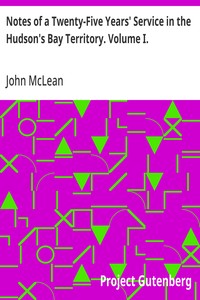
Notes of a Twenty-Five Years' Service in the Hudson's Bay Territory. Volume II. — Context and Discussion
(0 User reviews)
72
Project Gutenberg
2005
Not confirmed
Labrador (N.L.) -- Description and travel; Hudson's Bay Company; Northwest, Canadian -- Description and travel; Indians of North America -- Languages; McLean, John, 1799-1890
Readers of public-domain and historical texts
Project Gutenberg digital edition
en
Edition facts
Words
60,462
Reading time
263 min
Text sections
9
The source record for Notes of a Twenty-Five Years' Service in the Hudson's Bay Territory. Volume II. — Context and Discussion measures this digital text at 60,462 words, 4 hr 23 min estimated reading time, and 9 detected text sections.
The text analysis averages about 27.7 words per sentence, while the detected sections provide another way to judge how the source is divided.
Project Gutenberg metadata also associates the work with “Labrador (N.L.) -- Description and travel,” connecting these edition facts with the source record’s subject description.
Source:
Project Gutenberg record #16864
John McLean's second volume recounts his Hudson's Bay Company service in Labrador, blending travel narrative with observations on Indigenous peoples, colonial governance, and transatlantic cultural critique. Notable for its vivid descriptions of a 'stupendous cataract' and a sustained argument with an American clergyman's book.
Read the complete public-domain text at its original source.
Read on Project GutenbergJohn McLean's second volume opens with a journey to Norway House and quickly establishes a pattern of movement between remote posts and the wider world. The table of contents alone signals a work of varied interests: exploring expeditions through Labrador, detailed accounts of the Nascopie and Esquimaux peoples, and a chapter of 'General Remarks' on climate, soil, and animals. McLean writes as a servant of the Hudson's Bay Company, yet his narrative often steps back to assess the land and its inhabitants with a surveyor's eye.
What sets this volume apart is its willingness to engage in polemic. Late in the text, McLean launches into a lengthy rebuttal of an American publication titled 'The Glory and Shame of England,' defending English institutions while acknowledging the 'misery and wretchedness' in British cities. This editorial turn reveals a writer who sees his travel notes as a platform for broader cultural argument.
A Cataract and Its Context
McLean's discovery of a 'stupendous cataract' on the Hamilton River is one of the volume's set pieces. The phrasing is typical of his descriptive style: he favors strong adjectives ('stupendous') but provides little sensory detail, focusing instead on the event's significance as a geographical finding. The expedition up George's River that precedes it is narrated as a series of 'difficulties'—a word that recurs throughout the text. McLean rarely lingers on scenery for its own sake; landscape is usually an obstacle or a resource.
This approach contrasts with the chapter on the climate of Ungava, where he lists facts about the aurora borealis, soil, and vegetable productions in a systematic manner. The two modes—narrative and catalogue—sit side by side, suggesting a writer who values both the story of exploration and the data it yields.
Nascopie and Esquimaux: Observation and Inference
McLean devotes separate chapters to the Nascopies and the Esquimaux, organizing his material under headings such as 'Religion,' 'Manners and Customs,' and 'Dress.' His tone is ethnographic but not neutral: he notes the Nascopie practice of 'community of goods' and the Esquimaux's 'identity of language from Labrador to Behring's Straits,' yet he offers no explicit judgment. The structure itself—a list of traits—implies a desire to classify.
However, the excerpts do not reveal how McLean gathered this information or whether he relied on interpreters. Readers should note that his observations are filtered through his role as a Company servant and his own cultural assumptions. The chapter on 'Esquimaux Half-Breeds' and the Moravian Brethren suggests contact zones where multiple cultures intersect, but McLean's perspective remains that of an outsider.
A Transatlantic Argument
In the volume's later pages, McLean interrupts his travel narrative to respond to an American clergyman's book, 'The Glory and Shame of England.' He accuses the author of 'sacrificing the truth' and 'gratifying his resentment against England.' The passage is remarkable for its directness: McLean quotes the title, names the profession of the writer, and then argues against the idea that redistributing land would solve poverty.
His counter-argument relies on a chain of hypotheticals—'Supposing the whole arable soil of England were divided'—and a defense of the existing social order. He insists that the incomes of the nobility 'flow back into the hands of the merchants, tradesmen, servants.' This section reveals McLean as a conservative polemicist, willing to set aside his travelogue for a sustained political essay. It also shows his awareness of a transatlantic readership: he is writing back to American critics.
Readers approaching this volume should be prepared for a work that shifts between genres: travel journal, natural history, ethnography, and political pamphlet. McLean's voice is that of a Company man who is also a sharp observer of human behavior, whether among the Nascopies or in the streets of London. The volume's value lies not in a single narrative arc but in the juxtaposition of its parts—the cataract and the controversy, the snow-house and the sermon. Pay attention to the moments when McLean steps back from description to argue; they reveal the convictions that shaped his twenty-five years of service.
Flipping through McLean’s account of that relentless Labrador cataract, I felt the same patient travel—the way a landscape reshapes a man’s thoughts. It reminded me of another quiet record, Notes of an Overland Journey Through France and Egypt to Bombay — Text and Context, where distance does the same slow work, each mile a small, unhurried lesson in seeing.
There are no reviews for this eBook.
There are no comments for this eBook.
Reader reflection
How did this book work for you?
Your answers remain private and are stored only in this browser.
Your progress
0
/
10
2
How did the book work for you overall?
3
Would you pass this book on to a friend?
4
Did the language feel accessible?
5
How closely did the book connect with your experience?
6
Was the book what you thought it would be?
7
Did you gain anything practical from the text?
8
What did you think about the pace?
9
Which lesson or insight stayed with you?
10