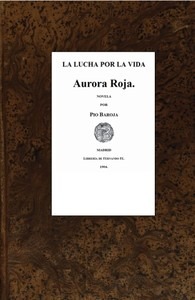
La lucha por la vida: Aurora roja by Pío Baroja

(8 User reviews)   4491
By Rebecca King Posted on Dec 22, 2025
In Category - Faith & Religion
Baroja, Pío, 1872-1956 Baroja, Pío, 1872-1956
Spanish
Hey, I just finished this gritty Spanish classic that feels shockingly modern. It's the final part of Baroja's 'The Struggle for Life' trilogy, following Manuel Alcázar, a young man trying to survive in the slums of early 1900s Madrid. Forget romantic adventures—this is about the daily grind of poverty, political awakening, and the search for meaning when you're at the bottom. The 'red dawn' of the title points to the anarchist and revolutionary ideas simmering in the city's underbelly. It's raw, it's honest, and it asks tough questions about society and justice that we're still wrestling with today. If you like stories about real people in impossible situations, give this a look.
Share

Read "La lucha por la vida: Aurora roja by Pío Baroja" Online

This book is available in the public domain. Start reading the digital edition below.

START READING FULL BOOK
Instant Access    Mobile Friendly

Book Preview

A short preview of the book’s content is shown below to give you an idea of its style and themes.

=Aventuras, inventos y mixtificaciones de Silvestre Paradox=; ídem. =Camino de perfección (pasión mística)=, novela; ídem. =El Mayorazgo de Labraz=, novela; ídem. =Idilios vascos=; con ilustraciones de F. Periquet y R. Baroja; ídem. LA LUCHA POR LA VIDA =La Busca= (novela); un vol. =Mala hierba= (novela); un vol. =Aurora roja= (novela); un vol. LA LUCHA POR LA VIDA Aurora Roja. NOVELA POR PIO BAROJA {imagen decorativa} MADRID LIBRERÍA DE FERNANDO FÉ. 1904. ES PROPIEDAD.--DERECHOS RESERVADOS Aurora Roja[*] [*] Los episodios que preceden á AURORA ROJA, se titulan LA BUSCA y MALA HIERBA. PROLOGO Cómo Juan dejó de ser seminarista. Habían salido los dos muchachos á pasear por los alrededores del pueblo, y á la vuelta, sentados en un pretil del camino, cambiaban á largos intervalos alguna frase indiferente. Era uno de los mozos alto, fuerte, de ojos grises y expresión jovial; el otro, bajo, raquítico, de cara manchada de roseolas y de mirar adusto y un tanto sombrío. Los dos, vestidos de negro, imberbe el uno, rasurado el otro, tenían aire de seminaristas; el alto, grababa con un cortaplumas en la corteza de una vara una porción de dibujos y de adornos; el otro, con las manos en las rodillas, en actitud melancólica, contemplaba, entre absorto y distraído, el paisaje. El día era de otoño, húmedo, triste. A lo lejos, asentada sobre una colina, se divisaba la aldea con sus casas negruzcas y sus torres más negras aún. En el cielo gris como una lámina mate de acero subían despacio las tenues columnas de humo de las chimeneas del pueblo. El aire estaba silencioso; el río, escondido tras de un boscaje resonaba vagamente en la soledad. Se oía el tintineo de las esquilas y un lejano tañer de campana. De pronto resonó el silbido estridente de un tren; luego se vió aparecer una blanca humareda entre los árboles, que pronto se convirtió en una neblina suave. --Vámonos ya--dijo el más alto de los mozos. --Vamos--repuso el otro. Se levantaron del pretil del camino, en donde estaban sentados, y comenzaron á andar en dirección del pueblo. Una niebla vaga y melancólica comenzaba á cubrir el campo. La carretera, como una cinta violácea, manchada por el amarillo y el rojo de las hojas muertas, corría entre los altos árboles desnudos por el otoño hasta perderse á lo lejos, ondulando en una extensa curva. Las ráfagas de aire hacían desprenderse de las ramas á las hojas secas que correteaban por el camino. --Pasado mañana ya estamos otra vez allí--dijo el mocetón alegremente. --Quién sabe--replicó el otro. --¿Cómo quién sabe? Yo lo sé y tú también. --Tú sabrás que vas á ir; yo, en cambio, sé que no voy. --¿Que no vas? --No. --¿Y por qué? --Porque estoy decidido á no ser cura. Tiró el mozo al suelo la vara que había labrado, y quedó contemplando á su amigo con extrañeza. --Pero tú estás loco, Juan. --No, no estoy loco, Martín. --¿No piensas volver al seminario? --No. --¿Y qué vas á hacer? --Cualquier cosa. Todo menos ser cura; no tengo vocación. --¡Toma! ¡Vocación! ¡vocación! Tampoco la tengo yo. --Es que yo no creo en nada. El buen mozo se encogió de hombros cándidamente. --Y el padre Pulpon, ¿cree en algo? --Es que el padre Pulpon es un bandido, un embaucador--dijo el más bajo de los dos con vehemencia--, y yo no quiero engañar á la gente, como él. --Pero hay que vivir, chico. ¿Si yo tuviera dinero me haría cura? No; me iría al campo y viviría la vida rústica y trabajaría la tierra con mis propios bueyes, como dice Horacio: _Paterna rura bobus, exercet...

This is a limited preview. Download the book to read the full content.

La lucha por la vida: Aurora roja (The Red Dawn) throws us back into the chaotic world of Manuel, a young man just trying to keep his head above water in Madrid's poorest neighborhoods. After the events of the previous books, he's a bit older, a bit more worn down, and deeply entangled with a group of anarchists and social reformers. The plot isn't about a single big event, but about the slow burn of life—finding work (or not), navigating friendships and betrayals within the political group, and witnessing the desperation and occasional violence that poverty breeds.

Why You Should Read It

Baroja doesn't give you heroes and villains. He gives you people. Manuel is frustrating, idealistic, confused, and utterly human. The book's power is in how it makes you feel the weight of an unfair system on his shoulders. You see how easy it is for hope to twist into anger, and for talk of a better world to lead to dangerous places. Reading it now, it's impossible not to see the echoes in today's discussions about inequality and political polarization. It's a historical novel that reads like urgent, contemporary social commentary.

Final Verdict

Perfect for readers who love character-driven stories and don't need a tidy, happy ending. If you enjoyed the social realism of writers like Charles Dickens or Émile Zola, but prefer something more direct and less sentimental, Baroja is your guy. This isn't a light read—it's often bleak—but it's a powerful, unforgettable look at a time and a struggle that shaped the modern world. Be ready to get a little dirt under your fingernails.


📜 Copyright Status

This title is part of the public domain archive. Knowledge should be free and accessible.

Elizabeth Lopez
1 year ago

I was skeptical at first, but the content flows smoothly from one chapter to the next. I will read more from this author.

Steven Anderson
1 year ago

Very interesting perspective.

Patricia Taylor
1 year ago

To be perfectly clear, the flow of the text seems very fluid. Worth every second.

Patricia Lewis
1 year ago

Five stars!

Nancy White
8 months ago

Great read!

4.5
4.5 out of 5 (8 User reviews )

Add a Review

Your Rating *
There are no comments for this eBook.
You must log in to post a comment.
Log in


Related eBooks