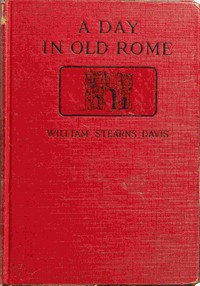
A day in old Rome : a picture of Roman life by William Stearns Davis

(9 User reviews)   1139
By Rebecca King Posted on Jan 13, 2026
In Category - Faith & Religion
Davis, William Stearns, 1877-1930 Davis, William Stearns, 1877-1930
English
Okay, forget everything you think you know about ancient Rome from dry history books. Imagine instead that you could just... step into it. That's what 'A Day in Old Rome' does. It’s not about emperors or epic battles. It’s about the smell of bread from a bakery before dawn, the grumble of a shopkeeper setting up his stall, the gossip in the public baths, and the chaos of the streets. The author, William Stearns Davis, doesn't just tell you facts—he builds you a time machine. He follows a fictional but totally believable Roman citizen named Publius through one completely ordinary day, from morning to night. The real 'conflict' here is just daily life: navigating crowded markets, dealing with family, avoiding trouble, and finding a moment of peace. It makes a civilization that feels distant and marble-carved suddenly warm, noisy, and incredibly human. If you've ever wondered what it was actually *like* to be there, this is your ticket.
Share

Read "A day in old Rome : a picture of Roman life by William Stearns Davis" Online

This book is available in the public domain. Start reading the digital edition below.

START READING FULL BOOK
Instant Access    Mobile Friendly

Book Preview

A short preview of the book’s content is shown below to give you an idea of its style and themes.

again gladly acknowledge the gracious and untiring services of my wife. The illustrations, which, it is hoped, add considerably to the interest of the book, have been collected from many sources. Many of the highly informational “restorations” included are from the monumental work of Jakob von Falke, _Hellas und Rom_, the English version whereof has long ceased to be available to American readers. W. S. D. THE UNIVERSITY OF MINNESOTA MINNEAPOLIS CONTENTS PAGE LIST OF ILLUSTRATIONS xxi Chapter I. The General Aspect of the City SECTION 1. The Prosperity of Rome in the Reign of Hadrian (A.D. 117–138) 1 2. Increasing Glory of the Imperial City 2 3. Population and Crowded Condition of Rome 3 4. The Country around Rome 5 5. The Tiber and Its Valley 6 6. A View over Rome from the Campus Martius 7 7. The Seven Hills of Rome 9 8. Building Materials Used in Rome 10 9. The Great Use of Concrete 11 10. Greek Architectural Forms Plus the Arch and Vault 12 Chapter II. Streets and Street Life 11. The Regions of Rome: Fashionable and Plebeian Quarters 15 12. A Typical Short Street, “Mercury Street” 16 13. The House and Shop Fronts 18 14. Street Shrines and Fountains 20 15. Typical Street Crowds 21 16. Frequent Use of Greek in Rome 22 17. Clamor and Thronging in the Streets 23 18. The Processions Attending Great Nobles 24 19. A Great Lady Traveling 25 20. Public Salutations: the Kissing Habit 26 21. The Swarms of Idlers and Parasites 27 22. Public Placards and Notices 28 23. Wall Scribblings 30 24. The Streets Dark and Dangerous at Night 32 25. Discomforts of Life in Rome 33 Chapter III. The Homes of the Lowly and of the Mighty 26. The Great _Insulæ_--Tenement Blocks 34 27. A Typical Insula 35 28. The Flats in an Insula 36 29. The Cheap Attic Tenements and Their Poor Occupants 37 30. A Senatorial “Mansion” (_Domus_) 39 31. The Plan of a Large Residence 40 32. Entrance to the Residence 42 33. The Atrium and the View across It 42 34. The Rooms in the Rear and the _Peristylium_ 44 35. The Dining Room (_Triclinium_) and the Chapel 45 36. The Garden and the Slaves’ Quarters 47 37. The Floors and Windows 49 38. Frescos, Beautiful and Innumerable 50 39. The Profusion of Statues and Art Objects 51 40. Family Portrait Busts 52 41. Death Masks (_Imagines_) 54 42. Couches, Their General Use 54 43. Elegant Chairs and Costly Tables 55 44. Chests, Cabinets, Water Clocks, and Curios 57 45. Spurious Antiques 58 46. Pet Animals 58 Chapter IV. Roman Women and Roman Marriages 47. Honorable Status of Roman Women 60 48. Men Reluctant to Marry 61 49. Rights and Privileges of Married Women 61 50. Selection of Husbands for Young Girls 63 51. A Marriage Treaty among Noble-Folk 64 52. A Betrothal in Wealthy Circles 65 53. Adjusting the Dowry 66 54. Dressing the Bride 66 55. The Marriage Ceremonies 67 56. The Wedding Procession 69 57. At the Bridegroom’s House 70 58. Honors and Liberties of a Matron 71 59. Unhappy Marriages and Frivolous Women 72 60. Divorces, Easy and Frequent 74 61. Celibacy Common: Old Families Dying Out 75 62. Nobler Types of Women 75 63. Famous and Devoted Wives 76 64. The Story of Turia 78 Chapter V. Costume and Personal Adornment 65. The Type of Roman Garments 80 66. The Toga, the National Latin Garment 81 67. Varieties of Togas 83 68. Draping the Toga 83 69. The Tunica 84 70. Capes, Cloaks, and Gala Garments...

This is a limited preview. Download the book to read the full content.

Most history books give you the headlines: Caesar crossed the Rubicon, Nero fiddled, the Empire fell. William Stearns Davis gives you the weather report, the street food, and the commute. A Day in Old Rome is a guided tour of the city in 134 AD, but instead of a lecture, it's an experience.

The Story

The book doesn't have a plot in the novel sense. Its structure is genius in its simplicity: it follows a well-to-do Roman named Publius through a single, typical day. We wake up with him in his home, follow him to the public baths for his morning routine, join him as he deals with business in the Forum, watches a gladiator show at the arena, shares dinner with friends, and finally returns home. Along the way, Davis points out everything. We learn how houses were built, what people ate for lunch, how the law courts worked, and why the baths were the social media hub of the ancient world. It's all woven into Publius's journey, so the information never feels dropped on you. You're just seeing his world through his eyes.

Why You Should Read It

This book completely changed how I see history. Davis wrote it in 1925, but it feels fresh because he focuses on human beings, not just events. You get a sense of the incredible noise, color, and smell of Rome. You understand the social rules—who bows to whom, what's considered rude, what people worried about. It demystifies the past. The Romans stop being statues and start being people who got headaches, argued with their spouses, and looked for a good place to eat. Davis has a friendly, clear style that makes even complex social structures easy to grasp. You finish the book feeling like you didn't just read about Rome, you visited.

Final Verdict

This is the perfect book for anyone who finds history interesting but finds textbooks boring. It's for the reader who watches a historical drama and thinks, 'But what did they DO all day?' It's also a fantastic companion if you're planning a trip to Rome—it will make the ruins come alive in your mind. If you love deep dives into daily life, vivid storytelling, and a book that educates you without you even noticing, pick this one up. It's a classic for a reason.


📢 Usage Rights

This publication is available for unrestricted use. Feel free to use it for personal or commercial purposes.

Jennifer White
1 week ago

Compatible with my e-reader, thanks.

Joshua Thomas
5 months ago

After finishing this book, it manages to explain difficult concepts in plain English. Don't hesitate to start reading.

Thomas Hill
1 year ago

Finally a version with clear text and no errors.

Oliver Rodriguez
3 weeks ago

Beautifully written.

Barbara Anderson
7 months ago

Thanks for the recommendation.

5
5 out of 5 (9 User reviews )

Add a Review

Your Rating *
There are no comments for this eBook.
You must log in to post a comment.
Log in


Related eBooks