1

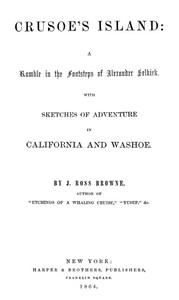
Crusoe's Island: A Ramble in the Footsteps of Alexander Selkirk With Sketches of Adventure in California and Washoe — Reading Companion
1
0
Project Gutenberg
2012
California -- Social life and customs; Pacific States -- Description and travel; Mines and mineral resources -- California; Ethnic groups -- California; Juan Fernández Islands; Washoe County (Nev.)
Readers of public-domain and historical texts
Project Gutenberg digital edition
en
Edition facts
Words: 125,140
Reading time: 545 min
Text sections: 16
Source:
Project Gutenberg record #39918
J. Ross Browne's 1864 travelogue blends a visit to Juan Fernández, the island of Alexander Selkirk, with sketches of California and Washoe. The narrative shifts between leisurely description and tense pursuit, revealing Browne's self-deprecating humor and sharp observations of frontier life.
J. Ross Browne opens Crusoe's Island not with a scholarly preface but with a boat adventure, immediately establishing a voice that is at once self-aware and wryly humorous. The narrative moves from a storm-tossed landing on Juan Fernández to a series of sketches that range from the comically mundane—cooking fish in a cave—to the genuinely harrowing, as when he flees through the Nevada desert. Browne's prose is marked by a deliberate shift in pace: leisurely, descriptive passages give way to taut, breathless sequences of pursuit. His observations are grounded in specific, often ironic details, such as the mule that refuses to move or the convict cells repurposed as shelters. This editorial note traces how Browne's language and narrative rhythm shape the reader's experience across three distinct sections of the work.
A Voice Between Irony and Alarm
Browne's narrative voice is remarkably flexible, shifting between a detached, ironic observer and a participant caught in genuine peril. In the Juan Fernández chapters, he describes the island's landscape with a dry humor that undercuts any romanticism: the famous cave of Robinson Crusoe is a damp, cramped space, and the local goats are more nuisance than novelty. Yet when the scene shifts to California and Washoe, the tone tightens. In the excerpt from “A Dangerous Journey,” Browne's language becomes urgent and sensory: he notes the “intolerable thirst,” the mule's stubborn refusal to speed up, and the “weird effect” of coyotes and night-owls. The contrast is not merely thematic but structural—the same author who jokes about dyspeptic companions later records the precise sound of hoofbeats approaching in the dark. This vocal range gives the book an uneven, unpredictable texture, as if the reader is never quite sure whether the next paragraph will offer a wry aside or a narrow escape.
Pace as a Narrative Tool
The pacing in Crusoe's Island is anything but uniform. Browne frequently slows the narrative to a crawl with detailed descriptions of landscapes, local customs, or the minutiae of camp life—paragraphs devoted to the layout of convict cells or the proper method of cooking fish. These passages create a sense of immersion, but they also set the stage for sudden accelerations. In the Washoe section, the rhythm changes dramatically: sentences grow shorter, actions become more desperate, and the reader is pulled into a chase sequence that spans multiple chapters. The excerpt from “The Attack” shows Browne compressing time: “It must have been nearly ten o'clock when my mule suddenly stopped.” The word “suddenly” is key—Browne uses abrupt shifts in tempo to mirror the unpredictability of frontier travel. The result is a book that feels less like a continuous journey and more like a series of distinct episodes, each with its own internal rhythm.
Recurring Details and Their Weight
Certain small details recur across the book, lending it a cohesive texture. Mules appear repeatedly, always with a personality of their own: they lag, bray, refuse to move, or bolt into the darkness. Browne's relationship with these animals becomes a running motif, a measure of his control—or lack thereof—over his environment. Similarly, the motif of thirst appears in both the island and the desert sections, linking the two geographies. The author's attention to physical discomfort—hunger, fatigue, the “parched” throat—grounds the narrative in bodily experience. Even the illustrations, listed in the contents, suggest a visual component to these details: “Crusoe's Cave,” “The Cliff,” “Abraham on the Peak.” These recurring elements are not symbolic in any heavy-handed sense; they function as anchors, reminding the reader that Browne's ramble is always, at bottom, a physical ordeal.
Readers approaching Crusoe's Island should be prepared for a work that resists easy categorization. It is part travelogue, part adventure story, and part social commentary, held together by Browne's distinctive voice. Pay attention to the shifts in pace—they are not accidental. The book rewards those who read slowly through the descriptive passages, because the moments of crisis are all the more effective for the calm that precedes them. Browne's self-deprecating humor and his willingness to record his own failures make him an engaging, if sometimes unreliable, guide.
Reader reflection
How did this book work for you?
Your answers remain private and are stored only in this browser.
Your progress
0
/
10
2
What was your overall reaction to the book?
3
Is this a title you would suggest to others?
4
What was the reading difficulty like?
5
How original did the book feel?
6
Did you relate to its people, ideas, or situations?
7
Could you see yourself revisiting this book?
8
Could you apply anything you learned?
9
In one sentence, what did you learn?
10