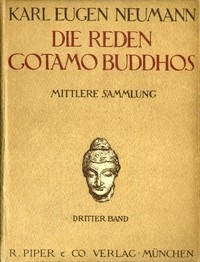
Die Reden Gotamo Buddhos. Mittlere Sammlung, dritter Band by Karl Eugen Neumann

(8 User reviews)   4569
By Rebecca King Posted on Dec 22, 2025
In Category - World Religions
German
Hey, have you ever felt like classic Buddhist texts were locked behind a dusty academic door? I just finished this incredible German translation of the Buddha's Middle Length Discourses, and it's like finding a fresh, clear window into ancient wisdom. Forget what you think you know about dry philosophy – this collection shows the Buddha as a real teacher, having deep, practical conversations with everyone from kings to farmers. The mystery here isn't a whodunit; it's how 2,500-year-old advice on dealing with stress, desire, and anger can feel so startlingly relevant to our modern chaos. It's not a quick self-help fix, but a slow, thoughtful dialogue with one of history's great minds.
Share

Read "Die Reden Gotamo Buddhos. Mittlere Sammlung, dritter Band by Karl Eugen Neumann" Online

This book is available in the public domain. Start reading the digital edition below.

START READING FULL BOOK
Instant Access    Mobile Friendly

Book Preview

A short preview of the book’s content is shown below to give you an idea of its style and themes.

und mit Hilfe eines vorangestellten Unterstriches versinnbildlicht. Die Wortformen, die in einigen Fußnoten einem Wurzelzeichen folgen, stellen die Wortwurzel der erklärten Begriffe dar. Diese wurden im Original kursiv gesetzt, in dieser Version werden diese jedoch in normalem Schriftschnitt beispielhaft folgendermaßen wiedergegeben: √(ruh). Der vorliegende Text wurde anhand der 1921 erschienenen Buchausgabe erstellt; Interpunktionsfehler wurden dabei stillschweigend korrigiert. Die Rechtschreibung des Originals wurde beibehalten, sofern es sich nicht um offensichtliche Fehler handelt. Der Seitenverweis ‚332‘ wurde zu ‚233‘ korrigiert; die anderen in den Corrigenda aufgeführten Punkte wurden aber wie im Original belassen. Die folgenden Stellen wurden korrigiert: S. 20: ‚ihr Mönch,‘ → ‚ihr Mönche,‘ S. 55: ‚Sunakkhato‘ → ‚Sunakkhatto‘ S. 253 (Anmerkung): ‚[217]‘ → ‚[127]‘ S. 287 (Anmerkung): ‚[136]‘ → ‚[138]‘ S. 492: ‚Die Nase‘ → ‚die Nase‘ S. 617: ‚.... H‘ → ‚.... = H‘ S. 618: ‚^{13-19}‘ → ‚p. 117 ^{13-19}‘; ‚^{21}‘ → ‚p. 117 ^{21}‘; ‚p. 221 ^7‘ → ‚p. 229 ^7‘; ‚125. ERSTAUNLICHE‘ → ‚123. ERSTAUNLICHE‘ S. 619: ‚p. 248‘ → ‚p. 248 ^1‘; ‚{18-18}‘ → ‚{18-19}‘ S. 620: ‚7 ^{2-3}‘ → ‚59 ^{2-3}‘; die Anmerkungen ‚195 ^{26-28}‘ und ‚219 ^{23-26}‘ konnten nicht zugeordnet werden. Anmerkung 171: ‚Simplissimus‘ → ‚Simplicissimus‘ Corrigenda: ‚letzte Zeile‘ → ‚viertletzte Zeile‘ ------------------------------------------------------------------------ DIE REDEN GOTAMO BUDDHOS AUS DER MITTLEREN SAMMLUNG MAJJHIMANIKĀYO DES PĀLI-KANONS ZUM ERSTEN MAL ÜBERSETZT VON KARL EUGEN NEUMANN ZWEITE AUFLAGE DRITTER BAND OBERES HALBHUNDERT MÜNCHEN 1921 * R. PIPER & CO. ALLE RECHTE VORBEHALTEN COPYRIGHT 1921 BY R. PIPER & CO. / G. M. B. H. / MÜNCHEN INHALT Seite VORREDE IX DIE MITTLERE SAMMLUNG DER REDEN GOTAMO BUDDHOS DRITTER BAND OBERES HALBHUNDERT ELFTER THEIL BUCH DER GÖTTERLACHE 101. Rede: Vor der Götterlache 3 102. „ Die Fünf und die Drei 23 103. „ Vielleicht 34 104. „ Vor Sāmagāmo 41 105. „ Sunakkhatto 54 106. „ Zur Unverstörung 68 107. „ Rechner Moggallāno 74 108. „ Meier Moggallāno 83 109. „ Vollmond (I) 95 110. „ Vollmond (II) 102 ZWÖLFTER THEIL BUCH DER REIHE 111. Rede: Die Reihe 111 112. „ Sechs erläutern 118 113. „ Ein guter Mensch 129 114. „ Zu betreiben und nicht zu betreiben 145 115. „ Viel der Artungen 161 116. „ Am Seherschlunde 170 117. „ Vierzigmächtig 173 118. „ Bedachtsame Ein- und Ausathmung 182 119. „ Einsicht in den Körper 195 120. „ Unterschiedliche Wiederkehr 209 DREIZEHNTER THEIL BUCH DER ARMUTH 121. Rede: Armuth (I) 219 122. „ Armuth (II) 227 123. „ Erstaunliche, außerordentliche Eigenschaften 239 124. „ Bakkulo 251 125. „ Rang der Gebändigten 256 126. „ Bhūmijo 271 127. „ Anuruddho 279 128. „ Verschlackung 290 129. „ Der Thor und der Weise 308 130. „ Die Götterboten 324 VIERZEHNTER THEIL BUCH DER ABZEICHEN 131. Rede: Glücksäligeinsam 341 132. „ Glücksäligeinsam -- Ānando -- 345 133. „ Glücksäligeinsam -- Kaccāno -- 350 134. „ Lomasakaṉgiyo 359 135. „ Kennzeichnung der Werke (I) 362 136. „ Kennzeichnung der Werke (II) 372 137. „ Sechsfachen Gebietes Abzeichen 384 138. „ Des Stämpels Abzeichen 395 139. „ Streitlose Abzeichen 407 140. „ Sechsfacher Artung Abzeichen 418 141. „ Der Wahrheit Abzeichen 433 142. „ Lautere Spende 440 FÜNFZEHNTER THEIL BUCH DES SECHSFACHEN GEBIETES 143. Rede: Anāthapiṇḍiko 449 144. „ Channo 459 145. „ Puṇṇo 464 146. „ Nandako 469 147. „ Rāhulo 480 148. „ Sechsfache Sechsheit 485 149. „ Mächtige Abzeichen 497 150. „ Die Nagaravinder 503 151. „ Almosenläuterung 509 152. „ Sinnesgewalt 516 ANMERKUNGEN 525 NACHWEISE. Vom Herausgeber 615 REGISTER 621 Zur Aussprache Seite VIII des ersten Bandes. Die Zahlen am Rande geben die Seiten des siamesischen Textes an. VORREDE Der dritte Band der Mittleren Sammlung ergänzt in...

This is a limited preview. Download the book to read the full content.

This book isn't a novel with a plot in the traditional sense. It's the third volume of Karl Eugen Neumann's landmark German translation of the Majjhima Nikaya, a core collection of the Buddha's medium-length teachings. Think of it as a series of conversations and lectures. The 'story' is the unfolding of Gotama Buddha's path. He talks with disciples, debates skeptics, and offers step-by-step guidance on everything from meditation to ethical living. The narrative drive comes from following the logic of his insights and seeing how they apply to universal human struggles.

Why You Should Read It

I was blown away by how direct and human these talks feel. Neumann's translation (though from the early 1900s) has a clarity that cuts through myth. You get the Buddha as a brilliant psychologist, patiently explaining how our own minds create suffering. Reading it feels like a mental reset. In a world of constant noise, these discourses ask you to slow down and examine your own thoughts and reactions. It's challenging, for sure – some ideas are counterintuitive – but that's what makes it so rewarding.

Final Verdict

This is for the curious reader, not the expert. If you're interested in philosophy, psychology, or just understanding a worldview that has shaped millions of lives, this is a fantastic entry point. It's perfect for anyone who likes to chew on big ideas and doesn't mind a book that asks more questions than it gives easy answers. Be ready to read a little, think a lot, and maybe see your daily life a bit differently.


📜 Public Domain Notice

Legal analysis indicates this work is in the public domain. Use this text in your own projects freely.

George Harris
3 months ago

Just what I was looking for.

Kevin King
1 year ago

I came across this while browsing and the clarity of the writing makes this accessible. Definitely a 5-star read.

Karen Jackson
1 year ago

Having read this twice, it creates a vivid world that you simply do not want to leave. Truly inspiring.

Emily Brown
5 months ago

Just what I was looking for.

Mary Lee
1 year ago

From the very first page, the narrative structure is incredibly compelling. I will read more from this author.

5
5 out of 5 (8 User reviews )

Add a Review

Your Rating *
There are no comments for this eBook.
You must log in to post a comment.
Log in


Related eBooks