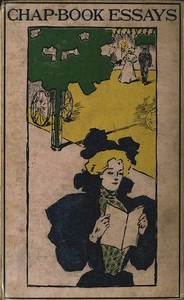
Essays from the Chap-Book by Various

(2 User reviews)   4030
By Rebecca King Posted on Dec 22, 2025
In Category - World Religions
Various Various
English
Hey, I just read this fascinating little collection called 'Essays from the Chap-Book' and you'd love it. It's not one story, but a whole box of literary chocolates from the 1890s. Think of it as a time capsule from a golden age of American magazines, filled with quirky opinions, sharp wit, and surprising observations from writers you've probably heard of and some you haven't. The main 'mystery' is seeing how people thought and wrote over a century ago—what worried them, what made them laugh, and how surprisingly modern some of their concerns feel. It's a perfect book to dip in and out of.
Share

Read "Essays from the Chap-Book by Various" Online

This book is available in the public domain. Start reading the digital edition below.

START READING FULL BOOK
Instant Access    Mobile Friendly

Book Preview

A short preview of the book’s content is shown below to give you an idea of its style and themes.

development of personality through the discipline of renunciation. Alfred Allmers, a poor and obscure man of letters, has married Rita, a rich and beautiful heiress. During the first seven or eight years of their marriage they live frankly the life of the senses; and in amorous intoxication forget the world with its claims, being completely absorbed in each other. Their little son Eyolf they leave largely to his aunt, Asta (Allmers’s supposed sister), and only interest themselves in him spasmodically, and then to very little purpose. Rita is, in fact, not very fond of the child, and feels vaguely annoyed whenever she is reminded of her duties toward it. It is directly due to her erotic intensity that the boy, who has been left in his high-chair at table, tumbles down and is crippled for life. He then becomes a reproach to his mother, and she rather shuns than seeks the sight of him. I find this development of Rita to be true and consistent. Women, as a rule, after marriage, develop the wifely character at the expense of the maternal, or the maternal at the expense of the wifely. Rita Allmers belongs to the former class. She is young, beautiful, and passionate; her wifehood is all to her; her motherhood only incidental. But this condition cannot endure. The husband, at all events, feels a subtle change steal over his relation to his wife; and in order to make it clear to himself, he goes on a long pedestrian tour into the mountains. On his return, at the end of two weeks, he is received by Rita with a bacchanalian seductiveness which ill befits his serious mood. He has resolved to introduce a radical change in the household. He will henceforth devote himself to the education of his son, and make that his chief concern. His book on “Human Responsibility,” at which he has been writing in a desultory fashion, shall no longer divert his attention from the actual responsibility, which it were a sin to shirk. Rita, however, when he unfolds his plan to her, is anything but pleased. She wants him all to herself, and is not content to share him with anybody, even though it be her own child. She cannot be put off with crumbs of affection. She coaxes, she threatens; she hints at dire consequences. With the passionate vehemence of a spoiled and petted beauty, who believes her love disdained, she upbraids him, and cries out at last that she wishes the child had never been born. Presently a wild scream is heard from the pier, and little Eyolf’s crutch is seen floating upon the still waters of the fiord. The second act opens with a scene in which Asta is endeavoring to console Allmers in his affliction. He is trying to find the purpose, the meaning of his bereavement. “For there must be a meaning in it,” he exclaims. “Life, existence,—destiny _cannot_ be so utterly meaningless.” Asta had loved the dead child, and he feels drawn to her by the communion of sorrow. From Rita, on the other hand, he feels repelled, because he cannot, in spite of her wild distraction, believe in the genuineness of her grief. She demands black crape, flag at half mast, and all the outward symbols of mourning; but the sensation which now is torturing her is not pain at the loss of the boy, but self-reproach. The keen tooth of remorse is piercing the very marrow of her bones. For the first time in her life she forgets how she looks,—what impression she is making. And that is,...

This is a limited preview. Download the book to read the full content.

Forget everything you know about stiff, formal essays. Essays from the Chap-Book is a vibrant snapshot of American thought at the turn of the 20th century. Originally published in a popular literary magazine, this collection brings together short pieces from a variety of writers. There's no single plot; instead, you get a parade of voices on everything from art and literature to society and daily life. It's like attending the best cocktail party of 1896, listening in on clever conversations.

Why You Should Read It

This book is a joy because it feels so alive. The writers aren't talking down to you from a pedestal; they're sharing strong opinions and witty observations. You'll find humor, skepticism, and genuine curiosity about the world. Reading it, you realize how some debates—about technology changing life, the value of art, or the quirks of human nature—are truly timeless. The personalities of the authors shine through, making each essay a small, self-contained discovery.

Final Verdict

Perfect for curious readers who enjoy nonfiction but want something lighter than a full-length biography or history. It's ideal for your nightstand or coffee table—a book you can read one or two pieces from at a time. If you love the feeling of uncovering a piece of the past that still speaks to the present, this charming collection is for you.


🔓 Legacy Content

This book is widely considered to be in the public domain. Share knowledge freely with the world.

Lucas Harris
3 months ago

I had low expectations initially, however it manages to explain difficult concepts in plain English. Thanks for sharing this review.

Lucas Williams
8 months ago

To be perfectly clear, the content flows smoothly from one chapter to the next. This story will stay with me.

5
5 out of 5 (2 User reviews )

Add a Review

Your Rating *
There are no comments for this eBook.
You must log in to post a comment.
Log in


Related eBooks