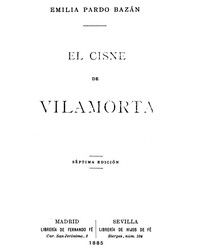
El cisne de Vilamorta by condesa de Emilia Pardo Bazán

(12 User reviews)   6805
By Rebecca King Posted on Jan 2, 2026
In Category - Faith & Religion
Pardo Bazán, Emilia, condesa de, 1852-1921 Pardo Bazán, Emilia, condesa de, 1852-1921
Spanish
Ever wondered what happens when a brilliant, ambitious woman gets stuck in a tiny town where everyone knows everyone's business? That's the heart of 'El cisne de Vilamorta.' It's not just a story about a small Spanish town—it's about Segundo García, a poet with big dreams, and the two women who get tangled up in his life. There's love, ambition, and a whole lot of gossip. Think of it as a 19th-century drama where artistic passion clashes with harsh reality, and the choices people make ripple through an entire community. It's surprisingly modern in its feel.
Share

Read "El cisne de Vilamorta by condesa de Emilia Pardo Bazán" Online

This book is available in the public domain. Start reading the digital edition below.

START READING FULL BOOK
Instant Access    Mobile Friendly

Book Preview

A short preview of the book’s content is shown below to give you an idea of its style and themes.

que consiga barrerlas bien, ni nunca se destierran por completo. Es probable que hasta el fin del mundo dure esta telaraña espesa y artificiosa, y se juzgue muy _idealista_ la descripción de una noche de luna y muy _naturalista_ la de una fábrica, muy _idealista_ el estudio de la agonía de un ser humano (sobre todo si muere de tisis como _La dama de las Camelias_), y muy _naturalista_ el del nacimiento del mismo ser! No es alarde de impenitencia, sino confesión sincerísima. Al escribir _La Tribuna_, me guiaban iguales propósitos que al trazar las páginas del _Cisne_: estudiar y retratar en forma artística gentes y tierras que conozco, procurando huir del estrecho provincialismo, para que el libro sea algo más que pintura de usanzas regionales y aspire al honroso dictado de _novela_. Á la misma luz que me alumbró por los rincones de la Fábrica de Tabacos de _Marineda_, he tratado de ver la curiosa fisonomía de _Vilamorta_. Si la Fábrica se diferencia en todo de la villita, no consiste en que yo las mire con distintos ojos, pero en que forzosamente ha de diferenciarse el puerto comercial y fabril de la comarca enclavada tierra adentro, que aún conserva, ó conservaba cuando la pisé por vez última, pronunciadísimo sabor tradicional, y elementos poéticos muy en armonía con el carácter del paisaje. Respecto á lo que en _El Cisne_ llamará alguien levadura romántica, quiero decir algo, muy sucintamente, á los buenos entendedores. El romanticismo, como época literaria, ha pasado, siendo casi nula ya su influencia en las costumbres. Mas como fenómeno aislado, como enfermedad, pasión ó anhelo del espíritu, no pasará tal vez nunca. En una ó en otra forma, habrá de presentarse cuando las circunstancias y lo que se conoce por _medio ambiente_ faciliten su desarrollo, ayudando á desenvolver facultades ya existentes en el individuo. Sucédele lo que á la vocación monástica: menos casos se dan hoy de tales vocaciones que se daban, por ejemplo, allá en tiempos de San Francisco ó San Ignacio; con todo, algunas he visto yo muy ardientes, probadas é irresistibles. No hay estado del alma que no se produzca en el hombre, no hay cuerda que no vibre, no hay carácter verdaderamente humano que no se encuentre queriéndolo buscar; y en nuestras pensadoras y concentradas razas del Noroeste, el espíritu romántico alienta más de lo que parece á primera vista. LA CORUÑA, Septiembre de 1884. EMILIA PARDO BAZÁN. [Ilustración] EL CISNE DE VILAMORTA I Allá detrás del pinar, el sol poniente extendía una zona de fuego, sobre la cual se destacaban, semejantes á columnas de bronce, los troncos de los pinos. El sendero era barrancoso, dando señales de haber sido devastado por las arroyadas del invierno; á trechos lo hacían menos practicable piedras sueltas, que parecían muelas fuera de sus alveolos. La tristeza del crepúsculo comenzaba á velar el paisaje: poco á poco fué apagándose la incandescencia del ocaso, y la luna, blanca y redonda, ascendió por el cielo, donde ya el lucero resplandecía. Se oyó distintamente el melancólico diptongo del sapo, un soplo de aire fresco estremeció las hierbas agostadas y los polvorientos zarzales que crecían al borde del camino; los troncos del pinar se ennegrecieron más, resaltando á manera de barras de tinta sobre la claridad verdosa del horizonte. Un hombre bajaba por la senda, muy despacio, como proponiéndose gozar la poesía y recogimiento del sitio y hora. Se apoyaba en un bastón recio, y según permitía ver la poca luz difusa, era joven y no mal parecido. Á cada paso se detenía, mirando á derecha é izquierda, lo mismo que si...

This is a limited preview. Download the book to read the full content.

If you're looking for a book that pulls you into another world, this is it. Emilia Pardo Bazán paints a vivid picture of Vilamorta, a small Galician town where not much happens, and everyone watches everyone else.

The Story

The story follows Segundo García, a young, handsome poet who believes he's destined for greatness. He's the 'swan' of the title—someone special in a very ordinary pond. His life gets complicated when he attracts the attention of two very different women: Leocadia, a rich and bored widow from the city, and Nieves, the sweet and innocent daughter of a local notary. As Segundo navigates these relationships, the whole town watches, judges, and gossips. The plot isn't about huge events; it's about the quiet tensions, the missed opportunities, and the way small-town life can both nurture and suffocate a dreamer.

Why You Should Read It

Pardo Bazán was a master at creating real, flawed people. Segundo isn't a perfect hero—he's often vain and indecisive. The women around him are complex, with their own desires and frustrations. What really grabbed me was how the book explores the trap of potential. We've all known someone (or been someone) who feels too talented for their surroundings, but lacks the grit to break free. The author handles this without being harsh; she just shows it as it is, and that makes it powerful.

Final Verdict

Perfect for readers who love character-driven stories and classic literature that doesn't feel dusty. If you enjoy novels about society's expectations, the artist's struggle, or the intricate social webs of small communities, you'll find a lot to love here. It's a sharp, compassionate, and utterly engaging slice of 19th-century Spanish life.


✅ Legacy Content

This publication is available for unrestricted use. Use this text in your own projects freely.

Mary Rodriguez
6 months ago

If you enjoy this genre, the author's voice is distinct and makes complex topics easy to digest. Exceeded all my expectations.

Liam Smith
1 year ago

The fonts used are very comfortable for long reading sessions.

Steven Young
1 year ago

Great read!

Edward Thompson
1 year ago

As someone who reads a lot, it provides a comprehensive overview perfect for everyone. Exceeded all my expectations.

Jennifer Sanchez
1 year ago

Enjoyed every page.

4.5
4.5 out of 5 (12 User reviews )

Add a Review

Your Rating *
There are no comments for this eBook.
You must log in to post a comment.
Log in


Related eBooks