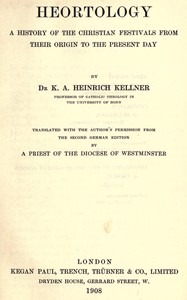
Heortology : A history of the Christian festivals from their origin to the…

(4 User reviews)   4330
By Rebecca King Posted on Dec 22, 2025
In Category - World Religions
Kellner, K. A. Heinrich (Karl Adam Heinrich), 1837-1915 Kellner, K. A. Heinrich (Karl Adam Heinrich), 1837-1915
English
Ever wonder why we celebrate Christmas on December 25th? Or how Easter's date hops around the calendar? I just finished a book that answers all those questions and more. 'Heortology' by K.A.H. Kellner is like a detective story, but for Christian holidays. It traces the wild origins of our most familiar celebrations—how pagan festivals got reshaped, why certain dates were chosen, and what people actually did on these days centuries ago. It turns out, the history behind your Christmas tree or Easter egg is way more fascinating and complicated than you probably thought. If you're curious about the 'why' behind the traditions, this is your backstage pass.
Share

Read "Heortology : A history of the Christian festivals from their origin to the…" Online

This book is available in the public domain. Start reading the digital edition below.

START READING FULL BOOK
Instant Access    Mobile Friendly

Book Preview

A short preview of the book’s content is shown below to give you an idea of its style and themes.

since to have done so would have interfered with the object of this book. BONN, _All Saints’, 1900_. AUTHOR’S PREFACE OF THE SECOND GERMAN EDITION This second (revised and enlarged) edition—from which Dr A. Mercati, Professor in the Seminary of Reggio, Emilia, has made the Italian translation—is in substance the same as the first. The sections dealing with the dedication of churches and the feast of the patron saint, with the feast of the Immaculate Conception, with the feasts of St Mary Magdalen, St Cecilia, and St Catherine, and the two concluding sections have been added, and some appendices. BONN, _May 1906_. TRANSLATOR’S NOTE In this translation, the excursus on the German Protestant “Buss-und-Bettage” and on St Ursula have been omitted as being of less general interest, and a few notes have been added. LONDON, _April 1908_. BOOKS QUOTED AND REFERRED TO (A) MEDIÆVAL WORKS, WHICH IN SOME DEGREE ARE OF THE NATURE OF ORIGINAL SOURCES ISIDORE of Seville († 658).—_De Officiis Ecclesiasticis._ MIGNE, _Patr. Lat._, lxxxiii. AMALARIUS SYMPHOSIUS (“chor-episcopus” at Metz, † between 850 and 853).—_De Officiis Ecclesiasticis libri quattuor._ MIGNE, _Patr. Lat._, cv. RABANUS MAURUS (Abbot of Fulda, later Archbishop of Mainz, † 856).—_De Officiis Ecclesiasticis._ MIGNE, _Patr. Lat._, cvii. ADO (Bishop of Vienne, † 875).—_Libellus de Festivitatibus SS. Apost._ MIGNE, _Patr. Lat._, cxxiii. JOHANNES ABRINCENSIS (Bishop of Rouen, † 1079).—_De Officiis Ecclesiasticis._ MIGNE, _Patr. Lat._, cxlvii. _Ordinarius Canonicorum Reg._, _ib._ 188-191. PSEUDO-ALCUIN (middle of the eleventh century).—_De Officiis Ecclesiasticis._ Incomplete in MIGNE, _Patr. Lat._, ci. 1175. According to Bäumer, Amalarius Fortunatus is really the author. BERNO of Reichenau († 1045).—_De Officio Missæ_, and two small tracts on Advent and the Embertides. MIGNE, _Patr. Lat._, cxlii. LANFRANC († 1089).—_Decreta pro Ord. S. Benedicti._ MIGNE, _Patr. Lat._, cl. BERNOLD of Constance († 1100). According to Bäumer, the author of the _Micrologus_. MIGNE, _Patr. Lat._, cli. _De Cærimoniis, Sacramentis, Officiis et Observantionibus Ecclesiæ libri tres_, by HUGO (Canon of St Victor in Paris, † 1118), or by ROBERTUS PULLUS. MIGNE, _Patr. Lat._, clxxvii. 381. RUPERT of Deutz († 1135).—_De Divinis Officiis._ MIGNE, _Patr. Lat._, clxx. GUIGO I. DE CASTRO (Prior of the Grande Chartreuse about 1137).—_Consuetudines Carthusienses._ MIGNE, _Patr. Lat._, clii. 631-759. HONORIUS of Autun († _circ._ 1145).—_Gemma Animæ._ MIGNE, _Patr. Lat._, clxxii. JOHANNES BELETH (Professor of Theology at Paris, † 1190).—_Rationale Divinorum Officiorum._ MIGNE, _Patr. Lat._, ccii. _Consuetudines Farfenses_, ed. B. Albers. Stuttgart, 1900. Older editions in MIGNE, _Patr. Lat._, c. 4, and (HERGOTT) _Vetus Disciplina Monast._ Paris, 1776. SICARDUS (Bishop of Cremona, † 1215).—_Mitrale._ MIGNE, _Patr. Lat._, ccxiii. INNOCENT III. (Pope, † 1216).—_De S. Altaris Mysterio libri sex._ MIGNE, _Patr. Lat._, ccxvii. ODERICUS (Canon of Siena, 1213).—_Ordo Officiorum Eccl. Senensis._ Ed. Trombelli. Bononiæ, 1766. CODINUS.—_Curopalates s. de Officialibus Palatii Constantinopolitani et de Officiis Magnæ Ecclesiæ._ Rec. Imm. Bekker. Bonn, 1839. (B) MORE RECENT WORKS EMPLOYED OR REFERRED TO (_a_) BY CATHOLIC AUTHORS ALLATIUS, LEO.—_De Dominicis et Hebdomadibus Græcorum Recentiorum._ Col., 1648. ARENS, FRANZ.—_Der Liber Ordinarius der Essener Stiftskirche_, Essen, 1901. ASSEMANI, JOS. SIM.—_Kalendaria Ecclesiæ Univ._ Romæ, 1730. Six vols. BAILLET, ADRIEN († 1706).—_Les Vies des Saints._ Paris, 1703; second ed. 1739, in ten vols. 4to. Vol. ix. contains a history of the movable feasts. BÄUMER, SUITB.—_Geschichte des Breviers_, etc. Freiburg, 1895. BENEDICT XIV. (Prosper Lambertini).—_De Festis D.N. Jesu Christi et B. Mariæ Virginis libri duo._ Patavii, 1756. ⸺ _Commentarius de Festis B. Virg. Mariæ_, etc. Dillingen, 1754. BINTERIM, ANTON. JOS.—_Denkwürdigkeiten der Kathol. Kirche._ Mainz, 1829, especially vol. v. part i: “Die kirchichle Heortologie und Chronologie.” ⸺ _Pragmatische Geschichte der deutschen Konzilien._ Mainz, 1836. CHEVALIER, UL.—_Bibliothèque Liturgique. Ordinaires de l’Eglise cath. de Laon._ Paris, 1897.—_Sacramentaire et Martyrologe de S....

This is a limited preview. Download the book to read the full content.

Okay, so this isn't a novel with a plot. Think of it more as a grand historical investigation. 'Heortology' is a deep dive into the origins and development of every major Christian festival, from Advent and Christmas right through to Pentecost and the feasts of saints. Kellner acts as a guide, showing us how these celebrations didn't just appear fully formed. He tracks how early Christians often adapted existing local traditions and calendars, creating new meanings for old practices. The book follows the journey of these holy days as they spread, changed, and were sometimes fiercely debated over centuries.

Why You Should Read It

This book completely changed how I see the calendar year. It connects dots you didn't even know were there. Reading it feels like getting a secret key to understanding so much of Western art, literature, and even why we have certain days off work. It's not dry at all; it's full of surprising details, like the fact that the date of Christmas was partly a response to a Roman sun god festival. It makes you realize that tradition is rarely simple—it's a long, messy, and incredibly human conversation across time.

Final Verdict

This is a perfect pick for anyone with a curious mind about history, religion, or culture. If you've ever asked 'why do we do that?' during a holiday, you'll find answers here. It's for the reader who enjoys documentaries, loves trivia, and appreciates seeing the ancient roots of modern life. Fair warning: it's an older, scholarly translation, so the language can be a bit formal in places. But the insights are absolutely worth it.


🔖 Open Access

The copyright for this book has expired, making it public property. Preserving history for future generations.

Joseph Allen
10 months ago

After finishing this book, the pacing is just right, keeping you engaged. I couldn't put it down.

Oliver Perez
1 month ago

Recommended.

Elijah Lopez
4 months ago

Recommended.

Andrew White
7 months ago

Without a doubt, the author's voice is distinct and makes complex topics easy to digest. Definitely a 5-star read.

5
5 out of 5 (4 User reviews )

Add a Review

Your Rating *
There are no comments for this eBook.
You must log in to post a comment.
Log in


Related eBooks