
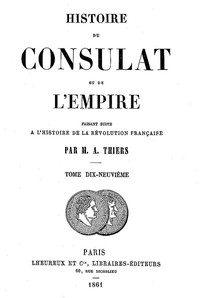
Histoire du Consulat et de l'Empire, (Vol. 19/20) by Adolphe Thiers
Read "Histoire du Consulat et de l'Empire, (Vol. 19/20) by Adolphe Thiers" Online
This book is available in the public domain. Start reading the digital edition below.
START READING FULL BOOKBook Preview
A short preview of the book’s content is shown below to give you an idea of its style and themes.
Adolphe Thiers's massive history reaches its climax in this volume, covering the explosive period known as the Hundred Days. After escaping exile on Elba, Napoleon Bonaparte returns to France in March 1815. To his surprise, the army and much of the public rally to him, and he marches into Paris without firing a shot, sending King Louis XVIII fleeing. For a brief, dizzying moment, the Empire is reborn.
The Story
The story here is a race against time. Napoleon promises peace and a liberal constitution, trying to convince a terrified Europe he has changed. But the allied powers—Britain, Prussia, Austria, Russia—aren't buying it. They declare him an outlaw and mobilize their armies. Thiers walks us through Napoleon's frantic efforts to rebuild his government and his military while facing distrust at home and enemies at the gates. The narrative builds relentlessly toward the twin battles of Ligny and Quatre-Bras, and finally, the legendary defeat at Waterloo. Thiers then details the tragic aftermath: Napoleon's second abdication, the return of the Bourbon king, and the end of an era that reshaped the continent.
Why You Should Read It
What makes Thiers special is his perspective. He was a statesman, not just a scholar. He writes about political maneuvering and public opinion with an insider's feel. You get the sense of opportunities missed and fatal miscalculations. Napoleon isn't a distant statue here; he's a tired, pressured leader making risky bets. Thiers also paints a vivid picture of the anxiety in Paris—the rumors, the shifting loyalties, the sheer exhaustion of a nation after decades of war. It's a story about the momentum of history and how, sometimes, even a genius can't turn back the tide.
Final Verdict
This is for the reader who already has a basic grip on the Napoleonic Wars and wants to understand the why behind the fall. It's perfect for history buffs who enjoy political drama and military strategy, or for anyone fascinated by stories of failed comebacks and irreversible decline. It's dense, yes, but Thiers's passionate, detail-oriented style makes you feel like you're getting the confidential briefing. Just be ready for a sobering, masterfully told story about the end of a legend.
Legal analysis indicates this work is in the public domain. Access is open to everyone around the world.
Karen Thompson
6 months agoIt took me a while to process the complex ideas here, but the bibliography and references suggest a high level of research and authority. Truly a masterpiece of digital educational material.
Christopher Brown
1 year agoI particularly value the technical accuracy maintained throughout.
John Davis
3 months agoI was particularly interested in the case studies mentioned here, the cross-referencing of different chapters makes it a great study tool. Well worth the time invested in reading it.
Jessica Rodriguez
1 year agoThe layout of the digital version made it easy to start immediately, the insights into future trends are particularly thought-provoking. This is a solid reference for both beginners and experts.








Robert Martinez
5 months agoFinally found a version that is easy on the eyes.