1

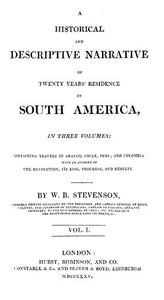
Historical and Descriptive Narrative of Twenty Years' Residence in South America (Vol 1 of 3) Containing travels in Arauco, Chile, Peru, and Colombia; with an — Story, Setting & Ideas
1
0
Project Gutenberg
2017
Peru -- Description and travel; Peru -- History -- War of Independence, 1820-1829; Ecuador -- Description and travel; Chile -- Description and travel; South America -- History -- Wars of Independence, 1806-1830
Readers of public-domain and historical texts
Project Gutenberg digital edition
en
Edition facts
Words: 100,333
Reading time: 437 min
Text sections: 11
Source:
Project Gutenberg record #55775
Stevenson's firsthand account of early 19th-century South America blends travelogue, colonial administration, and revolutionary history, drawing on his roles as private secretary to the president of Quito and secretary to Lord Cochrane.
Editorial Edition Score
4.8/5
★★★★★
★★★★★
Calculated from edition completeness, EPUB availability, text structure and catalogue metadata. Not a user rating.
Edition quality
Stevenson opens his preface by framing the work as a response to European curiosity about Spanish America after its recent revolutions, claiming that these regions 'remained almost unknown till the beginning of the nineteenth century.' He states that he postponed a voyage to publish his 'notes and memoranda—the gleanings of a twenty years' residence.' The dedication to Lord Cochrane signals the author's political alignment with the independence cause, and his title page lists roles—private secretary to the president of Quito, governor of Esmeraldas, secretary to the vice admiral of Chile—that position him as an insider in both colonial and revolutionary administrations.
The Author's Dual Perspective
Stevenson's preface lays out a deliberate structure: he will first describe the colonies 'before their fortunate struggle began to germinate,' then recount the revolution's 'cause of and the means by which the change was effected.' This two-part plan means the reader should expect the early chapters to focus on political and ecclesiastical institutions, customs, and antiquities, while later sections turn to the war itself. The author's own career—serving the Spanish colonial government and later the Chilean navy under Cochrane—gives him access to both sides, though the excerpts available do not reveal how he navigates potential conflicts of loyalty.
Lima's Plaza Mayor as a Microcosm
The longest excerpt describes Lima's central square in meticulous detail: the portal de botoneros where indigenous artisans make fringe and epaulettes, the site of Pizarro's murder, the brass fountain erected by the Viceroy Count de Salvatierra in 1653, and the water carriers with their mules and tinkling bells. Stevenson also recounts a vivid anecdote about the young alcalde Viscount de San Donas, who imprisoned a judge for interfering with a flogging sentence. This blend of topography, commerce, and legal drama suggests that Stevenson uses specific locations as entry points into broader social and political dynamics.
Market Details and Daily Life
The description of the morning market in the plaza includes a taxonomy of meats: charque (jerked beef), sesina (salted and smoked beef), hams, bacon, and frozen kid from the mountains. Stevenson notes that calves and lambs were never killed, citing 'an old law for the promotion of the breed of cattle.' Such observations ground the narrative in economic and regulatory realities. The water-distribution system—two ten-gallon barrels per mule, sold for one real—further illustrates the infrastructure of daily life. These passages indicate that Stevenson's travelogue is as attentive to mundane logistics as to dramatic events.
Navigating the Three-Volume Structure
This first volume covers travels in Arauco, Chile, Peru, and Colombia, but the excerpts only show material from Lima. The catalog subjects include the War of Independence in Peru and the broader South American wars of independence, but the available text does not yet reach those events. Readers should note that Stevenson's narrative is both historical and descriptive, meaning it alternates between ethnographic observation and political chronology. The preface's promise to explain 'the cause of and the means by which the change was effected' suggests that later volumes will deliver the revolutionary account hinted at by the dedication to Lord Cochrane.
Stevenson's narrative rewards readers who attend to his layered roles—colonial secretary, revolutionary officer, and travel writer. The early chapters establish a baseline of pre-revolutionary society through concrete details of urban life, commerce, and justice. As you read, watch for how these descriptive passages later connect to the political upheavals that Stevenson served and chronicled. The three-volume structure allows for a gradual shift from observation to analysis, but the foundation is laid in these first pages of Lima's plazas, fountains, and markets.
Reader reflection
How did this book work for you?
Your answers remain private and are stored only in this browser.
Your progress
0
/
10
2
How did the book work for you overall?
3
Would you recommend this book to another reader?
4
How demanding did the text feel?
5
How did the pace of the book feel?
6
How did the reading compare with what you expected?
7
Could you apply anything you learned?
8
Could you follow the author’s main argument?
9
What did this book teach you most?
10