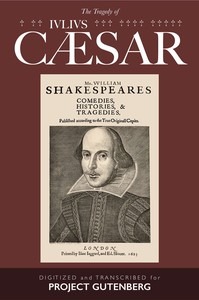
Julius Caesar by William Shakespeare

(13 User reviews)   4743
Shakespeare, William, 1564-1616 Shakespeare, William, 1564-1616
English
Hey, have you read 'Julius Caesar'? Forget dusty history lessons. This is a razor-sharp political thriller about friends turning into assassins. It asks the brutal question: if you truly believe your leader is destroying your country, is it right—or even possible—to stop them? The story follows Brutus, a good man caught in a terrible trap, as he joins a plot to murder his friend, Caesar. The real drama isn't the stabbing; it's what happens after, when the killers have to face a furious public and their own crumbling consciences. It’s about power, persuasion, and the chaos that follows when you break the rules, even for a good reason.
Share

Read "Julius Caesar by William Shakespeare" Online

This book is available in the public domain. Start reading the digital edition below.

START READING FULL BOOK
Instant Access    Mobile Friendly

Book Preview

A short preview of the book’s content is shown below to give you an idea of its style and themes.

Senators, Citizens, Soldiers, Commoners, Messengers, and Servants. SCENE: Rome, the conspirators’ camp near Sardis, and the plains of Philippi. ACT I SCENE I. Rome. A street. Enter Flavius, Marullus and a throng of Citizens. FLAVIUS. Hence! home, you idle creatures, get you home. Is this a holiday? What, know you not, Being mechanical, you ought not walk Upon a labouring day without the sign Of your profession? Speak, what trade art thou? CARPENTER. Why, sir, a carpenter. MARULLUS. Where is thy leather apron and thy rule? What dost thou with thy best apparel on? You, sir, what trade are you? COBBLER. Truly, sir, in respect of a fine workman, I am but, as you would say, a cobbler. MARULLUS. But what trade art thou? Answer me directly. COBBLER. A trade, sir, that I hope I may use with a safe conscience, which is indeed, sir, a mender of bad soles. MARULLUS. What trade, thou knave? Thou naughty knave, what trade? COBBLER. Nay, I beseech you, sir, be not out with me; yet, if you be out, sir, I can mend you. MARULLUS. What mean’st thou by that? Mend me, thou saucy fellow! COBBLER. Why, sir, cobble you. FLAVIUS. Thou art a cobbler, art thou? COBBLER. Truly, sir, all that I live by is with the awl; I meddle with no tradesman’s matters, nor women’s matters, but withal I am indeed, sir, a surgeon to old shoes: when they are in great danger, I recover them. As proper men as ever trod upon neat’s leather have gone upon my handiwork. FLAVIUS. But wherefore art not in thy shop today? Why dost thou lead these men about the streets? COBBLER. Truly, sir, to wear out their shoes, to get myself into more work. But indeed, sir, we make holiday to see Caesar, and to rejoice in his triumph. MARULLUS. Wherefore rejoice? What conquest brings he home? What tributaries follow him to Rome, To grace in captive bonds his chariot wheels? You blocks, you stones, you worse than senseless things! O you hard hearts, you cruel men of Rome, Knew you not Pompey? Many a time and oft Have you climb’d up to walls and battlements, To towers and windows, yea, to chimney tops, Your infants in your arms, and there have sat The livelong day with patient expectation, To see great Pompey pass the streets of Rome. And when you saw his chariot but appear, Have you not made an universal shout, That Tiber trembled underneath her banks To hear the replication of your sounds Made in her concave shores? And do you now put on your best attire? And do you now cull out a holiday? And do you now strew flowers in his way, That comes in triumph over Pompey’s blood? Be gone! Run to your houses, fall upon your knees, Pray to the gods to intermit the plague That needs must light on this ingratitude. FLAVIUS. Go, go, good countrymen, and, for this fault Assemble all the poor men of your sort, Draw them to Tiber banks, and weep your tears Into the channel, till the lowest stream Do kiss the most exalted shores of all. [_Exeunt Citizens._] See whether their basest metal be not mov’d; They vanish tongue-tied in their guiltiness. Go you down that way towards the Capitol; This way will I. Disrobe the images, If you do find them deck’d with ceremonies. MARULLUS. May we do so? You know it is the feast of Lupercal. FLAVIUS. It is no matter; let no images Be hung with Caesar’s trophies. I’ll about And drive away the vulgar from...

This is a limited preview. Download the book to read the full content.

The Story

Rome is buzzing. Julius Caesar, the wildly popular general, is about to be crowned king. Some senators, led by the cunning Cassius, see this as the end of Roman freedom. They need to convince the noble Brutus, Caesar's friend, to join their plot. Brutus is torn but decides Caesar must die for Rome's sake. On the Ides of March, they carry out the assassination in the senate.

But killing the man is easier than killing the idea. Mark Antony, Caesar's loyal friend, gives a famous speech that turns the public against the conspirators. Brutus and Cassius flee, raising an army. The final act is a brutal civil war, where the ideals of the assassins clash with the harsh reality of power and revenge.

Why You Should Read It

This play grabs you because it refuses easy answers. There are no clear heroes or villains. Brutus is genuinely trying to do the right thing, but his actions unleash hell. Cassius is driven by envy, but his fears about tyranny aren't wrong. And Mark Antony? He masterfully manipulates a crowd, showing how easily public opinion can be weaponized. It's a frighteningly modern look at how politics really works—the backroom deals, the grand speeches, and the unintended consequences of violent change.

Final Verdict

Perfect for anyone who loves a tense, talky drama about impossible choices. If you're into shows like 'House of Cards' or 'Succession', you'll find the same cutthroat politics here, just with togas. It's also a great pick for book clubs—there's so much to argue about! Is Brutus a hero or a fool? Was the murder justified? Centuries later, Shakespeare leaves it for us to decide.


🟢 Free to Use

The copyright for this book has expired, making it public property. It is now common property for all to enjoy.

Matthew Thomas
1 year ago

Citation worthy content.

Edward Sanchez
1 month ago

Comprehensive and well-researched.

Brian Wright
10 months ago

Comprehensive and well-researched.

Joseph Lee
1 year ago

Fast paced, good book.

Aiden Johnson
9 months ago

If you enjoy this genre, the narrative structure is incredibly compelling. Exactly what I needed.

4.5
4.5 out of 5 (13 User reviews )

Add a Review

Your Rating *
There are no comments for this eBook.
You must log in to post a comment.
Log in


Related eBooks