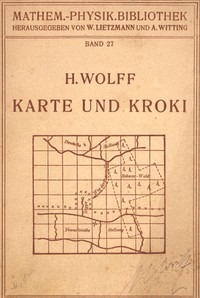
Karte und Kroki by Hans Wolff

(9 User reviews)   3202
By Rebecca King Posted on Dec 22, 2025
In Category - Faith & Religion
Wolff, Hans Wolff, Hans
German
Have you ever found an old family map that made you question everything you thought you knew? That's what happens to our main character in 'Karte und Kroki'. When he inherits a strange, hand-drawn sketch from his grandfather, he starts digging into a family history no one ever talked about. The map doesn't lead to treasure—it leads to secrets. Set against the backdrop of post-war Europe, this quiet mystery isn't about spies or grand adventures. It's about the ordinary silences in families, the stories we don't tell, and the quiet courage it takes to look at them. It's a slow, thoughtful burn that will have you looking at your own family photos a little differently.
Share

Read "Karte und Kroki by Hans Wolff" Online

This book is available in the public domain. Start reading the digital edition below.

START READING FULL BOOK
Instant Access    Mobile Friendly

Book Preview

A short preview of the book’s content is shown below to give you an idea of its style and themes.

6. =Einführung in die projektive Geometrie.= Von +M. Zacharias+. 7. =Die 7 Rechnungsarten mit allgemeinen Zahlen.= Von +H. Wieleitner+. 8. =Theorie der Planetenbewegung.= Von +P. Meth+. 9. =Einführung in die Infinitesimalrechnung.= Von +A. Witting+. 10. =Wo steckt der Fehler?= Von +W. Lietzmann+ und +A. Trier+. 11. =Konstruktionen in begrenzter Ebene.= Von +P. Zühlke+. 12. =Die Quadratur des Kreises.= Von +E. Beutel+. 13. =Geheimnisse der Rechenkünstler.= Von +Ph. Maennchen+. 14. =Darstellende Geometrie des Geländes.= Von +R. Rothe+. 15. =Beispiele zur Geschichte der Mathematik.= Von +A. Witting+ und +M. Gebhardt+. 16. =Die Anfertigung math. Modelle.= (Für Schüler mittl. Kl.) Von +K. Giebel+. 17. =Dreht sich die Erde?= Von +W. Brunner+. 18. =Mathematiker-Anekdoten.= Von +W. Ahrens+. 19. =Vom periodischen Dezimalbruch zur Zahlentheorie.= Von +A. Leman+. 20/21. =Mathematik und Malerei.= 2 Teile in 1 Bande. Von +G. Wolff+. 22. =Soldaten-Mathematik.= Von +A. Witting+. 23. =Theorie und Praxis des Rechenschiebers.= Von +A. Rohrberg+. 24. =Die mathemat. Grundlagen der Variations- u. Vererbungslehre.= Von +P. Riebesell+. 25. =Riesen und Zwerge im Zahlenreiche.= Von +W. Lietzmann+. 26. =Methoden zur Lösung geometrischer Aufgaben.= Von +B. Kerst+. 27. =Karte und Kroki.= Von +H. Wolff+. 28. =Die Funktionsleiter.= Erster Teil einer Einführung in die Nomographie. Von +P. Luckey+. In Vorbereitung: =A. Baruch=, Tag und Stunde. ∙ =W. Dieck=, Nichteuklidische Geometrie. ∙ =Pfeifer=, Photogrammetrie. ∙ =H. E. Timerding=, Der goldene Schnitt. ∙ =K. Doehlemann=, Mathematik und Architektur. Verlag von B. G. Teubner in Leipzig und Berlin MATHEMATISCH-PHYSIKALISCHE BIBLIOTHEK HERAUSGEGEBEN VON =W. LIETZMANN= UND =A. WITTING= 27 KARTE UND KROKI VON DR. H. WOLFF STÄNDIGER ASSISTENT UND DOZENT AN DER TECHNISCHEN HOCHSCHULE BERLIN-CHARLOTTENBURG MIT 47 FIGUREN IM TEXT [Illustration] 1917 LEIPZIG UND BERLIN VERLAG UND DRUCK VON B. G. TEUBNER SCHUTZFORMEL FÜR DIE VEREINIGTEN STAATEN VON AMERIKA: COPYRIGHT 1917 BY B. G. TEUBNER IN LEIPZIG. [Illustration] ALLE RECHTE, EINSCHLIESSLICH DES ÜBERSETZUNGSRECHTS, VORBEHALTEN VORWORT Das vorliegende 27. Bändchen der mathematisch-physikalischen Bibliothek soll, entsprechend seinem Titel, im ersten Teile einen Überblick über alle Arbeiten geben, welche zur Herstellung einer Karte nötig sind. Mit Rücksicht auf den Leserkreis, dem es zugedacht ist, wurden nur die einfachsten vermessungstechnischen Methoden eingehender angegeben, bei denen nur geringe mathematische Kenntnisse vorausgesetzt werden. Auf schwierigere geodätische Messungen und die Hilfsmittel bei diesen konnte nur kurz hingewiesen werden. Der zweite Teil beschäftigt sich mit der Anfertigung von Krokis und Skizzen. Im wesentlichen handelt es sich dabei um die Messung und Zeichnung von Entfernungen, Winkeln und Höhenunterschieden, wobei wiederum nur die einfachsten Methoden in Betracht kommen können. Mit Rücksicht auf den Umfang des Bändchens wurde nach Kürze, aber doch nach Klarheit des Ausdrucks gestrebt, um Vollständigkeit der Angaben zu erreichen. Angeregt wurde ich zu dem kleinen Werk durch mehrmonatige Tätigkeit als Vermessungsbeamter im Felde und durch Vorträge, die ich 1916 für das Generalkommissariat Brandenburg und in einem vom preußischen Kultusministerium für die Zeichenlehrer an höheren Schulen veranstalteten Geländezeichenkursus gehalten habe. Auch der ministerielle Erlaß, durch den der Unterricht im Kartenlesen, Skizzieren und Krokieren auf den höheren Schulen eingeführt wird, war maßgebend für den Entschluß zur Bearbeitung eines Bändchens, das die in den bekannten »Richtlinien« für die Ausbildung der Jungmannen angegebenen Kenntnisse über Karte und Kroki in leichtverständlicher Form entwickelt. +Berlin+, Januar 1917. =H. Wolff.= INHALT Seite Erster Teil Die topographische Karte Abschnitt 1. Grundbegriffe und Einteilung der Karten § 1. Begriff der Karte 1 § 2. Einteilung der Karten nach dem Maßstab 3 § 3. Einteilung der Karten nach dem Inhalt 4 Abschnitt 2. Arbeiten zur Herstellung der Karten Kapitel 1. Die trigonometrischen Arbeiten § 4. Die Netzlegung 5 § 5. Die Basismessung 6 § 6. Die Winkelmessung 7 § 7. Die Berechnung 10 § 8. Die grundlegenden Höhenbestimmungen 13 Kapitel 2. Die...

This is a limited preview. Download the book to read the full content.

I picked up 'Karte und Kroki' expecting a historical puzzle, but what I found was something much more personal and quietly powerful.

The Story

The book follows a man who, after his grandfather's death, is left a single puzzling item: a 'kroki', a rough, hand-drawn map or sketch. It's not of a place he recognizes, and his grandfather never spoke of it. Driven by a need to understand this silent man he loved, the narrator begins a low-key investigation. His journey takes him through old letters, faded memories of relatives, and the subdued landscape of a Europe still healing. The mystery isn't flashy, but the slow unraveling of a simple, human truth buried by time and shame is completely compelling.

Why You Should Read It

What stuck with me wasn't a plot twist, but the feeling. Wolff writes about memory and family with such gentle precision. He shows how history isn't just in textbooks—it's in the things our grandparents couldn't say, in the gaps in old photo albums, and in the weight of ordinary objects like a simple sketch. The narrator isn't a hero; he's just a guy trying to piece together a quiet puzzle, and that makes his journey deeply relatable. It’s a story about the inheritance we all deal with: not money or land, but the unanswered questions.

Final Verdict

This isn't a book for someone craving a fast-paced thriller. It's a slow, reflective, and ultimately moving read. If you enjoy character-driven stories, quiet historical fiction, or novels that explore family dynamics and the legacy of the past, you'll find a lot to love here. It's perfect for a thoughtful weekend, the kind of book that stays with you and makes the world seem just a bit more layered and full of hidden stories.


🔓 Usage Rights

This digital edition is based on a public domain text. Preserving history for future generations.

Lucas Walker
1 year ago

Based on the summary, I decided to read it and it creates a vivid world that you simply do not want to leave. Thanks for sharing this review.

Elizabeth Sanchez
1 year ago

Fast paced, good book.

Lucas Young
5 months ago

After hearing about this author multiple times, the atmosphere created is totally immersive. Thanks for sharing this review.

Jessica Lewis
8 months ago

Comprehensive and well-researched.

Lucas Sanchez
1 year ago

The index links actually work, which is rare!

5
5 out of 5 (9 User reviews )

Add a Review

Your Rating *
There are no comments for this eBook.
You must log in to post a comment.
Log in


Related eBooks