1

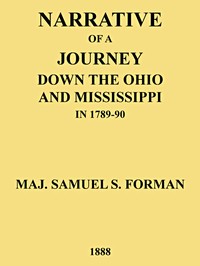
Narrative of a Journey Down the Ohio and Mississippi in 1789-90 — A Reader’s Guide
2
0
Project Gutenberg
2014
Mississippi River -- Description and travel; Frontier and pioneer life -- Ohio River Valley; Ohio River -- Description and travel; Frontier and pioneer life -- Mississippi River Valley; Forman, Samuel S., 1765-1862
Readers of public-domain and historical texts
Project Gutenberg digital edition
en
Edition facts
Words: 21,452
Reading time: 94 min
Text sections: 3
Source:
Project Gutenberg record #44823
Samuel S. Forman's 1789-90 journey down the Ohio and Mississippi, written from memory in 1849, reveals a merchant's eye for trade, negotiation, and frontier social customs, with precise observations on Sabbath observance, billiard etiquette, and the practicalities of navigating the Falls of the Ohio.
Samuel S. Forman's narrative, written sixty years after the events, is less a travelogue than a merchant's ledger of frontier life. The author's memory, as Lyman C. Draper notes, was 'unusually fine,' and the text bears this out in its concrete details: a locked-door negotiation with a planter, the precise location of a store moved 'to the center of the village,' and the casual mention of a 'spruce colored barber, who was also a tailor.' Forman's voice is direct, practical, and occasionally wry, as when he recalls being asked why his store remained closed on Sunday: 'I told them that I brought the Sabbath with me.'
A Merchant's Negotiation
Forman's account of closing his Louisville store is a masterclass in frontier commerce. He 'locked the door' with Mr. Buckner, spent the night in conversation, and ultimately traded his entire inventory for a tobacco boat loaded with the country's produce. The scene is rich with practical detail: Forman gave up his bed, 'threw down some blankets and coarse clothes for my own lodging,' and the deal was struck. This is not a romanticized frontier but a world of hard bargaining and mutual advantage. The author's pride in his success is evident when he notes that a 'young Irish gentleman' competitor 'could not succeed.'
The Sabbath and Social Customs
Forman's observation that 'Sunday had not crossed the mountains' is a striking piece of cultural geography. He records being the first to keep his store closed on that day in Louisville, a claim that subtly positions him as a civilizing influence. Yet he also notes that ladies played billiards, considering it 'a genteel and healthful amusement,' and he preferred their company to gentlemen's to avoid gambling. These details reveal a society in flux, where old norms were being renegotiated. Forman's own stance—observing the Sabbath but enjoying billiards with ladies—shows a pragmatic blend of piety and sociability.
The Perils of River Travel
The narrative includes a telling incident: Forman's boat 'broke from her fastenings' and drifted downstream before being recovered. He then put his blanket on Captain Bayard's boat and 'took my tea with him.' Later, a canoe came for him in the moonlight, and he wrapped blankets 'carelessly' around his arms. The scene is understated but hints at the constant risk and improvisation of river travel. Forman's focus is on the practicalities—the repair of damages, the loading below the Falls—rather than on dramatic danger, which lends authenticity to his account.
Race and Labor on the Frontier
Forman's text includes brief but telling references to enslaved labor. Captain Thomas offered him 'a little negro boy' to do chores, explaining that 'one was better than both' of his own boys. Forman also mentions a 'spruce colored barber, who was also a tailor,' whose company he 'occasionally had in helping out in my labors.' These asides are not elaborated, but they place Forman within the slaveholding economy of the Ohio Valley. The matter-of-fact tone suggests that such arrangements were unremarkable to him, offering modern readers a glimpse into the everyday workings of frontier society.
Forman's narrative rewards attention to its small, precise details: the locked door of a negotiation, the moonlight canoe, the barber-tailor who helped with chores. Written decades later, it captures not just events but the texture of a world where a man could 'bring the Sabbath' across the mountains and still play billiards with ladies. Readers should approach this text as a primary document of frontier commerce and custom, noting what Forman chooses to record and what he passes over without comment.
Reader reflection
How did this book work for you?
Your answers remain private and are stored only in this browser.
Your progress
0
/
10
2
What was your overall reaction to the book?
3
How likely are you to recommend this book?
4
How demanding did the text feel?
5
Did it raise ideas you would like to talk about?
6
How strongly did the book affect you emotionally?
7
How clearly were the main ideas presented?
8
Which part made the strongest impression?
9
What did this book teach you most?
10