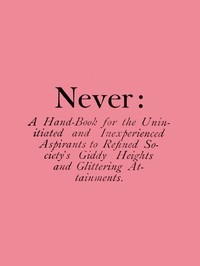
Never: A Hand-Book for the Uninitiated and Inexperienced Aspirants to Refined…

(6 User reviews)   4918
By Rebecca King Posted on Dec 22, 2025
In Category - World Religions
Urner, Nathan Dane, 1839-1893 Urner, Nathan Dane, 1839-1893
English
Ever feel like you're faking it? Like you're just one misstep away from everyone realizing you don't belong? That's the feeling Nathan Dane Urner grabs by the collar in this weird little 19th-century guide. It's not actually about etiquette. It's a strange, funny, and surprisingly sharp look at social anxiety and the fear of being 'found out' before we even had the words for it. Think of it as a time capsule from the past that holds up a mirror to our own insecurities. The main mystery is why this book even exists—and what it says about the person who wrote it.
Share

Read "Never: A Hand-Book for the Uninitiated and Inexperienced Aspirants to Refined…" Online

This book is available in the public domain. Start reading the digital edition below.

START READING FULL BOOK
Instant Access    Mobile Friendly

Book Preview

A short preview of the book’s content is shown below to give you an idea of its style and themes.

to your _vis-a-vis_. Sofas are not beds, nor are chairs vaulting-horses. Never, even when sitting in your chair, tilt it far back, with your heels resting on the mantel-piece, and your back to the rest of the company present. Are you a gentleman or an orang-outang? Never, either, keep twisting and squirming about in your chair as if sitting on a hornet’s nest, nor keep crossing and recrossing the legs every second and a half, nor carve your initials on the furniture with your penknife. St. Vitus’ dance is one thing, dignified repose another. Never, in being introduced to a lady, make a pun on her name, if it is a homely one, or jokingly allude to rouge-pots and whited sepulchers, if she is no longer young, with an air of having resorted to preservative aids. Illogical but intuitive, the feminine mind is swift to imagine and resent an innuendo where perhaps none was intended. Never, if the lady be young but homely, at once patronizingly remark that, after all, handsome is as handsome does, and you have even known the dowdiest and most unattractive girls make good matches through tact and perseverance. However laudable your intention, there may be a muscular brother inconveniently in the background. Never attempt to sing or play, even though pressed to do so, if you are absolutely ignorant of both vocal and instrumental music. Effects might, indeed, be produced, but would they be desirable? Never be so self-conscious as to fancy yourself a cave-bear and other people but field-mice. “True politeness will betray no hoggishness,” as an ancient writer has sagely observed. Never, especially with your superiors, buttonhole people, or shake your fist in their faces, or pound them in the ribs when you have occasion to address them. This is more appropriate to a horse auction than a drawing-room, and is in violation of good form. Never lean across one person with your hands on his knees and your back-hair in his face, to talk to another. Never bawl out at the top of your lungs, or try to monopolize all the talk; you are neither in the stock exchange nor a cattle yard. Never, if bald and warm, mop and rub up your head, ears and neck with your handkerchief. A reception or drawing-room is not a barber-shop. Never intrude your maladies upon the general conversation. People cannot be so much interested in your bunions or backache as you are. Never violently abuse people who may overhear you, nor be bitingly witty at another’s expense. Never interrupt the general conversation by reading long-winded newspaper reports aloud. Never contemptuously criticise the furniture, the pictures, or the wall-paper as being cheap and mean. This is but a scurvy return for the hospitality you are enjoying. Never chew tobacco, or smoke a pipe at receptions. If you must do the one or the other, be sure to use the cuspidor; but it is safer to let up on tobacco until out-of-doors, or in your own room. Never calumniate people, or give a false coloring to your statements. In other words, don’t lie any more than you can help. Be diplomatic. Never, above all, fail in tact. For instance, don’t say that the room is as cold as a barn, even if you think so. Tact and fact may not always go hand-in-hand. Never interrupt or contradict overbearingly, or with a sort of snort. Either of these faults is directly opposed to the canons of good society. Never be explosive or pugnacious, accompanying your side of an argument with roaring explosives and furious gesticulations. A lady’s...

This is a limited preview. Download the book to read the full content.

Published in 1886, this book presents itself as a guide for young people trying to navigate high society. But from the very first page, it’s clear something else is going on. The author, Nathan Dane Urner, doesn’t just list rules. He obsesses over every possible blunder, painting a picture of social life so fraught with peril it becomes almost comical. It's less an instruction manual and more a window into the author's own fears of being seen as uncultured or unworthy.

The Story

There isn't a traditional plot. Instead, the book is built as a series of warnings and pronouncements, all starting with the word 'Never.' 'Never ask for a second introduction.' 'Never wear a flower in your button-hole at night.' The advice ranges from practical to bizarre, creating a cumulative portrait of a social world governed by invisible, unforgiving laws. The real story is the tension between the polished surface it describes and the anxiety bubbling underneath every rule.

Why You Should Read It

This is where the book gets fascinating. Read between the lines, and you’ll find a deeply human document about the universal fear of not fitting in. Urner’s voice is oddly compelling—part fussy mentor, part worried outsider. His extreme caution reveals how much he cares about belonging, making the book feel strangely personal and relatable, even 140 years later. It’s a historical artifact that speaks directly to modern imposter syndrome.

Final Verdict

Perfect for readers who love oddities from the past, psychology, or social history. If you enjoy books that aren't quite what they seem on the cover, or if you've ever felt a twinge of social anxiety, you'll find a kindred spirit in Nathan Dane Urner. It’s a short, peculiar, and unexpectedly poignant read.


📜 Usage Rights

This masterpiece is free from copyright limitations. Enjoy reading and sharing without restrictions.

Paul Anderson
5 days ago

Read this on my tablet, looks great.

Paul Martin
8 months ago

This book was worth my time since the clarity of the writing makes this accessible. Exceeded all my expectations.

Dorothy Hernandez
10 months ago

I have to admit, the storytelling feels authentic and emotionally grounded. Absolutely essential reading.

Mark Rodriguez
6 months ago

Comprehensive and well-researched.
Deborah Allen
1 year ago

I have to admit, the depth of research presented here is truly commendable. Exceeded all my expectations.

5
5 out of 5 (6 User reviews )

Add a Review

Your Rating *
There are no comments for this eBook.
You must log in to post a comment.
Log in


Related eBooks