1

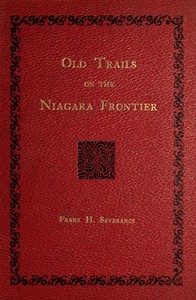
Old Trails on the Niagara Frontier — Background and Themes
2
0
Project Gutenberg
2011
Underground Railroad; Niagara Falls (N.Y. and Ont.) -- Description and Travel; Ogden, David, 1764-; Lay, John; Marsh, Robert, active 1837-1846; Niagara River Valley (N.Y. and Ont.) -- History; Old Fort Niagara (N.Y.); Buffalo (N.Y.) -- History
Readers of public-domain and historical texts
Project Gutenberg digital edition
en
Edition facts
Words: 89,291
Reading time: 389 min
Text sections: 11
Source:
Project Gutenberg record #36974
Frank H. Severance's 1899 collection of essays on Niagara frontier history uses primary sources like the Jesuit Relations and travel journals to examine French missions, military life, and early commerce, with a focus on narrative voice and shifts in pacing between documentary and anecdotal modes.
Frank H. Severance's Old Trails on the Niagara Frontier (1899) is a collection of essays that moves between documentary precision and narrative anecdote. The preface announces the work's method: to illustrate 'typical and well-defined periods' through 'individual experiences,' drawing on sources such as the Jesuit Relations, Champlain, and Hennepin. The essays range from the French missions of 'The Cross Bearers' to the travel diary of John Lay in 'The Journals and Journeys of an Early Buffalo Merchant,' where Lay's observations on roads, inns, and theater crowds in 1820s America are quoted at length. Severance's own voice is that of a local historian addressing Buffalo schoolchildren, yet his prose often shifts into a more detached, editorial tone when summarizing archival material.
Voice and Documentary Texture
Severance's narrative voice is not uniform. In the preface, he writes as a civic educator, dedicating the book to 'the Young People of the Schools of Buffalo.' But in the essays themselves, he frequently steps aside to let primary sources speak. The excerpt from John Lay's journal, for instance, is presented with minimal interruption: 'The streets of Philadelphia cross at right angles; are perfectly straight, well-paved but miserably lighted.' This direct quotation gives the text a documentary texture that contrasts with Severance's own more formal, periodic sentences, such as 'That the Niagara region has played an important part in that history, is an assurance wholly superfluous.' The effect is a layered reading experience where the historian's voice competes with the raw immediacy of the traveler's.
Pacing and the Use of Anecdote
The pacing of the essays varies significantly. 'The Cross Bearers' is described as a lecture, and its scope—covering all French missions in the region—suggests a broad, synthetic tempo. In contrast, 'The Journals and Journeys of an Early Buffalo Merchant' slows to a near-diary pace, following John Lay day by day: 'January 8th, Mr. Lay took his way south to Baltimore, making slow progress because of muddy roads.' Severance uses these granular details to create a sense of lived time, but he also accelerates when summarizing, as in the list of contents where chapter titles like 'What Befel David Ogden' promise swift narrative. This alternation between dense documentation and brisk storytelling shapes the reader's engagement with the frontier's history.
Recurring Details and the Frontier Landscape
Throughout the excerpts, certain details recur: the condition of roads, the quality of inns, and the movement of people. Lay's journal notes that 'the roads are now straightened, which has shortened the distance to 212 miles' between Boston and New York, while the 'Pittsburg pike' is described as 'the greatest highway to the West.' Severance himself emphasizes the region's role as a corridor, writing of 'the frontier territory of the Niagara from Lake Erie to Lake Ontario.' These repeated references to transportation and infrastructure ground the essays in a physical landscape that is both historical and tangible. The 'old trails' of the title are not just metaphors but actual routes, and Severance's attention to their condition—muddy, straightened, or turnpiked—gives the work a consistent material focus.
Readers approaching Old Trails on the Niagara Frontier should attend to the shifts in register between Severance's own prose and the voices he incorporates. The essays reward those who read for texture as much as for fact: the roughness of a road, the price of a coach fare, the noise of a theater crowd. These details, drawn from journals and relations, give the frontier a lived-in quality that broader histories often miss. The book is best taken in parts, letting each essay stand as its own study of a particular moment and its documentary remains.
Reader reflection
Record your reading impressions
A brief reflection can help important ideas stay with you longer.
Your progress
0
/
10
2
Was reading this book enjoyable?
3
Would you encourage someone else to read it?
4
How demanding did the text feel?
5
Did the book give you something worth debating?
6
How did the reading compare with what you expected?
7
Would a second reading be valuable?
8
How distinctive were its ideas or approach?
9
What changed or sharpened your thinking?
10