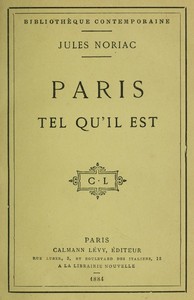
Paris tel qu'il est by Jules Noriac

(13 User reviews)   6267
By Rebecca King Posted on Jan 2, 2026
In Category - World Religions
Noriac, Jules, 1827-1882 Noriac, Jules, 1827-1882
French
Hey, have you ever wondered what Paris was really like when it was becoming the modern city we know? Forget the postcards and romantic legends. Jules Noriac's 'Paris tel qu'il est' (Paris As It Is) is a raw, unfiltered snapshot. Written in the 1860s, right as the old medieval alleys were being bulldozed to make way for grand boulevards, this book is like a time capsule. Noriac doesn't just show you the shiny new opera house; he takes you into the smoky cafes, the chaotic markets, and the crowded tenements. It's the gritty, noisy, and utterly fascinating truth about a city in the middle of an identity crisis. If you think you know Paris, this will make you look again.
Share

Read "Paris tel qu'il est by Jules Noriac" Online

This book is available in the public domain. Start reading the digital edition below.

START READING FULL BOOK
Instant Access    Mobile Friendly

Book Preview

A short preview of the book’s content is shown below to give you an idea of its style and themes.

Voir les Note de Transcription et Table des Matières en fin de livre. PARIS TEL QU'IL EST CALMANN LÉVY, ÉDITEUR ŒUVRES COMPLÈTES DE JULES NORIAC Format grand in-18 LA BÊTISE HUMAINE 1 vol. LE CAPITAINE SAUVAGE 1 — LE 101e RÉGIMENT 1 — LE CHEVALIER DE CERNY 1 — LA COMTESSE DE BRUGES 1 — LA DAME A LA PLUME NOIRE 1 — DICTIONNAIRE DES AMOUREUX 1 — LA FALAISE D'HOULGATE 1 — LES GENS DE PARIS 1 — LE GRAIN DE SABLE 1 — JOURNAL D'UN FLANEUR 1 — MADEMOISELLE POUCET 1 — LA MAISON VERTE 1 — LES MÉMOIRES D'UN BAISER 1 — SUR LE RAIL 1 — LE 101e RÉGIMENT Édition illustrée de 81 dessins, un volume grand in-16. Imprimeries réunies, B. PARIS TEL QU'IL EST PAR JULES NORIAC [Illustration: C · L] PARIS CALMANN LÉVY, ÉDITEUR ANCIENNE MAISON MICHEL LÉVY FRÈRES 3, RUE AUBER, 3 1884 Droits de reproduction et de traduction réservés. PARIS TEL QU'IL EST UNE DÉPÊCHE TÉLÉGRAPHIQUE Une erreur télégraphique, bien insignifiante au premier abord, vient de donner lieu à un procès qui a fait la joie de nos bons amis les anglais. Une jeune lady se marie au commencement du printemps à un jeune gentleman fort qualifié. Cette union, admirablement assortie, ne tarda pas à être heureuse; tout fait prévoir à l'heureux époux qu'il aura la joie de voir son nom perpétué d'âge en âge, et que du haut du ciel, leur demeure dernière, ses nobles aïeux vont sourire. Or, tout le monde sait qu'il n'est pas sans danger de contrarier une jeune lady dans une position intéressante. La jeune lady en question n'avait qu'un désir, que dis-je? une simple envie, mais passée à l'état d'idée fixe. Elle voulait éprouver les douleurs de la maternité en Italie. D'où venait cette envie de la jeune femme? Voulait-elle, à cet instant suprême, lever ses yeux bleus vers un ciel plus bleu que ses yeux? Croyait-elle que la terre classique des beaux-arts lui ferait enfanter un chef-d'œuvre? Voulait-elle, après avoir connu le beau de l'amour, se familiariser avec l'amour du beau? Toutes ces suppositions sont également admissibles. Le jeune époux résistait, non qu'il voulût contrarier en rien sa jeune femme, mais tout simplement parce que les médecins de Naples n'avaient pas sa confiance. Il avait été jadis assez gravement indisposé dans la ville de Masaniello, et il s'en souvenait. Néanmoins, voyant que l'envie de sa moitié était invincible, il parvint à décider son médecin à faire le voyage, quand le moment serait venu. De Londres à Naples, il y a loin. Un médecin anglais appartient à ses malades; mais le désir d'obliger et les offres généreuses du mari décidèrent le praticien à consentir. Les époux partent, la jeune femme est dans la joie, et son mari est bien vite convaincu qu'elle avait raison, que l'air du golfe lui est fort salutaire. Si salutaire même, qu'un beau soir un petit anglais superbe arrive huit jours avant d'être attendu. L'heureux père se livre à sa joie pendant toute la nuit, et, le lendemain, il songe à son médecin, dont le voyage n'aurait plus de but, et il télégraphie en anglais, naturellement, la dépêche suivante: _Honorable B..., docteur, rue ...., no .., Londres, Angleterre._ «Ne venez pas, trop tard!» Le docteur ne voit-il pas la virgule? La virgule a-t-elle été omise par le télégraphe italien ou par le télégraphe anglais? On ne sait. Toujours est-il que le bon docteur lit: «Ne venez pas trop tard.» Et qu'il s'empresse de faire ses malles et de quitter les malades qui sont à ses trousses, si j'ose m'exprimer ainsi. Il arrive...

This is a limited preview. Download the book to read the full content.

Jules Noriac was a journalist with a sharp eye, and in 'Paris tel qu'il est,' he turned that eye on his own transforming city. The book isn't a single narrative but a series of vivid sketches and observations. He wanders from the glittering new department stores to the damp, forgotten corners where the poor lived. He describes the chaos of construction, the characters of the streets, and the stark contrast between old and new. It's a portrait painted from life, not from a guidebook.

The Story

There isn't a traditional plot. Instead, think of it as the best kind of documentary. Each chapter is a visit to a different part of Parisian life. You'll sit in on a political argument in a cafe, get jostled in a market, and watch the wealthy parade in the new parks. The real 'story' is the city itself—its energy, its problems, and its people trying to make sense of a world changing faster than ever before.

Why You Should Read It

This book has a incredible energy. Noriac writes with the urgency of someone documenting a world he knows is vanishing. You can feel the dust from the construction and smell the coal smoke. It strips away all our romantic notions and shows a real, working, sometimes struggling city. The people feel immediate, from the ambitious shopkeeper to the weary laborer. It’s history that breathes.

Final Verdict

Perfect for anyone who loves Paris, history, or just great observational writing. It's not a dry history text; it's a direct line to the past. If you enjoyed books like 'The Professor and the Madman' for how they bring history to life, or if you just love wandering cities and imagining their stories, this is your next read. It’s a reminder that cities are never finished—they're always being written.


📜 Public Domain Content

This text is dedicated to the public domain. Use this text in your own projects freely.

Mark Wilson
1 year ago

Perfect.

Anthony Torres
1 year ago

As someone who reads a lot, it manages to explain difficult concepts in plain English. I will read more from this author.

Jessica Allen
1 year ago

Great read!

Michael Anderson
1 year ago

The index links actually work, which is rare!

Matthew Scott
1 year ago

As someone who reads a lot, the clarity of the writing makes this accessible. Truly inspiring.

5
5 out of 5 (13 User reviews )

Add a Review

Your Rating *
There are no comments for this eBook.
You must log in to post a comment.
Log in


Related eBooks