1

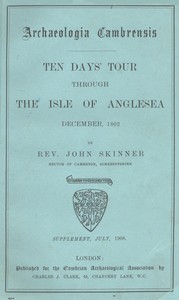
Ten Days' Tour through the Isle of Anglesea, December, 1802 — Inside the Classic
2
0
Project Gutenberg
2020
Skinner, John, 1772-1839; Celts -- Wales -- Anglesey (Gwynedd); Anglesey (Wales) -- Description and travel; Anglesey (Wales) -- Antiquities; Wales -- Antiquities, Celtic
Readers of public-domain and historical texts
Project Gutenberg digital edition
en
Edition facts
Words: 21,646
Reading time: 95 min
Text sections: 3
Source:
Project Gutenberg record #64154
John Skinner's 1802 journal records a December tour of Anglesey, blending antiquarian observations of cromlechs, churches, and inscriptions with candid accounts of travel hardships, local hospitality, and the copper-mining boom at Amlwch.
Editorial Edition Score
4.6/5
★★★★★
★★★★★
Calculated from edition completeness, EPUB availability, text structure and catalogue metadata. Not a user rating.
Edition quality
John Skinner's Ten Days' Tour through the Isle of Anglesea, December, 1802 is a manuscript journal that combines antiquarian curiosity with the practical realities of winter travel. The catalog subjects list Celts, antiquities, and topography, but the excerpts reveal a more uneven texture: Skinner's eye for prehistoric stones and church carvings is matched by his frankness about pedestrian fatigue, suspicious innkeepers, and the industrial transformation of Amlwch. The text, transcribed from the British Museum manuscript with original watercolours, preserves Skinner's own punctuation and capitals, giving the prose a hurried, immediate quality.
Antiquarian Pursuits and Local Intermediaries
Skinner's search for ancient remains depends heavily on local guides. At one stop, he notes that his interpreter 'seemed to be pretty well tired of antique hunting' and was replaced by the public-house host. The party examines three upright stones 'placed three paces asunder forming an exact triangle,' which Skinner speculates were waymarkers visible from hillocks and the coast. He regrets that the stones lack a name that might 'throw some light upon the inscription in Llantrisant parish.' Elsewhere, he interprets a scatter of large stones as the 'cistfaen of a carnedd,' supported by locals' memory of stones removed for wall-building. These episodes show Skinner piecing together landscape evidence with oral testimony, but also the limits of his knowledge: he can only guess at function and date.
Church Interiors and Ecclesiastical Detail
Skinner's church visits yield precise architectural and epigraphic records. At Llanelian, he describes a church 'differing from most others in North Wales' with a spire 'coated all the way up with small slate,' battlements, and pinnacles 'in the style of our parish churches built about the time of Henry the seventh.' Inside, he finds 'a profusion of carving in oak,' a Latin inscription on the communion table—non nobis Domine non nobis sed nomine tuo—and six painted wooden figures playing bagpipe and pibcorn, 'rendered still more ridiculous' by black coats, yellow waistcoats, and white wigs. At another church, he transcribes a Latin epitaph for Robert Humphreys, noting his botanical knowledge. These observations are methodical but not reverent; Skinner's tone is that of a curious cataloguer, not a pilgrim.
Travel Conditions and the Copper Town of Amlwch
The journal is punctuated by the physical strain of December travel. After a 'long five miles walk,' Skinner and his party reach Amlwch, where 'with some little difficulty (the hostess not admiring our pedestrian appearance) we gained admittance.' The town itself is a study in rapid growth: 'before the working of the Parys mines there were not an hundred tenements in the parish,' but now it holds four to five thousand inhabitants. Skinner notes a new church built by the copper company, a quay for ships of 'two or three hundred tons burthen,' and smelting houses. The contrast between the antiquarian's interest in ancient stones and the visible industrial boom is sharp, and Skinner records both without moralising, letting the juxtaposition stand.
Skinner's tour is best read as a layered document: part antiquarian field notebook, part travel diary, part social record. Readers interested in the material culture of early nineteenth-century Wales will find detailed descriptions of monuments and church furnishings, while those drawn to the texture of everyday travel will appreciate the candid accounts of fatigue, negotiation, and hospitality. The manuscript's survival, with its watercolours and Skinner's own stipulation that his chests remain unopened for fifty years, adds a biographical frame that deepens the text's curiosity.
Reader reflection
Your personal reading reflection
Build a private reading journal entry for this title.
Your progress
0
/
10
2
Did this book hold your interest?
3
Is this a title you would suggest to others?
4
How much effort did this book require?
5
Did this book create an emotional response?
6
Would you start a conversation about this book?
7
How would you rate its originality?
8
How did the pace of the book feel?
9
What is the main idea you are taking away?
10