1

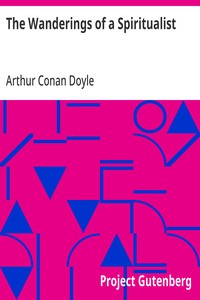
The Wanderings of a Spiritualist — Reading Companion
1
0
Project Gutenberg
2012
Spiritualism; Australia -- Description and travel; Doyle, Arthur Conan, 1859-1930; Doyle, Arthur Conan, 1859-1930 -- Travel -- Australia; Spiritualism -- Australia -- History -- 20th century
Readers of public-domain and historical texts
Project Gutenberg digital edition
en
Edition facts
Words: 87,638
Reading time: 382 min
Text sections: 10
Source:
Project Gutenberg record #39718
Arthur Conan Doyle's travelogue and spiritualist manifesto recounts his 1920-21 Australian lecture tour, blending observations of colonial society, psychic phenomena, and personal conviction. The narrative weaves séances, debates with skeptics, and encounters with local figures into a defense of Spiritualism.
In The Wanderings of a Spiritualist, Arthur Conan Doyle presents a travel narrative that is also a sustained argument for Spiritualism. The book opens with a challenge: a séance in Merthyr Tydfil, where a spirit message allegedly foretold his Australian tour. Doyle immediately establishes the dual purpose of his journey—to observe a continent and to defend a faith. The text is punctuated by episodes that test the boundaries of evidence: a Sydney spiritualist’s son cuts a paper star as a sign from guides, and a politician’s high regard for Aboriginal intelligence counters prevailing racial assumptions. Doyle’s voice is that of a crusader, quoting Theodore Roosevelt’s maxim on “aggressive fighting for the right” as his motto.
Evidence and Its Discontents
Doyle repeatedly frames his encounters as tests of proof. When a Sydney newspaper offers a challenge for psychic photography, he dismisses it because the challenger “refused to submit to test conditions.” The episode reveals a central tension: Doyle demands rigorous standards from skeptics while accepting anecdotal signs—like the paper star—as divine guidance. He recounts a conversation with Mr. Maskell, the Sydney spiritualists’ secretary, who received a precut star from his son after praying for a sign about emigrating. Doyle presents this as a meaningful coincidence, not a controlled experiment. The contrast between his scorn for unscientific challenges and his embrace of personal omens marks a persistent pattern in the narrative.
Colonial Encounters and Intellectual Curiosity
Doyle’s Australian journey brings him into contact with figures who challenge his expectations. Dr. Creed, a New South Wales parliamentarian, is praised for having “a mind which takes a keen interest in everything.” Doyle notes Creed’s high opinion of Aboriginal intellect, reporting that “their results at the school which is devoted to their education are as high as with the white Australians.” This observation stands out in a text otherwise focused on spiritual matters. Doyle also meets the young poet Leon Gellert, whose war verses he calls “the most notable literary achievement” of recent Australian writing. These digressions reveal Doyle’s broader curiosity about the society he travels through, even as his primary mission remains spiritual advocacy.
The Preacher in a Nonconformist Pulpit
A telling episode occurs when Doyle speaks at a Congregational church in Manly. He describes it as “a novel experience for me to be in a Nonconformist pulpit,” yet he finds the audience receptive and hopes they “found something comforting and new.” The moment underscores Doyle’s ambiguous position: he is a famous author known for Sherlock Holmes, but here he acts as a lay preacher for Spiritualism. His willingness to address a Christian congregation suggests an attempt to bridge his faith with established religion, even as his views on atonement (mentioned in the chapter list) likely diverged from orthodox doctrine. The scene encapsulates the book’s blend of travelogue, memoir, and religious polemic.
Readers should approach The Wanderings of a Spiritualist as a document of its time—a record of how one prominent figure reconciled empirical travel writing with unverifiable spiritual claims. Doyle’s voice is earnest and combative, and his observations of Australia are filtered through his missionary zeal. The book rewards those interested in the intersection of early twentieth-century popular science, colonial travel, and the history of Spiritualism.
Reader reflection
Your personal reading reflection
Build a private reading journal entry for this title.
Your progress
0
/
10
2
How did the book work for you overall?
3
Is this a title you would suggest to others?
4
How easy was the book to follow?
5
How did the pace of the book feel?
6
Did the book give you something worth debating?
7
How clear did the writing feel?
8
How original did the book feel?
9
What did this book teach you most?
10