1

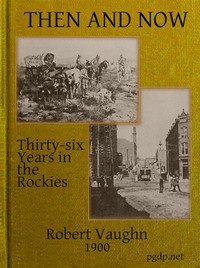
Then and Now; or, Thirty-Six Years in the Rockies Personal Reminiscences of Some of the First Pioneers of the State of Montana — A Closer Reading
1
0
Project Gutenberg
2014
Montana -- Description and travel; Pioneers -- Montana -- Biography; Frontier and pioneer life -- Montana; Indians of North America -- Montana -- History -- 19th century; Indians of North America -- Wars -- Montana; Montana -- History -- 19th century
Readers of public-domain and historical texts
Project Gutenberg digital edition
en
Edition facts
Words: 133,536
Reading time: 581 min
Text sections: 14
Source:
Project Gutenberg record #47334
Robert Vaughn's 1900 memoir, written as letters to his daughter, recounts his 36 years in Montana from 1864, blending personal anecdotes of gold rushes, Indian encounters, and frontier business with a pioneer's eye for detail.
Robert Vaughn's Then and Now; or, Thirty-Six Years in the Rockies begins not with a grand historical claim but with a personal dedication to his young daughter, Arvonia Elizabeth, and a preface explaining that the book originated as a series of private letters. This framing shapes the narrative voice throughout: intimate, direct, and grounded in lived experience rather than formal history. Vaughn insists he has “kept strictly to the truth,” a promise that colors the reader's expectation of the episodes to follow.
The table of contents reveals a structure built around discrete events—a stampede, a gold discovery, a buffalo hunt, a robbery—rather than a continuous chronology. This episodic quality invites the reader to approach the book as a collection of vivid set pieces, each offering a self-contained glimpse into Montana's early days.
A Letter-Writer's Voice
The epistolary origin of Then and Now is not merely a biographical footnote; it shapes the texture of the prose. Vaughn addresses his daughter directly in the dedication, and the preface notes that the letters were “not intended for publication.” This private audience explains the conversational tone that surfaces in the excerpts: Vaughn describes a harrowing encounter with two Piegan Indians who robbed him of his watch and saddle, recounting the moment with a matter-of-factness that feels confided rather than performed. He notes the Indian “drew his gun, a short Henry rifle and threw in a cartridge with the lever,” a detail that suggests both the narrator's familiarity with firearms and his impulse to record precise observations for a reader he trusts. The voice is that of a father telling stories, not a historian delivering a lecture.
The Economics of Danger
Vaughn's narrative repeatedly intertwines risk and commerce. In one excerpt, a fellow traveler named Coppick chooses to flee toward Salt Lake with $30,000 in gold dust rather than risk the Indian threat on the Sun River route. Vaughn himself, after being robbed, reflects on the value of his lost Jurgensen stop watch and heavy gold chain—objects that signal both his prosperity and his vulnerability. The text also notes the dramatic drop in freight rates “from ten to eighteen cents per pound” down to three cents, and wagon freights from Benton to Helena falling from six cents to one cent. These economic details are not dry statistics; they are the coordinates of a world where a man's livelihood depended on the safety of a trail and the price of a pound of goods. Vaughn's own shift from merchandise to sheep raising in 1877 marks a personal adaptation to changing conditions.
Encounters with the Unpredictable
The excerpts present a series of encounters with Native Americans that range from tense negotiation to outright violence. Vaughn's account of the robbery is notable for its restraint: he describes the Indian's painted face, brass rings in his hair, and the moment when a companion called out “Don't shoot.” The narrative does not demonize or sentimentalize; it reports. Earlier, Vaughn mentions a “Brave Piegan War Chief” and “Bloody Battles and Tragedies in the Sun River Valley,” but the excerpts focus on the immediate, personal threat. The reader sees Vaughn making quick calculations—when the Indian aims his Henry rifle, Vaughn “concluded that I did not want the watch.” These moments of decision, rendered without embellishment, give the memoir its particular gravity. The unpredictability of these encounters is underscored by the fact that Vaughn, despite his caution, is caught off guard while riding unarmed.
The Shape of a Life in Fragments
The book's structure as a series of letters means that the reader moves through Vaughn's life in leaps. The table of contents jumps from “From Home to the State of Illinois” to “Crossing the Plains” to “The Discovery of Alder Creek,” and later to “From the Mines to the Farm” and “From the Farm to the City of Great Falls.” This is not a smooth autobiography but a mosaic of key episodes. Vaughn himself acknowledges this when he writes, “I will skip the years until 1877.” The gaps are as telling as the inclusions: the reader must infer the quiet periods of farming and business from the dramatic peaks of stampedes and Indian wars. The final excerpt, which details the robbery, is followed by a long Project Gutenberg colophon, but the narrative itself ends abruptly. This fragmentary quality is not a flaw; it mirrors the way memory works, and it invites the reader to piece together the arc of a pioneer's life from the stories he chose to preserve.
Because Vaughn wrote for his daughter, the reader occupies the position of a trusted confidant. The best approach is to read each letter as a self-contained story, noting the specific details of place, price, and person that Vaughn includes. Pay attention to what he leaves out—the years he skips, the emotions he understates—as much as to what he records. The memoir rewards those who read slowly, savoring the texture of a world where a watch chain could be worth a life, and where a father's letter could become a state's history.
Reader reflection
How will you remember this book?
Save your reaction, strongest insight, and memorable passage.
Your progress
0
/
10
2
Did this book hold your interest?
3
Would you recommend this book to another reader?
4
Did the language feel accessible?
5
How clear did the writing feel?
6
Would this book work well in a reading group?
7
Is this a title worth rereading?
8
Did any part of the book stay with you emotionally?
9
What is the main idea you are taking away?
10