1

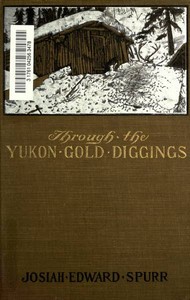
Through the Yukon Gold Diggings: A Narrative of Personal Travel — Background and Themes
1
0
Project Gutenberg
2013
Alaska -- Description and travel; Klondike River Valley (Yukon) -- Gold discoveries; Yukon River Valley (Yukon and Alaska) -- Gold discoveries
Readers of public-domain and historical texts
Project Gutenberg digital edition
en
Edition facts
Words: 54,381
Reading time: 237 min
Text sections: 7
Source:
Project Gutenberg record #44038
Josiah Edward Spurr's 1900 narrative of his 1896 expedition as a U.S. Geological Survey geologist through the Yukon gold diggings, offering firsthand observations of travel, mining camps, and the Klondike discovery, with a plain, unadorned style that prioritizes accuracy over drama.
Editorial Edition Score
4.7/5
★★★★★
★★★★★
Calculated from edition completeness, EPUB availability, text structure and catalogue metadata. Not a user rating.
Edition quality
Josiah Edward Spurr opens his narrative with a geologist's matter-of-factness, stating that he was placed in charge of the first U.S. Geological Survey expedition into interior Alaska. His preface sets a deliberate tone: he aims to record what he saw and encountered 'as fully and simply as possible,' sacrificing picturesqueness for accuracy. This commitment to plainness shapes the entire account. The reader is warned that tedious passages correspond to tedious incidents—an honest framing that distinguishes Spurr's work from more romanticized gold-rush tales. The narrative voice remains consistently that of a government scientist, even when describing physical exhaustion or danger.
A Geologist's Voice Amid the Stampede
This scientific detachment extends to his descriptions of miners. He observes that 'everybody does not get rich in the gold diggings, even in Alaska,' and notes that before the Klondike discovery, the largest net sum taken out by any one man was about $30,000. He does not moralize; he simply presents the data. The hospitality of miners, he writes, is 'not a mere act of courtesy which costs nothing, but the genuine unselfishness which cheerfully divides the last crust with a passing stranger.' The phrasing is careful, avoiding sentimentality while acknowledging generosity.
Pace and the Physical Toll of Travel
This shift in pace is not merely stylistic; it reflects the increasing danger and exhaustion. Spurr records that he 'caught fifteen-minute naps' and once woke to find his coat burning. The narrative does not linger on these moments; it moves on, just as the traveller must. The reader feels the cumulative fatigue through the accumulation of such incidents, not through explicit commentary. The structure itself—chapter headings like 'The Forty Mile Diggings' and 'The Birch Creek Diggings'—suggests a journey organized by geography, but the prose within those chapters accelerates and decelerates according to the terrain.
Recurring Details: The Skookum, Moccasins, and Mosquitoes
Another recurring element is the mention of provisions—or the lack thereof. Miners are 'very short of provisions, yet, hospitable to the last morsel.' Spurr himself carries 'some crackers and bacon' and notes when he dares not drink from a stagnant pool. The scarcity of food and the constant need to move create a rhythm of deprivation and relief. These details, repeated across chapters, build a portrait of a region where survival depends on small, practical decisions. The narrative's power lies in this accumulation of concrete, unadorned observations.
Spurr's narrative rewards readers who attend to its plain surfaces. The geologist's eye for detail—the precise description of a rapid, the offhand mention of a burning notebook—creates a record that feels trustworthy. The book is best read as a travel diary written by a professional observer, not as a dramatic adventure. Its value lies in its specificity: the names of creeks, the condition of trails, the behavior of mosquitoes. For those interested in the Yukon gold rush as experienced by a scientist rather than a prospector, Spurr's account offers a unique, unvarnished perspective.
Reader reflection
Your personal reading reflection
Build a private reading journal entry for this title.
Your progress
0
/
10
2
Was reading this book enjoyable?
3
Would you encourage someone else to read it?
4
Did the language feel accessible?
5
How much did the book move you?
6
How did the reading compare with what you expected?
7
How distinctive were its ideas or approach?
8
Did it raise ideas you would like to talk about?
9
Which lesson or insight stayed with you?
10