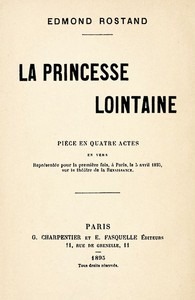
La Princesse lointaine: Pièce en quatre actes, en vers by Edmond Rostand

(9 User reviews)   6225
Rostand, Edmond, 1868-1918 Rostand, Edmond, 1868-1918
French
Imagine a knight so in love with the idea of a woman he's never met that he risks everything for her—and a troubadour who knows the real woman behind the legend. That's the beautiful, painful heart of Edmond Rostand's 'La Princesse lointaine' (The Faraway Princess). It’s a play in verse that asks a tough question: Is it better to love a perfect dream, or a flawed, real person? The poetry is gorgeous, the characters ache with longing, and the ending will leave you thinking about it for days. If you loved the romantic agony of 'Cyrano de Bergerac,' you need to meet this earlier, less-known gem.
Share

Read "La Princesse lointaine: Pièce en quatre actes, en vers by Edmond Rostand" Online

This book is available in the public domain. Start reading the digital edition below.

START READING FULL BOOK
Instant Access    Mobile Friendly

Book Preview

A short preview of the book’s content is shown below to give you an idea of its style and themes.

Les Romanesques, comédie en trois actes et en vers (Comédie-Française). PROCHAINEMENT: Poèmes Sensitifs. Paris.--Imprimerie L. MARETHEUX, 1, rue Cassette.--5632. A MADAME SARAH BERNHARDT puis-je ne pas dédier cette pièce? E. R. LES PERSONNAGES: MÉLISSINDE, princesse d'Orient, comtesse de Tripoli Mme Sarah Bernhardt. BERTRAND D'ALLAMANON, chevalier et troubadour provençal MM. Guitry. JOFFROY RUDEL, prince de Blaye, troubadour aquitain De Max. FRÈRE TROPHIME, chapelain du prince Jean Coquelin. ÉRASME, son médecin Chameroy. SQUARCIAFICO, marchand génois Laroche. LE CHEVALIER AUX ARMES VERTES, aventurier au service de l'Empereur Manuel Comnène Castelli. SORISMONDE, dame d'honneur de Mélissinde Mme Marthold. LE PATRON DE LA NEF } MM. Montigny. TROBALDO LE CALFAT } Lacroix. FRANÇOIS LE RÉMOLAR } Angelo. PÉGOFAT } Mariniers Arquillière. BRUNO } Monrose. BISTAGNE } Gérard. JUAN LE PORTINGALAIS } Pelletier. MARRIAS D'AIGUES-MORTES } Magnin. LE PILOTE Cauroy. PREMIER PÈLERIN Ramy. DEUXIÈME PÈLERIN Torey. TROISIÈME PÈLERIN Besnard. QUATRIÈME PÈLERIN Letellier. CINQUIÈME PÈLERIN Maugis. NICHOLOSE, Valet de Squarciafico Piron. UN MOUSSE Camus. Les Mariniers, Des Musiciens, Esclaves, etc. XIIe SIÈCLE LA PRINCESSE LOINTAINE PREMIER ACTE Le pont d'une nef qui paraît avoir souffert une longue et terrible traversée. On voit qu'il y a eu tempête: voiles en loques, vergues brisées, échevèlement de cordages, mât rajusté qui penche. On voit qu'il y a eu bataille: taches de sang, armes éparses. Nuit finissante. Ombre grise et transparente. Ciel qui pâlit. Étoiles qui se raréfient. Mer violette sous des écharpes de vapeurs. Horizon de brumes. L'éclairage, au cours de l'acte, change insensiblement. SCÈNE PREMIÈRE LES MARINIERS: BRUNO, BISTAGNE, MARRIAS, PÉGOFAT, TROBALDO, FRANÇOIS, ETC., LE PILOTE, puis LE PATRON DE LA NEF et FRÈRE TROPHIME (Au lever du rideau, couchés ou assis en tous sens, de mariniers à face tragique, blêmes, décharnés; ils paraissent épuisés de fatigues et de privations. Quelques-uns, blessés, sont sommairement pansés de haillons. Deux d'entre eux, au fond en balancent, par la tête et par les pieds, un troisième, inerte.) LES DEUX MARINIERS: PÉGOFAT et BRUNO, au fond. Un... deux... trois... houp! (Ils lancent le corps par-dessus le bastingage. On entend sa chute dans l'eau.) PÉGOFAT C'est fait. BRUNO Encore un camarade Qui ne nagera pas, Tripoli, dans ta rade! PÉGOFAT, ôtant son bonnet vers le disparu. Adieu, garçon! BRUNO, regardant au loin. Bientôt l'aurore. Une rougeur. (Ils redescendent.) FRANÇOIS, se réveillant et s'étirant. Qui vient-on de jeter? BRUNO Audriu l'Égorgeur. FRANÇOIS Maudite fièvre! (Il regarde le pont dévasté.) Eh bien, elle en a fait, la vague! BISTAGNE, levant la tête. Et le vent, donc! Plus de boulines!... BRUNO Plus d'itague! FRANÇOIS Le mât pourrait bien choir. Mieux vaudrait le scier. BISTAGNE Moi, je voudrais manger. BRUNO Rien chez le pitancier! FRANÇOIS, se levant. Aï! ma blessure!... (Il chancelle.) Ho! ho!... On ne se tient plus, presque! Que l'on rencontre encore une nef barbaresque, Et l'on ne pourra plus se battre!... BRUNO On se battra! Car il faut arriver! Rien ne l'empêchera! Tant pis pour toute nef qui nous cherchera noise! BISTAGNE Quand donc voguera-t-on dans l'eau sarrasinoise? LE PILOTE Bientôt, j'espère. Mais le temps fut si mauvais! Ah! l'aiguille qui dit le nord, si je l'avais! Et la pierre dont on la frotte!... BISTAGNE, haussant les épaules. Quelle bourde! LE PILOTE Non, ils sont quelques-uns qui l'ont, dans une gourde: On frotte. De la pierre est amoureux le fer. Alors l'aiguille tourne et dit le nord: c'est clair. TOUS LES MARINIERS Ha! ha!--C'est idiot!... Est-il bête!--Une aiguille! PÉGOFAT Bah! passons-nous d'aiguille, et vogue la coquille! --Tiens, le temps s'éclaircit, la misère prend fin! BRUNO Tu trouves, toi? Hé bien, et la soif? FRANÇOIS Et la faim? BISTAGNE Oui, ce qu'on a souffert! PÉGOFAT Le...

This is a limited preview. Download the book to read the full content.

Edmond Rostand, the genius behind Cyrano de Bergerac, wrote this poetic play a few years earlier. It’s a feast of beautiful language, even in translation, full of the same romantic spirit and sharp wit that made Cyrano a classic.

The Story

The famous knight, Prince Geoffroy Rudel, is dying of a mysterious sickness. He believes only one thing can save him: seeing the face of the legendary Countess of Tripoli, Melissinde, whose beauty he knows only from songs. He sets sail on a desperate, final voyage. But his loyal troubadour, Bertrand, gets there first. Bertrand meets the real Melissinde—a lonely, kind woman trapped by her own public image—and they fall in love. When Geoffroy finally arrives, he’s faced with a brutal choice: cling to his perfect dream of the 'faraway princess,' or open his eyes to the complex, real woman right in front of him.

Why You Should Read It

This play hooked me because it’s so honest about how we build people up in our heads. We’ve all done it. Rostand doesn’t pick sides; he shows the tragedy and the beauty in both kinds of love. Geoffroy’s pure, idealistic passion is moving, but Bertrand and Melissinde’s grounded, real connection is just as powerful. The conflict isn't about good guys and bad guys—it’s about different ways of loving, and how sometimes they can’t coexist.

Final Verdict

Perfect for romantics, poetry lovers, and anyone who’s ever wondered about the gap between fantasy and reality. It’s a shorter, more intimate play than Cyrano, but it packs a similar emotional punch. If you enjoy stories about unrequited love, artistic passion, and impossible choices wrapped in stunning verse, this distant princess is well worth seeking out.


🔖 Public Domain Notice

Legal analysis indicates this work is in the public domain. It is now common property for all to enjoy.

Kimberly Perez
1 year ago

Fast paced, good book.

Elizabeth Gonzalez
1 year ago

Simply put, the storytelling feels authentic and emotionally grounded. Exceeded all my expectations.

Kimberly Sanchez
3 months ago

As someone who reads a lot, the author's voice is distinct and makes complex topics easy to digest. One of the best books I've read this year.

Andrew Jackson
1 year ago

Essential reading for students of this field.

5
5 out of 5 (9 User reviews )

Add a Review

Your Rating *
There are no comments for this eBook.
You must log in to post a comment.
Log in


Related eBooks