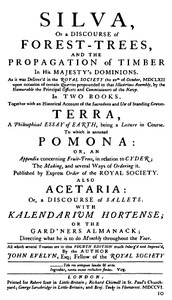
Sylva; Or, A Discourse of Forest Trees. Vol. 1 (of 2) by John Evelyn

(8 User reviews)   4492
Evelyn, John, 1620-1706 Evelyn, John, 1620-1706
English
Ever wonder what 17th-century England thought about trees? John Evelyn's 'Sylva' is basically a 350-year-old TED Talk on the subject, but with more Latin plant names and a national crisis at its heart. England was running out of wood for its navy and buildings, and this book was the passionate, detailed, and surprisingly readable plan to fix it. It’s part practical guide, part love letter to oaks and elms, and a fascinating window into a world where trees were the key to national survival. Forget dry history—this is a rescue mission for a kingdom, written by a man who truly believed in the power of a well-planted forest.
Share

Read "Sylva; Or, A Discourse of Forest Trees. Vol. 1 (of 2) by John Evelyn" Online

This book is available in the public domain. Start reading the digital edition below.

START READING FULL BOOK
Instant Access    Mobile Friendly

Book Preview

A short preview of the book’s content is shown below to give you an idea of its style and themes.

principally for his services in connection with Christ’s Hospital. From the hasty sketch drafted in the above outlines, it will be seen that throughout all Pepys’ manhood the circumstances of his daily life and environment were much more similar to those of Evelyn than to those of Walton, who may well be ranked as their senior by almost one generation. Like Evelyn, Izaak Walton was rather the child of the country than a boy of the town. Born in Stafford in 1593, he only came to settle in London after he had attained early manhood. Thus, though a citizen exposing his linen drapery and mens’ millinery for sale first in the Gresham Exchange on the Cornhill, then in Fleet Street, and latterly in Chancery Lane, the Bond Street of that time, he ever cherished a longing for more rural surroundings and a desire to exchange life in the city for residence in a smaller provincial town. On the civil war breaking out in Charles the Ist’s time, he retired from business and went to live near his birth place, Stafford, where he had previously bought some land. Here the last forty years of his long life were spent in ease and recreation. When not angling or visiting friends, mostly brethren of the angle, he engaged in the light literary work of compiling biographies and in collecting material for the enrichment of his _Compleat Angler_. Published in 1653, this ran through five editions in 23 years, besides a reprint in 1664 of the third edition (1661). In spite of the many similarities between Evelyn and Pepys as to university education, official position, political partisanship, and social and scientific status in London, there are yet such essential differences between what has been bequeathed to us by these two friends that comparison between them is almost impossible. They are both authors: but it was by chance rather than by design that Pepys ultimately acquired repute as an author, whereas Evelyn at once achieved the literary fame he desired and wrote for. Neither of the two works published by Pepys, _The Portugal History_ (1677) and the _Memories of the Royal Navy_ (1690), procured for him the gratification of revising them for a second edition, and it is indeed open to question if the _Diary_ upon which his undying fame rests was ever intended by him to be published after his death. This is a point that is never likely to be settled satisfactorily. The fact of its having been written in cipher looks as if it had been compiled solely for private amusement, and not with any intention of posthumous publication; and this view is greatly strengthened by the unblushing and complete manner in which he lays aside the mask of outward propriety and records his too frequent quaffing of the wine-cup, his household bickerings, his improprieties with fair women, and his graver conjugal infidelities. The improprieties of other persons, and especially those of higher social rank than himself, might very intelligibly have been written in cipher intended to have been transcribed and printed after his death; but it would be at variance with human nature to believe that he could so unreservedly have reduced to writing all the faults and follies of his life had even posthumous publication of his _Diary_ been contemplated by him at the time of writing it. For it is hardly capable of argument that, next to the instincts of self-preservation and of the maintenance of family ties, the desire to preserve outward appearances is undoubtedly one of the strongest of human feelings; and this great natural law, often...

This is a limited preview. Download the book to read the full content.

Let's be clear: This is not a novel. There's no dashing hero or dramatic love story. Instead, John Evelyn's Sylva presents a different kind of drama: the urgent need to save England from itself. Published in 1664, the book was born from a Royal Society request for solutions to a critical shortage of timber. The navy needed ships, builders needed beams, and the country's forests were shrinking.

The Story

Think of it as a massive, beautifully organized owner's manual for Britain's trees. Evelyn systematically goes through different species—majestic oaks, sturdy elms, useful ashes—detailing everything: how to identify them, where they grow best, how to plant and care for them, and what they're good for (shipbuilding, furniture, firewood). The 'plot' is the argument he builds, tree by tree, for a national program of planting and conservation. It's a blueprint for a greener, stronger England.

Why You Should Read It

What grabbed me was Evelyn's voice. He's not a detached scientist; he's a guy who gets genuinely excited about the perfect soil for a walnut tree and furious about wasteful deforestation. His passion is contagious. Reading it, you feel the weight of history—how something as fundamental as wood shaped an empire. It reframes trees not just as scenery, but as the literal backbone of a society.

Final Verdict

Perfect for history buffs, gardeners, nature lovers, or anyone who enjoys primary sources that aren't stuffy. If you like the idea of hearing a clear, intelligent voice from the 1600s talk about a topic that still matters today (sustainability, anyone?), you'll find Sylva surprisingly engaging. It's a specialized read, but for the right reader, it's a quiet, profound delight.


🟢 Open Access

You are viewing a work that belongs to the global public domain. It is available for public use and education.

Karen Jackson
1 year ago

I had low expectations initially, however the author's voice is distinct and makes complex topics easy to digest. Exactly what I needed.

Anthony Hill
4 months ago

I started reading out of curiosity and the clarity of the writing makes this accessible. Exceeded all my expectations.

Elizabeth Martinez
1 week ago

Having read this twice, the plot twists are genuinely surprising. One of the best books I've read this year.

Paul Hill
1 year ago

Solid story.

Matthew Lee
1 year ago

Finally a version with clear text and no errors.
4.5
4.5 out of 5 (8 User reviews )

Add a Review

Your Rating *
There are no comments for this eBook.
You must log in to post a comment.
Log in


Related eBooks