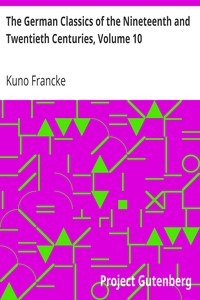
The German Classics of the Nineteenth and Twentieth Centuries, Volume 10 by Francke

(15 User reviews)   5069
English
Ever feel like you're missing a piece of the puzzle when you think about modern Europe? This book is that missing piece. It's not a single story, but a whole library's worth of voices from 19th and 20th century Germany, all crammed into one volume. Think of it as a time capsule. You get philosophers arguing about the meaning of life, poets capturing moments of beauty and despair, and playwrights holding up a mirror to a society on the brink of massive change. It's a direct line to the thoughts that shaped a continent. If you've ever wondered where so many of our modern ideas about art, politics, and identity really started, this collection offers some surprisingly clear answers.
Share

Read "The German Classics of the Nineteenth and Twentieth Centuries, Volume 10 by Francke" Online

This book is available in the public domain. Start reading the digital edition below.

START READING FULL BOOK
Instant Access    Mobile Friendly

Book Preview

A short preview of the book’s content is shown below to give you an idea of its style and themes.

Correspondence of William I. and Bismarck. Translated by J.A. Ford. From "Thoughts and Recollections." Translated under the supervision of A.J. Butler. Bismarck as an Orator. By Edmund von Mach. Speeches of Prince Bismarck. Translated by Edmund von Mach: Professorial Politics Speech from the Throne Alsace-Lorraine a Glacis Against France We Shall Never Go to Canossa! Bismarck as the "Honest Broker" Salus Publica--Bismarck's Only Lode-Star Practical Christianity We Germans Fear God, and Nought Else in the World Mount the Guards at the Warthe and the Vistula! Long Live the Emperor and the Empire! Count Helmuth Von Moltke The Life of Moltke. By Karl Detlev Jessen. Letters and Historical Writings of Moltke: The Political and Military Conditions of the Ottoman Empire in 1836. Translated by Edmund von Mach. A Trip to Brussa. Translated by Edmund von Mach. A Journey to Mossul. Translated by Edmund von Mach. A Bullfight in Spain. Translated by Edmund von Mach. Description of Moscow. Translated by Grace Bigelow. The Peace Movement. Translated by Edmund von Mach. Fighting on the Frontier. Translated by Clara Bell and Henry W. Fischer. Battle of Gravelotte--St. Privat. Translated by Clara Bell and Henry W. Fischer. Consolatory Thoughts on the Earthly Life and a Future Existence. Translated by Mary Herms. Ferdinand Lassalle The Life and Work of Ferdinand Lassalle. By Arthur N. Holcombe. The Workingmen's Programme. Translated by E.H. Babbitt. Science and the Workingmen. Translated by Thorstein B. Veblen. Open Letter to the Central Committee. Translated by E.H. Babbitt. ILLUSTRATIONS--VOLUME X Bismarck Meeting Napoleon after the Battle of Sedan Prince Bismarck. By Franz von Lenbach Prince Bismarck. By Franz von Lenbach Princess Bismarck Coronation of King William I at Königsberg. By Adolph von Menzel Emperor William I. By Franz von Lenbach King William's Departure for the Front at the Beginning of the Franco-German War. By Adolph von Menzel Prince Bismarck. By Franz von Lenbach The Berlin Congress. By Anton von Werner Prince Bismarck. By Franz von Lenbach The Bismarck Monument at Hamburg. By Lederer William I on his Deathbed. By Anton von Werner Moltke. By Anton von Werner Count Moltke Moltke at Sedan. By Anton von Werner King William at the Mausoleum of his Parents on the Day of the French Declaration of War. By Anton von Werner The Capitulation of Sedan. By Anton von Werner Ferdinand Lassalle The Iron Foundry. By Adolph von Menzel Flax Barn in Laren. By Max Liebermann * * * * * BISMARCK AS A NATIONAL TYPE[1] BY KUNO FRANCKE, PH.D., LL.D., Litt.D. Professor of the History of German Culture, Harvard University. No man since Luther has been a more complete embodiment of German nationality than Otto von Bismarck. None has been closer to the German heart. None has stood more conspicuously for racial aspirations, passions, ideals. It is the purpose of the present sketch to bring out a few of these affinities between Bismarck and the German people. I Perhaps the most obviously Teutonic trait in Bismarck's character is its martial quality. It would be preposterous, surely, to claim warlike distinction as a prerogative of the German race. Russians, Frenchmen, Englishmen, Americans, undoubtedly, make as good fighters as Germans. But it is not an exaggeration to say that there is no country in the world where the army is as enlightened or as popular an institution as it is in Germany. The German army is not composed of hirelings of professional fighters whose business it is to pick quarrels, no matter with whom. It is, in the strictest sense of the word, the people in arms. Among its officers there is a large percentage of the intellectual élite...

This is a limited preview. Download the book to read the full content.

Let's be clear from the start: this isn't a novel. The German Classics, Volume 10 is a curated collection, a sampler platter of intellectual and artistic heavy-hitters. You won't follow one character's journey. Instead, you'll hop from the dense, world-shaping ideas of philosophers like Hegel and Nietzsche to the intimate, emotional verses of poets like Heine and Rilke. You'll sit in on plays that dissect social class and read essays that question the very foundation of knowledge. The 'plot' is the unfolding of an era—the seismic shift from Romantic idealism to the gritty realities of the industrial age and the looming shadows of the 20th century.

Why You Should Read It

I picked this up thinking it would feel like homework. I was wrong. The magic is in the variety. One minute you're wrestling with a complex philosophical concept, and the next you're reading a poem that captures a feeling so perfectly it gives you chills. It removes the middleman. You're not reading about what Nietzsche thought; you're reading Nietzsche himself, in short, powerful bursts. It makes these monumental figures feel human and their ideas urgent, not just dusty historical facts.

Final Verdict

This is for the curious reader, not the casual one. It's perfect for anyone who loves history and wants to understand the why behind the what. If you enjoy big ideas, beautiful language, and seeing how art and philosophy collide with real-world change, you'll find this volume fascinating. Consider it a brainy, rewarding challenge—a chance to have a direct conversation with the minds that built the modern world.


🟢 Open Access

This text is dedicated to the public domain. It is now common property for all to enjoy.

Matthew Robinson
1 year ago

Five stars!

Mary Jackson
1 year ago

Not bad at all.

Jackson Smith
1 year ago

Compatible with my e-reader, thanks.

Sandra Lee
7 months ago

Recommended.

Aiden Garcia
9 months ago

Loved it.

5
5 out of 5 (15 User reviews )

Add a Review

Your Rating *
There are no comments for this eBook.
You must log in to post a comment.
Log in


Related eBooks