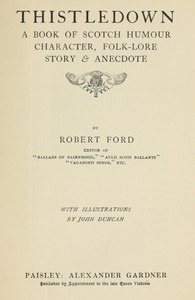
Thistledown: A Book of Scotch Humour, Character, Folk-lore, Story & Anecdote

(13 User reviews)   5912
Ford, Robert, 1846-1905 Ford, Robert, 1846-1905
English
Hey, have you ever wished you could just sit in a cozy Scottish pub and listen to the locals tell stories? That's exactly what 'Thistledown' feels like. It's not one big story, but a whole collection of them—funny jokes, clever sayings, spooky folk tales, and wild anecdotes that people have been passing down for generations. The 'conflict' here isn't a villain, but the struggle to capture a way of life and a sense of humor that was starting to fade even back in the 1890s. Robert Ford raced against time to write these stories down before they were lost. It’s a hilarious and surprisingly touching rescue mission for Scotland’s soul, one punchline and ghost story at a time.
Share

Read "Thistledown: A Book of Scotch Humour, Character, Folk-lore, Story & Anecdote" Online

This book is available in the public domain. Start reading the digital edition below.

START READING FULL BOOK
Instant Access    Mobile Friendly

Book Preview

A short preview of the book’s content is shown below to give you an idea of its style and themes.

unguarded moment, a manifest Scotticism slips into their conversation. There is a portion of the semi-educated working population, again, who, imitating the snobbish element of the middle grade, speak Scotch freely only in their working clothes. On Sundays, and extra occasions, when dressed in their very best, there is just about as much Scotch in their talk as will show one how poorly they can speak English, and just about enough English to render their Scotch ridiculous. Observing all this, and taking it in conjunction with the other denationalising tendencies of the age, there are those who predict that the time is not far distant when Burns’s poems, Scott’s novels, and Hogg’s tales will be sealed books to the partially educated Scotsman. That there is a growing tendency in the direction indicated is quite true, but the disease, I believe, is only skin deep as yet, and the bone and sinew of the country remain quite unaffected. That there will be a sudden reaction in the patient must be the sincere desire of every patriotic Scot. If the prediction of obsoletism is ever to be realized, then, “the mair’s the pity.” Scotland will not stand where she did. For very much—oh, so much—of what has made her glorious among the nations of the world will have passed away, taking the sheen of her glory with it. What Scotsmen, as Scotsmen, should ever prize most is bound up inseparably with the native language. Ours is a matured country, and the stirring scenes of her history on which the mind of the individual delights to dwell, are so frequently enshrined in spirited ballad and song, couched in the pithy Scottish vernacular, that, to suppose these latter dead—they are not translatable into English—is to suppose the best part of Scottish history dead and buried beyond the hope of resurrection. For its own sake alone the Scottish tongue is eminently deserving of regard—of cultivation and preservation. Scotsmen should be—and so all well-conditioned Scotsmen surely are—as proud of their native tongue as they are of their far-famed native bens and glens. For why, the rugged grandeur of the physical features of our country are not more worthy of admiration than the language in which their glories have been most fittingly extolled. They have characteristics in common; for rugged grandeur is as truly a feature of the Scottish language as it is the dominant feature of Scottish scenery. True, its various dialects are somewhat tantalising. The Forfar man is vividly identified by his “foo’s” and his “fa’s,” and his “fat’s” and his “fans”; and the Renfrewshire man by his “weans,” his “wee weans,” and his “yin pound yin and yinpence,” etc. Taking a simple phrase as an example—(_Anglice_):—“The spoon is on the loom.” The Aberdonian will tell you that “The speen’s on the leem.” The Perthshire man will say “That spun’s on the luim”; and the Glasgow citizen will inform you that “The spin’s on the lim.” In a fuller example, a Renfrewshire person will vouchsafe the information that he “Saw a seybo synd’t doon the syvor till it sank in the stank.” A native of Perthshire will only about half understand what the speaker has said, and may threaten to “rax a rung frae the boggars o’ the hoose and reeshil his rumple wi’t,” without sending terror to the soul of his West country confederate. Latterly, an Aberdonian may come on the scene and ask, “Fa’ fuppit the loonie?” and neither of the forenamed parties will at once perceive the drift of his inquiry. To illustrate how difficult it may be for the East and...

This is a limited preview. Download the book to read the full content.

Forget about a single plot. Thistledown is more like opening a treasure chest. Robert Ford spent years collecting the jokes, legends, and everyday stories that defined Scottish life in the 19th century. He gathered tales of clever beggars outsmarting the rich, eerie encounters with fairies and witches in the glens, and the dry, witty banter heard in marketplaces and farmhouses.

Why You Should Read It

This book is a joy because it feels authentic. You're not getting a historian's dry analysis; you're getting the stories people actually told each other. The humor is sharp and often comes from a place of making light of hardship. The folk tales are wonderfully strange, full of superstition and landscape. It shows you the character of a nation through its laughter and its fears. Reading it, I felt like I was being let in on a private joke that’s been running for centuries.

Final Verdict

Perfect for anyone with Scottish roots, lovers of folklore, or people who just enjoy a really good, old-fashioned joke. It’s also great for dipping in and out of—you can read a couple of anecdotes before bed. If you’ve ever enjoyed the wit in a show like Still Game or wondered about the stories behind old superstitions, this is your book. It’s a warm, funny, and essential record of a world that’s mostly gone now.


📚 Usage Rights

The copyright for this book has expired, making it public property. You are welcome to share this with anyone.

Donna Walker
1 year ago

Very helpful, thanks.

Robert Martinez
2 months ago

The formatting on this digital edition is flawless.

Charles King
1 month ago

The formatting on this digital edition is flawless.
4.5
4.5 out of 5 (13 User reviews )

Add a Review

Your Rating *
There are no comments for this eBook.
You must log in to post a comment.
Log in


Related eBooks