1

Brackenridge's Journal of a voyage up the river Missouri, 1811; Franchère's Voyage to Northwest Coast, 1811-1814 — Key Ideas to Explore
(0 User reviews)
516
Project Gutenberg
2025
Not confirmed
Astoria (Or.); Fur trade -- Oregon; Northwest, Canadian -- Description and travel; Voyages to the Pacific coast; Oregon Territory -- History; Indians of North America -- Missouri River Valley; Missouri River Valley -- Discovery and exploration
Readers of public-domain and historical texts
Project Gutenberg digital edition
en
Edition facts
Words
136,560
Reading time
594 min
Text sections
61
For Brackenridge's Journal of a voyage up the river Missouri, 1811; Franchère's Voyage to Northwest Coast, 1811-1814 — Key Ideas to Explore, the stored edition analysis reports 136,560 words, 9 hr 54 min estimated reading time, and 61 detected text sections.
The text analysis averages about 23.1 words per sentence, while the detected sections provide another way to judge how the source is divided.
Project Gutenberg metadata also associates the work with “Astoria (Or.),” connecting these edition facts with the source record’s subject description.
Source:
Project Gutenberg record #76209
Two firsthand accounts of early American exploration: Brackenridge's 1811 Missouri River journal and Franchère's narrative of the Astor expedition to the Pacific Northwest (1811-1814), edited by Reuben Gold Thwaites. The texts contrast riverine and maritime travel, reveal tensions between captains and crews, and document encounters with indigenous peoples and natural hazards.
Read the complete public-domain text at its original source.
Read on Project GutenbergThis volume pairs two distinct exploration narratives from the same pivotal years, 1811–1814, each following a different route toward the Pacific. Henry Marie Brackenridge’s journal traces an ascent of the Missouri River, while Gabriel Franchère’s account describes a voyage by sea around Cape Horn to the mouth of the Columbia River. Both men were participants, not leaders, and their perspectives reflect the anxieties and dependencies of life under often reckless commanders. The editor, Reuben Gold Thwaites, presents them as part of his series Early Western Travels, with annotations that clarify obscure references without overwhelming the original texts.
Contrasting Geographies: River vs. Sea
The two journals offer complementary but contrasting physical environments. Brackenridge moves upstream against the Missouri’s current, recording the river’s shifting channels, sandbars, and the labor of poling and rowing. His progress is measured in miles per day, often impeded by weather and the river’s own meanders. Franchère, by contrast, crosses open ocean, subject to gales, calms, and the constant risk of shipwreck. His description of the Columbia River bar—where breakers made the entrance “a confused and agitated sea”—highlights the danger of transitioning from deep water to a river mouth. Together, the two accounts show that neither route offered safe passage; each demanded different skills and exposed travelers to distinct forms of hardship.
The Captain’s Authority and Its Limits
A recurring tension in both narratives is the relationship between the expedition leader and the men. Brackenridge records his own fear that the captain planned to abandon him on an island—a fear that proved “ill-founded” but reveals the precarious trust between commander and crew. Franchère’s account is more explicit: the captain’s “obstinacy” in sending a boat ashore in heavy weather, against the advice of partners M’Kay and M’Dougall, leads to the loss of the boat and its crew. The men’s foreboding is confirmed when the boat never returns. These episodes underscore how survival depended not only on natural forces but on the competence and judgment of those in charge—qualities that were not always present.
Encounters and Labor: Indigenous People and Islanders
Both journals document the use of indigenous and local labor. Franchère describes taking on a dozen islanders at the Falkland Islands for a three-year engagement, with pay in merchandise and a promise of one hundred dollars. These men, he notes, “make very good sailors” and were eager for employment. The transaction is presented matter-of-factly, yet it reveals the economic dependencies that underpinned exploration. Brackenridge’s journal, though less detailed in the excerpt, similarly involves interactions with Native peoples along the Missouri. The volume as a whole shows that exploration was never a solitary endeavor; it relied on the knowledge, labor, and willingness of people who were often not the authors of their own stories.
Editorial Framing and Textual Condition
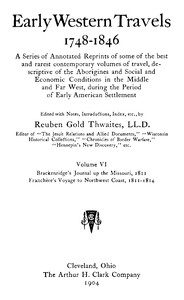
Reuben Gold Thwaites’s editorial apparatus shapes how these texts are read. His preface and notes situate the journals within the broader context of Western travel literature, but the excerpts also reveal the textual challenges: the transcriber’s note acknowledges inconsistent spelling, dialect, and non-standard diacriticals, especially in French. Manuscript page numbers are preserved in brackets, reminding the reader that this is a reproduction of a historical document. The inclusion of facsimile title pages and illustrations (such as “Astoria, as it was in 1813”) adds a visual dimension. Readers should be aware that the text carries the marks of its own production—both the original authors’ idiosyncrasies and the editor’s interventions.
These two accounts reward a comparative reading: Brackenridge’s river journey and Franchère’s sea voyage each illuminate the other by contrast. Pay attention to the moments when the narrators express doubt, fear, or relief—these are not mere adventure tales but records of uncertainty. The volume’s value lies in its accumulation of specific, often mundane details: the price of a cask, the number of men in a boat, the direction of the wind. Such details ground the larger story of American expansion in the lived experience of those who undertook it.
Sitting with Brackenridge’s river and Franchère’s sea, I kept thinking how both men measured distance not in miles but in patience—the slow turn of seasons, the quiet tension between a captain and his crew. That same unhurried weight of travel, of waiting on rivers and coasts, returned to me in Great African Travellers: From Mungo Park to Livingstone and Stanley — Background and Themes, where every step inland felt like a held breath.
There are no reviews for this eBook.
There are no comments for this eBook.
Reader reflection
How will you remember this book?
Save your reaction, strongest insight, and memorable passage.
Your progress
0
/
10
2
How did the book work for you overall?
3
Is this a title you would suggest to others?
4
How easy was the book to follow?
5
Which aspect of the book did you value most?
6
Would you read this book again?
7
Was the book easy to understand?
8
How did the reading compare with what you expected?
9
What changed or sharpened your thinking?
10