1

Exploration of the Valley of the Amazon, Part 2 (of 2) — Key Ideas to Explore
(0 User reviews)
1547
Project Gutenberg
2018
Not confirmed
Peru -- Description and travel; Brazil -- Description and travel; Bolivia -- Description and travel; Amazon River Valley -- Description and travel; Amazon River Valley -- Discovery and exploration -- American
Readers of public-domain and historical texts
Project Gutenberg digital edition
en
Edition facts
Words
154,427
Reading time
672 min
Text sections
18
For Exploration of the Valley of the Amazon, Part 2 (of 2) — Key Ideas to Explore, the stored edition analysis reports 154,427 words, 11 hr 12 min estimated reading time, and 18 detected text sections.
The text analysis averages about 18.6 words per sentence, while the detected sections provide another way to judge how the source is divided.
Project Gutenberg metadata also associates the work with “Peru -- Description and travel,” connecting these edition facts with the source record’s subject description.
Source:
Project Gutenberg record #57771
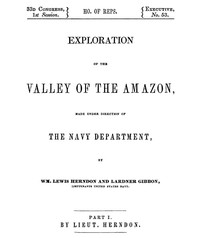
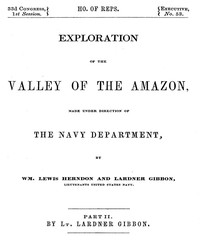
This second part of the Amazon exploration report, authored by Lt. Lardner Gibbon, details his separate route through Bolivia and Peru, with observations on geography, indigenous peoples, and economic potential, based on official U.S. Navy expedition records.
Read the complete public-domain text at its original source.
Read on Project GutenbergLt. Lardner Gibbon’s narrative in Part II of the Amazon exploration shifts focus from the main river to the highlands and tributaries of Bolivia and Peru. The text opens with a lithograph of llamas laden with silver crossing the Andes, immediately signaling the intersection of natural resources and transport that occupies much of the report. Gibbon’s voice emerges through precise descriptions of terrain, climate, and local practices, such as the padre whose clerical garments and salt-licking cattle reveal a blend of mission life and frontier pragmatism. The report is structured as a series of geographic and ethnographic observations, often framed by conversations with residents like Mr. Mauricio Bach, whose firsthand accounts of Chiquitos province lend credibility to Gibbon’s assessments of agricultural and navigational possibilities.
A Reporter’s Reliance on Local Informants
Gibbon frequently acknowledges his dependence on the knowledge of settlers, traders, and missionaries. The excerpt featuring Mr. Mauricio Bach is a prime example: Bach, who traveled overland from Rio de Janeiro to Bolivia, provides detailed intelligence on the route, the risks from “savage Indians,” and the fertility of the Chiquitos region. Gibbon does not claim to have seen everything himself; instead, he presents Bach’s testimony as a key source, noting that Bach “had a fair chance of judging” the land after years of residence. This method recurs throughout the report, where the author’s own observations are supplemented by the accounts of those with deeper local experience. Readers should note how Gibbon distinguishes between what he witnessed directly and what he gathered from interviews, a practice that lends the work an ethnographic texture but also requires careful reading to separate firsthand data from secondhand report.
The Landscape as a Commercial Prospectus
Much of the descriptive detail in the excerpts serves an implicit argument for economic development. Gibbon catalogs resources with an appraiser’s eye: the streams near Santiago contain “gold, silver, signs of cinnibar,” the forests offer “ornamental woods and medicinal plants,” and the soil can produce “both the torrid and temperate zones” from chocolate to wheat. The passage on the abandoned settlement of Florida, established by Mr. Oliden in 1836, reads like a case study in failed opportunity—fertile rice lands, a climate free of troublesome insects, and a river system that Bach believed could support steamboats, yet the venture collapsed due to Indian fears and lack of canoe skills. Gibbon’s tone is factual, but the accumulation of such details builds a picture of a region ripe for intervention, a theme consistent with the expedition’s official purpose of assessing commercial and navigational potential.
Boundary Disputes and Shifting Claims
Interspersed with natural description are passages on territorial disputes between Brazil and Bolivia. Gibbon reports a Brazilian commander’s claim that his government “claimed as far west as the cattle of Brazil roamed,” a remark that underscores the fluidity of borders in a sparsely populated region. He then references a century-old treaty between Spain and Portugal that set the initial point at the mouth of the Jaurũ River, but notes that such agreements were of little importance until the recent “awakening to the importance of commerce and steamboat navigation.” These observations reveal the political context behind the expedition: the U.S. Navy’s interest in the Amazon basin was not purely scientific but also strategic, as the region’s waterways promised new trade routes. Gibbon’s inclusion of these disputes adds a layer of geopolitical tension to what might otherwise be read as a straightforward travelogue.
The Texture of Daily Life in the Interior
Beyond resources and politics, Gibbon records small, telling details of life in the Bolivian interior. The image of a padre in clerical garments whose cattle “gratefully lick salt from his hands” and then rub their horns against his legs—a gesture the padre “did not seem to like much”—offers a glimpse of the mundane interactions that shaped mission existence. Gibbon also notes, with a hint of dry humor, that “padres in these countries sometimes go about without trousers.” Such asides humanize the narrative and remind the reader that the exploration was conducted not in a vacuum but amid the daily routines of people whose customs and quirks were as much a part of the landscape as the rivers and forests. These moments provide relief from the catalog of resources and help anchor the report in lived experience.
Gibbon’s report rewards readers who attend to the interplay between his own observations and the voices of the people he encountered. The text is at once a government document, a geographical survey, and a collection of anecdotes that reveal the complexities of mid-nineteenth-century exploration. As you read, note how the author’s assessments of navigability and agricultural potential are often hedged by the limitations of his informants’ knowledge or the practical difficulties of travel. The work is best approached not as a definitive account but as a layered record of what one officer saw, heard, and inferred during a journey through a region on the cusp of change.
The rain drummed on the window while I followed Gibbon’s river routes, his quiet notes on Bolivian trails somehow making the afternoon feel slower. When I closed him, I found myself reaching for Celebrated Travels and Travellers, Part 1. The Exploration of the World — Story, Setting & Ideas without really deciding to. That older book carries the same patient wonder, the same sense of maps still unfolding, and I stayed with it until the rain stopped.
There are no reviews for this eBook.
There are no comments for this eBook.
Reader reflection
How will you remember this book?
Save your reaction, strongest insight, and memorable passage.
Your progress
0
/
10
2
What was your overall reaction to the book?
3
Would you pass this book on to a friend?
4
How easy was the book to follow?
5
Did the story or argument move comfortably?
6
Did it raise ideas you would like to talk about?
7
What did you appreciate most?
8
Did this book create an emotional response?
9
Which lesson or insight stayed with you?
10