1

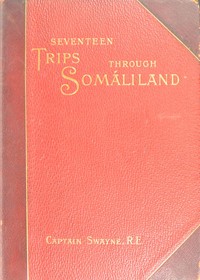
Seventeen trips through Somáliland A record of exploration & big game shooting, 1885 to 1893 — A Closer Reading
(0 User reviews)
77
Project Gutenberg
2018
Not confirmed
Ethiopia -- Description and travel; Horn of Africa -- Description and travel; Hunting -- Horn of Africa; Swayne, H. G. C. (Harald G. C.), 1860-1940; Ethnology -- Horn of Africa; Zoology -- Horn of Africa
Readers of public-domain and historical texts
Project Gutenberg digital edition
en
Edition facts
Words
152,576
Reading time
664 min
Text sections
17
Before opening Seventeen trips through Somáliland A record of exploration & big game shooting, 1885 to 1893 — A Closer Reading, the edition data offers a quick orientation: 152,576 words, 11 hr 4 min estimated reading time, and 17 detected text sections.
The text analysis averages about 29.0 words per sentence, while the detected sections provide another way to judge how the source is divided.
Project Gutenberg metadata also associates the work with “Ethiopia -- Description and travel,” connecting these edition facts with the source record’s subject description.
Source:
Project Gutenberg record #57907
Captain Swayne's narrative of seventeen journeys in Somáliland between 1885 and 1893, combining exploration, big game hunting, and ethnographic observation. The text reveals his authorial choices in diction, dialogue, and description, from precise hunting accounts to interactions with Somali guides.
Read the complete public-domain text at its original source.
Read on Project GutenbergCaptain H. G. C. Swayne's account of his seventeen journeys through Somáliland is marked by a deliberate, observational prose that blends the technical language of a military engineer with the enthusiasm of a naturalist. His descriptions of hunting episodes are precise: he notes the construction of ambush shelters, the calibre of his rifle, and the behaviour of game. The narrative voice is that of a man who relishes the practical challenges of exploration, from managing a camp to tracking a leopard.
Swayne's diction often shifts between the formal and the colloquial. He refers to his Somali followers as 'my brave and intelligent Somáli followers' in the dedication, yet in the field he records their shouts of 'Wiyil, wiyil' (Rhinoceros) without translation, embedding local language into his English text. This choice gives the reader a sense of immediacy and cultural encounter, while his own voice remains that of a British officer, confident and occasionally wry.
The Language of the Hunt
Swayne's hunting narratives are built on a precise vocabulary of action and observation. He describes a leopard that 'jumped into the middle of the camp to seize my best milch goat,' and notes how 'Makunan’s mule, by braying at the brute, aroused the whole camp.' The prose is economical: 'I dived quietly under my bed and drew out my coat, which had cartridges in the pockets, and a rifle.' The reader is placed in the scene through concrete details—the pile of camel-mats, the overhanging wall of earth fifteen feet high.
His choice of verbs is particularly telling. Animals 'make off,' 'gallop out with a crash,' and 'take away over the low stony hills.' Swayne himself 'sends a Martini-Henry picket' through a hyena, a phrase that combines military terminology with the hunter's craft. He does not linger on emotion; instead, he records outcomes: 'his body dropping into the water,' 'he stumbled away and fell in a ravine.' The effect is a narrative that feels both immediate and detached, focused on the mechanics of the hunt rather than its drama.
Encounters with Somali Guides and Locals
Swayne's interactions with Somali individuals are rendered through brief, telling exchanges. He meets an old man called Mader Ádan, 'the first Malingúr I had seen,' who 'greeted me cheerily, and told me to expect lions and rhinoceroses in plenty.' The guide's speech is reported directly, and his local knowledge is treated as valuable intelligence. Swayne's response—'This was joyful news'—reveals his own eagerness for sport.
Elsewhere, a guide 'going into the thickest of this to look for water, started a cow rhinoceros and calf. He came running back to us shouting, “Wiyil, wiyil.”' Swayne does not comment on the guide's courage or fear; he simply records the event. The Somali language appears as a natural part of the landscape, not exoticized. Swayne's authorial choice is to let these moments stand without editorializing, trusting the reader to infer the dynamics of trust and dependence that underpin his expeditions.
The Structure of a Journey
The narrative is organized by date and location, giving it the rhythm of a travel diary. Swayne notes when he breaks camp, the distances marched, and the features of the terrain: 'the bed of a torrent, deep cut in the red earth,' 'a river-bed, choked with dense, evergreen jungle and some high trees hung with rope-like creepers.' These descriptions are functional, but they accumulate to create a vivid sense of place.
Swayne also records the time of day and the conditions: 'a hot day even for the Kalíl season.' He notes the mosquitoes that 'breed in these stagnant pools' and the difficulty of keeping still in the bower. His structure mirrors the practical concerns of a traveller: where to find water, how to construct a shelter, when to march. The reader follows his logic, from the decision to sit up at a pool to the eventual disappointment when no game appears. This methodical approach gives the book a documentary quality, as if the author is compiling a field report for future explorers.
Voice and Self-Presentation
Swayne's authorial voice is that of a young officer—he was twenty-five at the outset—who is both confident and self-aware. He writes that 'the sense of responsibility, and the prospect of exploring new country, filled me with delight and awakened my faculties.' This is a rare moment of introspection; more often, he presents himself through action. When the leopard escapes, he notes wryly: 'of course by the time all this was ready the leopard had gone!'
His dedication 'to my brave and intelligent Somáli followers' signals a respect that is not always explicit in the text. He does not claim heroism; instead, he records his own limitations: 'going hard for two or three miles over very broken thorny country he fairly beat us, and we gave him up and returned to camp, knocked up by the hot sun.' This honesty about physical exhaustion and failure is characteristic. Swayne's narrative is not a tale of mastery but of persistence, and his voice remains that of a man who is both a participant and a recorder.
Swayne's prose rewards a reader attentive to the small decisions of language and structure. His account is not merely a record of what he saw, but of how he chose to see it—through the lens of a hunter, a surveyor, and a curious observer of Somali life. The book's value lies in these authorial choices, which transform a travelogue into a document of a particular mind encountering an unfamiliar world. Read for the precision of its observations and the restraint of its voice.
Something about Swayne’s restrained hunting notes and his careful listening to Somali guides stayed with me long after closing the book. It reminded me of the quieter awe in Celebrated Travels and Travellers, Part 1. The Exploration of the World — Story, Setting & Ideas—how both men simply let the landscape and its people speak, without rushing to conquer them completely. That stillness felt like a secret.
There are no reviews for this eBook.
There are no comments for this eBook.
Reader reflection
What did you think of this book?
Answer a few questions and save a private reflection on this device.
Your progress
0
/
10
2
Did this book hold your interest?
3
Would you recommend this book to another reader?
4
What was the reading difficulty like?
5
What was its emotional impact?
6
How clear did the writing feel?
7
Did the book deliver what you hoped for?
8
How valuable was this book for your own interests?
9
What is the main idea you are taking away?
10