1

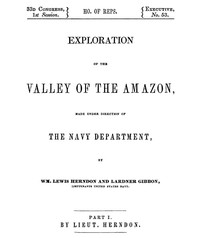
Exploration of the Valley of the Amazon, Part 1 (of 2) — Inside the Classic
(0 User reviews)
1147
Project Gutenberg
2018
Not confirmed
Peru -- Description and travel; Brazil -- Description and travel; Bolivia -- Description and travel; Amazon River Valley -- Description and travel; Amazon River Valley -- Discovery and exploration -- American
Readers of public-domain and historical texts
Project Gutenberg digital edition
en
Edition facts
Words
191,966
Reading time
835 min
Text sections
19
This digital edition of Exploration of the Valley of the Amazon, Part 1 (of 2) — Inside the Classic is described by source-level measurements including 191,966 words, 13 hr 55 min estimated reading time, and 19 detected text sections.
The text analysis averages about 22.5 words per sentence, while the detected sections provide another way to judge how the source is divided.
Project Gutenberg metadata also associates the work with “Peru -- Description and travel,” connecting these edition facts with the source record’s subject description.
Source:
Project Gutenberg record #57756
Lieutenant Herndon's 1851-1852 expedition report blends official naval documentation with ethnographic observations and logistical challenges, revealing a narrative voice that shifts from bureaucratic precision to candid cultural commentary.
Read the complete public-domain text at its original source.
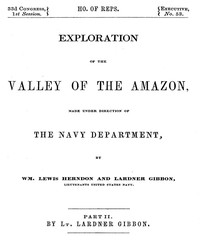
Read on Project GutenbergLieutenant William Lewis Herndon's report of the exploration of the Amazon Valley, submitted to the U.S. Navy Department in 1854, is a document of two minds. Its opening pages are dominated by official correspondence—letters from the Secretary of the Navy and President Millard Fillmore—that frame the work as a government record. Yet as Herndon's narrative proceeds, the voice shifts markedly. The same officer who dutifully transcribes resolutions for printing extra copies also records, with evident frustration, the difficulty of recruiting boatmen at Sarayacu, noting that 'although I offered double pay, we could not get more than eight men.' This tension between institutional formality and personal observation gives the report its distinctive character.
Official Framing and Personal Voice
The report opens with a cascade of governmental apparatus: a letter from the Secretary of the Navy, a resolution from the House of Representatives ordering ten thousand extra copies, and President Fillmore's brief transmittal. These documents establish the expedition's official purpose—to explore the Amazon and its tributaries—and its audience: the U.S. Congress. But once Herndon begins his own narrative, the tone relaxes. He describes the Conibos and Shipebos as 'vagabonds of the Ucayali,' a phrase that would be out of place in a formal dispatch. He admits uncertainty about the Mayorunas, stating 'very little is known of this tribe.' These asides reveal a narrator who is both a naval officer and a curious traveler, willing to record what he does not know.
Ethnographic Detail and Cultural Distance
Herndon's descriptions of indigenous groups are precise but filtered through his own cultural assumptions. He notes that the Sencis, according to a missionary source, 'kill those who are idle,' and contrasts this with the Ucayali tribes he met, who 'would be rather disposed to kill the industrious than the lazy.' The comparison is blunt, even dismissive, but it also shows Herndon wrestling with conflicting reports. He observes that the Conibos and Shipebos 'will not trust the white man, for which they have probably good cause,' a rare moment of self-awareness. His account of the Mayorunas—'whiter than the other tribes, to wear their beards, and to go naked'—mixes physical description with hearsay, underscoring the limits of his firsthand knowledge.
Logistics and the Pace of Travel
The expedition's progress is measured not in miles but in negotiations with missionaries, recruitment of boatmen, and the gathering of provisions. Herndon's plan to ascend the Ucayali to Chanchamayo is thwarted by practical realities: Father Calvo warns that a previous attempt with 150 men had been beaten back, and that he 'could not possibly furnish provisions for half that number.' Herndon scales back to twenty-five men, but even then, only eight volunteers appear. The narrative lingers on these setbacks—the making of farinha, the distilling of aguadiente—giving the reader a sense of the slow, uncertain rhythm of travel in the mid-nineteenth-century Amazon. The pace of the text itself mirrors the journey: patient, detailed, and often stalled by circumstance.
Readers should approach this report as a hybrid document: part official record, part personal narrative. Herndon's voice is most revealing in the gaps between his duties—when he admits uncertainty, expresses frustration, or offers a candid observation about the people he encounters. The excerpts available here cover only the early portion of the expedition; the full report likely contains further shifts in tone and focus as Herndon moves deeper into the valley. Pay attention to how the narrator's position—as a naval officer, a representative of the U.S. government, and a solitary traveler—shapes what he chooses to record and how he describes it.
That old naval report, Lieutenant Herndon’s, lingers less for its charts than for the quiet way he tires of his own official uniform, noticing instead the smells and shrugs of the people along the river. It made me think of another journey, gentler in tone, where the landscape does the talking. Camps and Trails in China A Narrative of Exploration, Adventure, and Sport in Little-Known China — Key Ideas to Explore holds that same feeling of a man simply walking, and remembering it all for us.
There are no reviews for this eBook.
There are no comments for this eBook.
Reader reflection
Your personal reading reflection
Build a private reading journal entry for this title.
Your progress
0
/
10
2
Was reading this book enjoyable?
3
Is this a title you would suggest to others?
4
How much effort did this book require?
5
How did the pace of the book feel?
6
Do you expect to return to this book?
7
Was the book easy to understand?
8
Would this book work well in a reading group?
9
What is the main idea you are taking away?
10