1

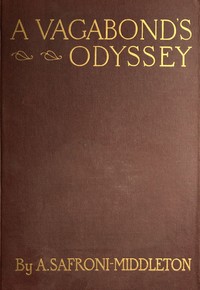
A Vagabond's Odyssey being further reminiscences of a wandering sailor-troubadour in many lands — Context and Discussion
(0 User reviews)
800
Project Gutenberg
2019
Not confirmed
Voyages and travels; Oceania -- Description and travel; Safroni-Middleton, A. (Arnold), 1873-1950
Readers of public-domain and historical texts
Project Gutenberg digital edition
en
Edition facts
Words
122,234
Reading time
532 min
Text sections
31
For A Vagabond's Odyssey being further reminiscences of a wandering sailor-troubadour in many lands — Context and Discussion, the stored edition analysis reports 122,234 words, 8 hr 52 min estimated reading time, and 31 detected text sections.
The text analysis averages about 24.8 words per sentence, while the detected sections provide another way to judge how the source is divided.
Project Gutenberg metadata also associates the work with “Voyages and travels,” connecting these edition facts with the source record’s subject description.
Source:
Project Gutenberg record #59303
Safroni-Middleton's second autobiography blends travel memoir with philosophical reflection, recounting his wanderings through Oceania and Australia, with vivid portraits of fellow vagabonds and a notable encounter with Robert Louis Stevenson in Samoa.
Read the complete public-domain text at its original source.
Read on Project GutenbergThe foreword to A Vagabond's Odyssey sets an unusual tone: the author acknowledges his own literary roughness, then defends the vagabond life with a paradoxical mix of self-deprecation and defiance. He writes of “jumping out of bed on a cold night to hold a candle to the devil” and describes cities as “necropolis wherein multitudes of wandering corpses breathe.” This opening signals a memoir that is as much about memory and mood as about travel.
The narrative voice is self-aware, sometimes digressive, and unapologetically subjective. Readers should expect a work that prioritizes impression over chronology, where a chance memory of a bushman’s red beard can derail a chapter into a meditation on time.
A Foreword That Frames the Journey
The foreword is not a conventional introduction. Safroni-Middleton admits he has “travelled along in my reminiscences without caring for the material niceties of recognised literary method.” He then revised the text, but the tension between raw experience and polished prose remains central. He defends the vagabond’s perspective as “strangely biassed in favour of those lost outcasts who drift on the waters of infinity.” This is not a travelogue promising exotic sights; it is a personal reckoning with a life lived outside respectability. The foreword also introduces a philosophical bent: life is a “terrible contradiction,” and the book itself is likened to “moss-grey tablets of immortality.” Readers should note that the author’s reflections often interrupt the narrative flow, making the foreword a key to understanding the digressive style that follows.
Memory as a Shifting Lens
Chapter XIV opens with a frank admission: “Dreaming over New Zealand days and the many types and characters I have met destroys the continuity of actual events.” The author acknowledges that memories vary with mood—sometimes vivid, sometimes “illusive, and seem some sad, intangible thing.” This chapter is built around a series of vignettes: the old bushman’s red beard, squatting savages, beachcombers, and the noise of sailors. The structure is associative rather than linear. The most extended portrait is of Robert Louis Stevenson in Samoa, described in precise physical detail: “his tall, bony form, attired in white trousers, shirt and old shoes only.” The scene is static, almost painterly, as Stevenson stares seaward. Safroni-Middleton calls it a “tragical living picture.” This section demonstrates how the author uses memory as a creative tool, blending observation with a sense of unreality.
Encounters with the Unforgettable
The author states plainly that he has “met many strange types of men and women in my travels, types both good and bad.” The excerpts offer glimpses of these encounters: a cannibal’s execution, an Australian sundowner, a Voltaire of the Southern Seas. But the narrative does not dwell on plot; instead, it captures fleeting impressions. For instance, the memory of a comrade from the Australian bush is reduced to “the lights that shine down the dark tracks far away as I remember their eyes.” The author’s focus is on the emotional residue of these meetings rather than their full stories. This approach may frustrate readers seeking a conventional travel narrative, but it rewards those interested in the psychology of the wanderer. The text suggests that the value of these encounters lies not in their completeness but in their power to evoke a time and place.
The Author’s Voice and Its Contradictions
Safroni-Middleton’s prose is marked by a tension between self-mockery and earnestness. He calls himself a “genuine vagabond” yet strives to “compete with the literary aristocrats.” He quotes Browning (“God’s in His heaven—all’s right with the world”) while acknowledging that men “fall by the roadside and die.” This duality extends to his view of respectability: he half-believes in “holding a candle to the devil,” suggesting that even the fallen have a kind of beauty. The writing can be ornate, with metaphors of night bats and sepulchres, but it is grounded in concrete details—a loose scarf, a trading ship’s skipper. Readers should pay attention to these shifts in register, as they reveal the author’s ambivalence about his own craft and his subject matter. The voice is the true constant across the book’s digressions.
A Vagabond’s Odyssey is best approached as a mosaic of impressions rather than a linear memoir. The author’s digressions and philosophical asides are not flaws but features of a mind that values mood over chronology. Readers who accept the foreword’s invitation to wander without a strict map will find a richly textured account of a life lived on the margins, told in a voice that is by turns rueful, lyrical, and defiant.
There's something about Safroni-Middleton’s wandering restlessness that stays with you, especially his quiet reverence for the people he met along the way. It reminds me of the slower, bookish delights found in A Bibliographical, Antiquarian and Picturesque Tour in France and Germany, Volume Two — Reading Notes, where each page feels like a gentle detour into someone else’s patient curiosity. Both feel like old friends holding a lantern, not in a hurry.
There are no reviews for this eBook.
There are no comments for this eBook.
Reader reflection
What did you think of this book?
Answer a few questions and save a private reflection on this device.
Your progress
0
/
10
2
How much did you enjoy the reading experience?
3
Would you encourage someone else to read it?
4
How much effort did this book require?
5
How closely did the book connect with your experience?
6
How useful were the ideas in this book?
7
Could you see yourself revisiting this book?
8
Did the book offer a fresh perspective?
9
What did this book teach you most?
10