1

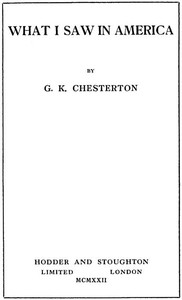
What I Saw in America — A Reader’s Guide
(0 User reviews)
975
Project Gutenberg
2008
Not confirmed
United States -- Description and travel; Chesterton, G. K. (Gilbert Keith), 1874-1936 -- Travel -- United States; National characteristics, American; United States -- Social life and customs -- 1918-1945; United States -- Civilization -- 1918-1945
Readers of public-domain and historical texts
Project Gutenberg digital edition
en
Edition facts
Words
94,695
Reading time
412 min
Text sections
9
This digital edition of What I Saw in America — A Reader’s Guide is described by source-level measurements including 94,695 words, 6 hr 52 min estimated reading time, and 9 detected text sections.
The text analysis averages about 24.1 words per sentence, while the detected sections provide another way to judge how the source is divided.
Project Gutenberg metadata also associates the work with “United States -- Description and travel,” connecting these edition facts with the source record’s subject description.
Source:
Project Gutenberg record #27250
Chesterton's travelogue uses paradox and wit to examine American culture, structure, and politics, with recurring contrasts between abstraction and reality, and a distinctive movement from hotel meditations to broader social critique.
Read the complete public-domain text at its original source.
Read on Project GutenbergChesterton opens his account of America not with a landing or a first glimpse, but with a meditation on the narrowing effect of travel itself. He argues that staying home allows a deeper, abstract bond with humanity, while actual travel risks reducing people to their unfamiliar customs. This paradoxical stance sets the tone for a book that constantly questions first impressions and resists easy conclusions.
The structure of What I Saw in America mirrors this tension: it moves from confined spaces—a New York hotel room, a Broadway street—to broader landscapes and national debates. Chesterton uses these shifts to test his own preconceptions, often finding that the America he encounters defies the stereotypes he brought with him.
From Hotel Room to Nation
The book’s early chapters are anchored in specific, enclosed locations. “A Meditation in a New York Hotel” and “A Meditation in Broadway” establish a pattern: Chesterton begins with a physical setting, then expands into abstract reflection. The hotel room becomes a vantage point for contemplating the city’s scale and energy, while Broadway serves as a stage for observing American crowds and their restless motion.
This movement from the particular to the general recurs throughout. Chesterton rarely describes a scene without immediately drawing a larger inference about American character or institutions. Yet he also undercuts his own generalizations, admitting that travel “narrows the mind” and that the tourist’s amusement can become a form of condescension. The result is a travelogue that is as much about the limits of observation as about what is observed.
Recurring Images of Scale and Speed
Chesterton repeatedly returns to images of size, speed, and mechanical power. New York’s skyscrapers, the “towering” buildings, and the “restless” crowds suggest a civilization driven by ambition and haste. He contrasts this with the slower, more rooted rhythms of English life, but avoids simple praise or condemnation.
The image of the “boomerang” appears in his discussion of Prohibition, where he argues that wartime justifications for banning alcohol would logically require war to be eternal. Such metaphors—sharp, unexpected, and often humorous—are a hallmark of Chesterton’s style. They serve to crystallize complex arguments into memorable pictures, while also revealing the author’s own position as an outsider trying to make sense of a foreign culture.
The Structure of Argument by Contrast
Chesterton organizes his chapters around a series of contrasts: America versus England, the city versus the countryside, the businessman versus the politician, Prohibition versus freedom. These oppositions are not merely descriptive; they drive his arguments forward. In “The American Business Man,” he sets the efficiency of commerce against the inefficiency of democracy, only to question whether either ideal truly describes American life.
This dialectical structure allows Chesterton to explore multiple perspectives without committing to a single thesis. He often presents a common American view, then undermines it with a paradox or a counterexample. The effect is a book that feels conversational and exploratory, rather than dogmatic. Readers are invited to follow the twists of his reasoning, even when the conclusions remain tentative.
Movement Between Public and Private
The book shifts between public spectacle and private reflection. Chapters like “Irish and Other Interviewers” and “Fads and Public Opinion” examine how Americans present themselves to the world, while “A Meditation in a New York Hotel” offers a more introspective pause. Chesterton is acutely aware of the performative aspects of travel: the tourist is always on stage, and the natives are always performing their own identity.
This awareness leads him to question the authenticity of what he sees. He notes that Americans are “extraordinary” precisely because they are so willing to be interviewed, to explain themselves, to become characters in their own story. Yet he also finds moments of genuine connection, particularly with ordinary people and with the landscape of the American countryside. The tension between performance and reality gives the book its restless energy.
Chesterton’s America is a place of contradictions, and he does not pretend to resolve them. Readers will find not a systematic analysis but a series of sharp, often witty observations that reward careful attention to his language and structure. The book is best approached as a conversation with a brilliant, opinionated companion—one who knows that travel narrows the mind, but who travels anyway, hoping to be surprised.
I keep returning to Chesterton’s hotel-room meditations—how a nation reveals itself in the smallest habits of its architecture. There’s a similar pilgrim’s patience in Wanderings of a pilgrim in search of the picturesque, Volume 2 (of 2) — A Closer Reading, where travel becomes less about sights than about slow inward surprise. Both books feel like quiet friends, content to walk awhile without insisting on the destination.
There are no reviews for this eBook.
There are no comments for this eBook.
Reader reflection
What was your reading experience?
Capture what you thought, learned, and would like to remember.
Your progress
0
/
10
2
Did this book hold your interest?
3
How likely are you to recommend this book?
4
What was the reading difficulty like?
5
Did the book offer a fresh perspective?
6
What was its emotional impact?
7
Would this book work well in a reading group?
8
Could you see yourself revisiting this book?
9
What is the main idea you are taking away?
10