1

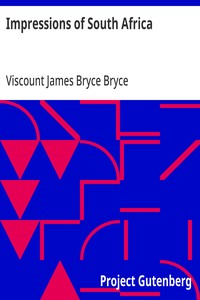
Impressions of South Africa — A Reader’s Guide
(0 User reviews)
1261
Project Gutenberg
2007
Not confirmed
South Africa -- Description and travel; South African War, 1899-1902; South Africa -- History -- 1836-1909; Black people -- South Africa; South Africa -- Politics and government -- 1836-1909; Transvaal (South Africa); Free State (South Africa)
Readers of public-domain and historical texts
Project Gutenberg digital edition
en
Edition facts
Words
176,745
Reading time
769 min
Text sections
18
The catalog record for Impressions of South Africa — A Reader’s Guide provides practical reading context through 176,745 words, 12 hr 49 min estimated reading time, and 18 detected text sections.
The text analysis averages about 30.8 words per sentence, while the detected sections provide another way to judge how the source is divided.
Project Gutenberg metadata also associates the work with “South Africa -- Description and travel,” connecting these edition facts with the source record’s subject description.
Source:
Project Gutenberg record #22323
Bryce's 1897 travelogue combines acute observations of South African landscapes, geology, and colonial settlement with a prescient warning about racial conflict, revised on the eve of the Anglo-Boer War.
Read the complete public-domain text at its original source.
Read on Project GutenbergJames Bryce, a British historian and statesman, published Impressions of South Africa in 1897 after a journey through the region. The book blends travel narrative with political analysis, and this third edition (1899) includes a new prefatory chapter written as war with the South African Republic and Orange Free State was breaking out. Bryce notes that he has left his earlier views unchanged, wanting it understood they were formed before the recent controversies. The result is a work that captures both the late-Victorian traveler's eye for landscape and the mounting tensions that would soon erupt.
Landscape as Geological Record
Bryce's descriptive passages are precise and scientifically informed. He notes the "fantastic kopjes of granite" near Marandella's, their tops "cleft and riven by deep fissures," and the "huge detached blocks" strewn about. He explicitly compares these to the blocs perchés of Western Europe, but argues they are not glacial in origin—instead, they result from "alternate heat of the day and cold of the night" splitting the rock. This attention to process, rather than mere scenery, is characteristic. He also remarks on the absence of ancient moraines in Basutoland, leaving the question of a South African glacial period open. The landscape is not static; it is shaped by forces he observes and interprets.
The Colonial Enterprise in Microcosm
At Lawrencedale, Bryce describes two young Englishmen who have brought some forty acres into cultivation, raising vegetables for the market at Fort Salisbury. He notes the risks: locusts that "may in a few hours strip the ground clean." The settlers hope to scare off swarms, and if successful, "their profits would be large and certain." This vignette captures the precarious optimism of colonial agriculture. Bryce also observes that a man who understands business may profit more from supplying the town than from prospecting for gold. The passage is understated but reveals the economic realities behind the imperial adventure—hard work, speculation, and vulnerability to nature.
A Preface Written on the Eve of War
The prefatory chapter of this edition is dated October 1899, as war commences. Bryce recalls that in 1897 he had hoped for a peaceful solution to the "race conflict," advocating "tact, coolness and patience, above all, patience." Now he acknowledges that a "new chapter is opened" which "completely alters the situation." He declines to continue the historical sketch to the outbreak, saying the materials are "still scanty and imperfect" for judging intentions. This restraint is notable: Bryce does not claim hindsight or assign blame, but lets the original text stand as a document of a moment when peace still seemed possible.
The Texture of Travel
Bryce's journey is marked by small, telling details: the grass "fresh and green" after showers, trees with "exquisite tints of red," and glimpses of "dim blue mountains" through gaps. He contrasts the "monotonous thorny acacias" of the west with the varied foliage of the east, where the wood disposes itself "with wonderful grace" into park-like scenery. He even pauses to question why nature should be thought to imitate art. These observations ground the political analysis in a lived experience of place, making the book as much a record of sensory impressions as of imperial politics.
Bryce's Impressions rewards readers who attend to both its descriptive precision and its historical moment. The 1899 preface frames the original travelogue as a document of a lost hope, while the body of the work remains a detailed account of landscapes, settlements, and the natural forces that shape them. Readers interested in the intersection of travel writing and colonial history will find here a nuanced, observant voice that resists easy categorization.
Flipping back through Bryce’s warnings about South Africa’s buried tensions, I felt that same strange quiet—the weight of places where history hasn’t finished speaking. It reminded me, unbidden, of another journey’s solitude. There is a particular ache in such accounts, a lonely watching. I found it again in The Captive in Patagonia — Reading Notes, where the landscape itself seems to hold its breath. Both books feel less like reports, more like held pauses.
There are no reviews for this eBook.
There are no comments for this eBook.
Reader reflection
Record your reading impressions
A brief reflection can help important ideas stay with you longer.
Your progress
0
/
10
2
Was reading this book enjoyable?
3
Is this a title you would suggest to others?
4
How easy was the book to follow?
5
Did the story or argument move comfortably?
6
Did it raise ideas you would like to talk about?
7
Was the book easy to understand?
8
How well did it match your expectations?
9
What did this book teach you most?
10