1

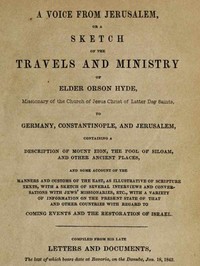
A Voice from Jerusalem Or, A Sketch of the Travels and Ministry of Elder Orson Hyde — Key Ideas to Explore
(0 User reviews)
1538
Project Gutenberg
2014
Not confirmed
Middle East -- Description and travel; Jerusalem -- Description and travel; Church of Jesus Christ of Latter-day Saints -- Missions
Readers of public-domain and historical texts
Project Gutenberg digital edition
en
Edition facts
Words
18,219
Reading time
80 min
Text sections
2
A Voice from Jerusalem Or, A Sketch of the Travels and Ministry of Elder Orson Hyde — Key Ideas to Explore can be approached with a clearer sense of reading commitment from its source measurements: 18,219 words, 1 hr 20 min estimated reading time, and 2 detected text sections.
The text analysis averages about 30.3 words per sentence, while the detected sections provide another way to judge how the source is divided.
Project Gutenberg metadata also associates the work with “Middle East -- Description and travel,” connecting these edition facts with the source record’s subject description.
Source:
Project Gutenberg record #46208
Orson Hyde's 1842 travel narrative combines prophetic mission with detailed observations of Jerusalem, Constantinople, and European cities, blending scriptural commentary, personal letters, and descriptions of Jewish customs.
Read the complete public-domain text at its original source.
Read on Project GutenbergOrson Hyde's A Voice from Jerusalem (1842) is a composite work: part travel diary, part theological argument, and part personal correspondence. The text opens with Hyde recounting a vision in which London, Amsterdam, Constantinople, and Jerusalem appeared to him in succession, and the Spirit directed him to declare a message to Judah. This prophetic framing sets the tone for a narrative that moves between scriptural exegesis and on-the-ground reporting. The book is compiled from letters and documents, the latest dated January 1842 from Bavaria, and was published in Liverpool by P. P. Pratt. Hyde's voice shifts noticeably between formal exhortation and intimate worry—particularly in letters where he frets over his family and confesses his anxiety after nearly a year without news.
Prophetic Calling and Narrative Frame
The mission is introduced through a retrospective account of a prophecy made by Joseph Smith eight years earlier, predicting Hyde would go to Jerusalem as a watchman. Hyde then describes a vision in March 1840 that confirmed the call. This double framing—prophecy and vision—establishes the work's authority and purpose. The narrative voice in these passages is declarative and assured, using phrases like “the vision of the Lord, like clouds of light, burst upon my view.” Yet the same author later admits to being “a poor captive exile” and writes of his “bad feelings” from long separation. The contrast between prophetic certainty and personal vulnerability is a recurring structural feature.
Observations of Place and Custom
Hyde's descriptions of Jerusalem and other locations are interwoven with scriptural references. He mentions Mount Zion, the Pool of Siloam, and other ancient places, and notes the manners and customs of the East as illustrative of Bible texts. His observations are precise: he records the speech of American missionaries at Jerusalem, noting that Mr. Whiting's family “all speak fluently the English and Arabic.” He also expresses strong distaste for “the star and crescent, the turban and the covered face,” calling them “an abomination in my sight.” These reactions reveal a traveler whose religious convictions shape his perception of foreign cultures, and who is unafraid to record his visceral responses.
Epistolary Intimacy and Shifting Pace
The book's letter format allows for abrupt changes in tone and tempo. In one letter, Hyde writes a lengthy theological account of his mission; in the next, he confesses to being “childish” from quarantine and pleads for news of his wife. The pacing slows during descriptions of quarantine—fifty-six days on shipboard, twenty-eight in the harbor of Trieste—and quickens when he anticipates release: “To-morrow, if the Lord will, the jubilant song… will greet the ears of a poor captive exile.” These personal passages, with their raw emotion and concrete detail, give the work a documentary immediacy that balances its prophetic claims.
Readers should approach A Voice from Jerusalem as a layered document: a missionary report, a travelogue, and a collection of private letters. The shifts between public declaration and private anxiety are not flaws but features of the genre. Pay attention to the dates and locations—Hyde's movements from Alexandria to Trieste to Bavaria trace a geography of both mission and exile. The book rewards those who read for voice as much as for argument.
I kept thinking about how Orson Hyde’s journey felt less like travel and more like listening—to stones, to scripture, to strangers’ prayers. That same quiet attentiveness lives in Gleanings in Buddha-Fields: Studies of Hand and Soul in the Far East — Themes and Context, where the author’s hand touches unfamiliar ground and somehow finds the familiar ache of longing. It stayed with me, like a voice from somewhere I’ve never been but somehow recognize.
There are no reviews for this eBook.
There are no comments for this eBook.
Reader reflection
Your personal reading reflection
Build a private reading journal entry for this title.
Your progress
0
/
10
2
How did the book work for you overall?
3
Is this a title you would suggest to others?
4
How demanding did the text feel?
5
How useful did the reading feel?
6
How personally connected did you feel to the book?
7
Did any part of the book stay with you emotionally?
8
What did you think about the pace?
9
Which lesson or insight stayed with you?
10