1

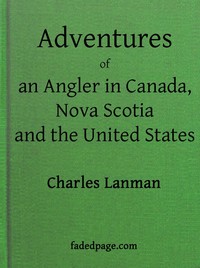
Adventures of an Angler in Canada, Nova Scotia and the United States — Inside the Classic
(0 User reviews)
934
Project Gutenberg
2017
Not confirmed
Canada -- Description and travel; New York (State) -- Description and travel; Maine -- Description and travel; New England -- Description and travel; Adirondack Mountains (N.Y.); Fishing -- North America; Québec (Province) -- Description and travel; Saguenay River Valley (Québec)
Readers of public-domain and historical texts
Project Gutenberg digital edition
en
Edition facts
Words
71,731
Reading time
312 min
Text sections
8
Adventures of an Angler in Canada, Nova Scotia and the United States — Inside the Classic can be approached with a clearer sense of reading commitment from its source measurements: 71,731 words, 5 hr 12 min estimated reading time, and 8 detected text sections.
The text analysis averages about 27.2 words per sentence, while the detected sections provide another way to judge how the source is divided.
Project Gutenberg metadata also associates the work with “Canada -- Description and travel,” connecting these edition facts with the source record’s subject description.
Source:
Project Gutenberg record #53939
Charles Lanman's 1848 travelogue follows an angler's summer journey through the Hudson, St. Lawrence, and St. John river valleys, blending precise descriptions of landscapes, fishing techniques, and local encounters with a keen eye for the region's natural and human geography.
Read the complete public-domain text at its original source.
Read on Project GutenbergCharles Lanman's Adventures of an Angler in Canada, Nova Scotia and the United States opens with a piscatorial dream that launches a summer pilgrimage through the valleys of the Hudson, St. Lawrence, and St. John rivers. The narrative moves from the Catskill Mountains to the Saguenay River, weaving together detailed observations of landscape, weather, and the craft of angling. Lanman's prose is anchored in specific, tangible details—the grain of sandstone on Goose Island, the precise height of hills along the St. Lawrence, the arrangement of a camp supper of fish, pork, and onions. These concrete observations ground the reader in the physical world the author traverses.
Movement Between Scenes
The book's structure is built around a series of discrete journeys, each chapter marking a new location or mode of travel. Lanman frequently signals transitions with precise temporal and spatial markers: “We hoisted sail at twelve o’clock, and were favoured by a stiff westerly breeze.” This attention to the mechanics of movement—sailing, stagecoach, walking—creates a rhythm of departure, passage, and arrival. The narrative rarely lingers; instead, it propels the reader forward with the same momentum as the author's own travels. The chapters are short, often focused on a single landscape or event, such as a corn-planting bee or a night on Lake Horicon. This episodic structure mirrors the angler's practice of moving from one fishing ground to the next, each offering a new set of conditions and encounters.
Recurring Images: Water and Stone
Two elements recur throughout the excerpts: water in its many forms—rivers, lakes, falls, and the sea—and stone, whether in the form of mountains, bluffs, or sandstone reefs. Lanman describes the Fall of Montmorency “pouring the waters of a noble tributary immediately into the St. Lawrence,” and later notes the “rich Indian red” and “deep blue” sandstone of Goose Island. These images are not merely decorative; they anchor the narrative in the physical geography of the regions he visits. The interplay of water and stone also shapes the angler's experience: the rivers determine where fish are found, while the rocky shores and mountains define the vistas. Lanman's eye for geological detail—the two distinct species of sandstone, the elevation of hills—suggests a scientific curiosity that complements his recreational pursuit.
The Angler's Perspective
Lanman writes from the point of view of an enthusiast, but his observations are those of a naturalist and traveler rather than a sportsman boasting of catches. He notes the “luxuriant” vegetation of Goose Island and the “common hard woods of the north” with the same care he might give to describing a trout stream. The act of fishing itself is often mentioned in passing, as when he records that his companions cooked “a supper of fish, pork, and onions” while he took “sundry observations.” The angler's passion serves as the pretext for the journey, but the narrative's focus is on the places and people encountered along the way. This perspective allows the reader to experience the landscape through the eyes of someone who is both a participant and an observer, attuned to the details that make each location distinct.
Encounters with Locals
Lanman populates his narrative with brief but vivid portraits of the people he meets: the “warm-hearted and intelligent Frenchman” skipper Belland, the “simple” inhabitants of the parish of St. Laurent, and the Adirondac hunter John Cheney. These encounters are often economical, sketched in a few lines, yet they convey a sense of the social fabric of the regions he visits. The skipper's crew consists of “one boy”; the villagers are “virtuous and ignorant of the world at large.” Lanman does not idealize or condemn; he reports with a mixture of curiosity and detachment. These human details ground the travelogue in lived experience, reminding the reader that the landscapes he describes are also homes and workplaces for the people who inhabit them.
Readers approaching this work should attend to the way Lanman balances the specific and the general: a precise description of a sandstone reef sits alongside a broader reflection on the character of a village. The book rewards those who read for its incidental details—the color of a rock, the direction of a breeze, the name of a boat—as much as for its overarching narrative of travel. It is a record of a summer's pilgrimage, but also a document of a particular moment in the natural and human history of northeastern North America.
I finished the Lanman one a while back, and some afternoons still feel quiet the way his river trips did—just that slow attention to light and water. It lingered like a low hum. It made me curious about all travel writing from that era, then I found Greater Britain: A Record of Travel in English-Speaking Countries During 1866-7 — Themes and Context, which holds a similar wandering patience. A certain peace there.
There are no reviews for this eBook.
There are no comments for this eBook.
Reader reflection
How did this book work for you?
Your answers remain private and are stored only in this browser.
Your progress
0
/
10
2
How much did you enjoy the reading experience?
3
Would you pass this book on to a friend?
4
Did the language feel accessible?
5
Would this book work well in a reading group?
6
What was its emotional impact?
7
What was the strongest part of the book?
8
How would you rate its originality?
9
In one sentence, what did you learn?
10