1

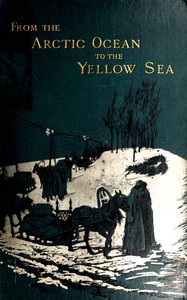
From the Arctic Ocean to the Yellow Sea — Text and Context
(0 User reviews)
1032
Project Gutenberg
2024
Not confirmed
Voyages and travels; China -- Description and travel; Siberia (Russia) -- Description and travel; Mongolia -- Description and travel
Readers of public-domain and historical texts
Project Gutenberg digital edition
en
Edition facts
Words
93,045
Reading time
405 min
Text sections
34
This digital edition of From the Arctic Ocean to the Yellow Sea — Text and Context is described by source-level measurements including 93,045 words, 6 hr 45 min estimated reading time, and 34 detected text sections.
The text analysis averages about 30.9 words per sentence, while the detected sections provide another way to judge how the source is divided.
Project Gutenberg metadata also associates the work with “Voyages and travels,” connecting these edition facts with the source record’s subject description.
Source:
Project Gutenberg record #73828
Julius M. Price's 1890-1891 journey from Siberia to north China, recorded with 142 of his own illustrations. Observations of prison workshops, forged banknotes, and Siberian hospitality reveal a travelogue shaped by the author's dual role as special artist and writer.
Read the complete public-domain text at its original source.
Read on Project GutenbergJulius M. Price, special artist for the Illustrated London News, crossed Siberia, Mongolia, the Gobi Desert, and north China in 1890–1891. His narrative, originally serialized with his own sketches, blends travelogue with visual reportage. Price’s preface frames the journey as a response to Captain Wiggins’s 1887 Arctic voyage, which opened a sea route to the Yenisei River. Yet the excerpts reveal a writer more attentive to human detail than to commercial geography.
The Artist’s Eye in Prison Workshops
Price’s description of a Siberian prison atelier is one of the most vivid passages in the excerpts. He notes that convicts work cheerfully, without guards, and that their labor benefits the community. The scene is not sentimentalized: he observes tailors, hatters, smiths, and even two artists—one painting portraits from photographs, the other copying a celebrated picture in solitary confinement. The portrait painter speaks German fluently and is not reticent; the other, moody, declares he is now “a number, no longer a man.” Price’s eye for incongruity is sharp: the easel and canvas look out of place among cigarette-makers, and the large framed oil-painting seems strangely incongruous in a cell lit only by a small grated window. He also notes the economic exploitation—local tradesmen get work done at less than a third of the cost of town labor. A double brass seal engraved for less than 2s. 6d. and a stick engraved with his initials illustrate the cheapness of prison labor. The passage ends with a facsimile of a forged five-rouble banknote, the work of a prison artist, whose elaborate pen-and-ink work led to a long imprisonment.
Gratitude and the Texture of Siberian Hospitality
Before leaving Siberia, Price records his gratitude for the assistance he received, noting that from the highest officials to the humblest employee, the courtesy was so great that in all his varied experiences of travel he remembers nothing to equal it. He names several gentlemen to whom he owes a special debt: Mr. E. Wostrotine in Yeniseisk; General Telakoffsky, Dr. Peacock, and others in Krasnoiarsk; General Grimiken and M. Soukatchoff in Irkutsk; and M. Feodroff and M. Shollingen in Ourga. This list is not mere formality—it anchors the narrative in a network of real people whose kindnesses shaped his journey. Price’s tone is warm but not effusive; he trusts that if the same spirit prevails across the empire, his wanderings may lead him into Greater Russia itself. The passage reveals a traveler who values human connection over exotic spectacle.
The Narrative’s Dual Origin: Serial Sketches and Text
Price acknowledges that his book is based on sketches and drawings made for the Illustrated London News, many already published there, and the accompanying text that formed the basis of this work. This dual origin shapes the narrative’s structure: each chapter likely corresponds to a set of images, and the prose often describes what the reader cannot see. The 142 illustrations are not decorative but integral to the project. Price’s role as “Special Artist” means he is both observer and recorder, and his descriptions often have a compositional quality—he notes the light entering a cell, the arrangement of shelves, the position of an easel. The reader is invited to imagine the sketches that accompany the text, though the digital edition may not include them. This interdependence of word and image is a defining feature of the work.
Diction and the Traveler’s Voice
Price’s prose is direct and unpretentious. He uses phrases like “quite refreshing” and “much out of place” to convey his reactions without hyperbole. His descriptions are precise: the portrait painter works in the same room as cigarette-makers; the solitary artist has fitted up his cell “quite as a studio.” He notes that the forged banknote represents only five roubles (10s.), yet for this small amount a long term of imprisonment follows. Price’s voice is that of a seasoned traveler who is neither easily impressed nor jaded. He records details that others might miss—the absence of guards, the percentage of earnings going to the government, the fact that the prisoners were convicted but not yet sentenced. His tone is observational, not judgmental, allowing the reader to draw conclusions about the penal system and the resilience of the men he encounters.
Price’s narrative rewards readers who attend to small details: the cost of a brass seal, the mood of a prisoner, the list of names in a preface. His journey from the Arctic Ocean to the Yellow Sea is as much an interior one—through the customs and characters of the places he passes—as a geographic traverse. The excerpts offer a glimpse of a travelogue that values the specific over the sweeping, and the human over the scenic.
There’s a particular ache in old travelogues—that sense of a world captured just as it’s about to shift. Price’s sketches from that frozen railway feel like holding a lantern to a departing train. I found the same quiet haunting in Travels in France during the years 1814-15 Comprising a residence at Paris, during the stay of the allied armies, and at Aix, at the period of the landing of Bonaparte, in — A Closer Reading Travels in France during the years 1814-15 Comprising a residence at Paris, during the stay of the allied armies, and at Aix, at the period of the landing of Bonaparte, in — A Closer Reading, where every doorway seems to hold a ghost of what’s next.
There are no reviews for this eBook.
There are no comments for this eBook.
Reader reflection
How did this book work for you?
Your answers remain private and are stored only in this browser.
Your progress
0
/
10
2
Did this book hold your interest?
3
How likely are you to recommend this book?
4
What was the reading difficulty like?
5
How original did the book feel?
6
Did it raise ideas you would like to talk about?
7
Did this book create an emotional response?
8
Did the story or argument move comfortably?
9
Which lesson or insight stayed with you?
10