1

From the Indus to the Tigris — Text and Context
(0 User reviews)
273
Project Gutenberg
2024
Not confirmed
Iran -- Description and travel; Afghanistan -- Description and travel; Balochistan (Pakistan) -- Description and travel; Bellew, H. W. (Henry Walter), 1834-1892; Brahui language; Khurasan (Iran) -- Description and travel
Readers of public-domain and historical texts
Project Gutenberg digital edition
en
Edition facts
Words
159,534
Reading time
694 min
Text sections
25
The catalog record for From the Indus to the Tigris — Text and Context provides practical reading context through 159,534 words, 11 hr 34 min estimated reading time, and 25 detected text sections.
The text analysis averages about 24.4 words per sentence, while the detected sections provide another way to judge how the source is divided.
Project Gutenberg metadata also associates the work with “Iran -- Description and travel,” connecting these edition facts with the source record’s subject description.
Source:
Project Gutenberg record #74127
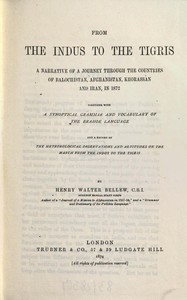
Henry Walter Bellew's 1874 narrative of a journey from the Indus to the Tigris combines travelogue, political analysis, and linguistic study, with a preface framing Central Asian geopolitics and a detailed account of Sistan's tribal conflicts.
Read the complete public-domain text at its original source.
Read on Project GutenbergHenry Walter Bellew's From the Indus to the Tigris opens with a preface that immediately situates the journey within the geopolitical anxieties of the 1870s, warning that Russian advances in Turkistan may lead to 'paramount ascendancy over all the region draining to the valley of the Oxus.' The narrative voice is that of a surgeon in the Bengal Staff Corps, blending clinical observation with strategic concern. Bellew's prose shifts between measured political analysis and granular ethnographic detail, as when he recounts the rise and fall of local chiefs in Sistan with a catalog of names, alliances, and betrayals. The work also includes a synoptical grammar of the Brahoe language and meteorological records, reflecting the author's dual role as medical officer and amateur linguist.
A Preface of Strategic Alarm
The preface sets a tone of urgency, framing the journey as a response to 'the steady progress of Russian conquest in Turkistan.' Bellew writes with a politician's eye, noting that the region 'now claims the attention of the several Governments concerned.' His language is deliberate and cautionary, warning against focusing on minor threats while ignoring larger ones: 'let us be careful lest, while straining at the gnat of Yárkand, we swallow the camel of Herat.' This proverb-like phrasing is characteristic of Bellew's tendency to embed aphorisms within geopolitical argument. The preface establishes the book as both travel narrative and policy brief, a dual purpose that shapes the pacing throughout.
Narrative Voice and the Weight of Detail
Bellew's narrative voice is that of a seasoned colonial administrator: precise, detached, yet capable of sharp judgment. In the Sistan section, he recounts the deposition of Táj Muhammad with a series of subordinate clauses that mirror the complexity of local politics: 'a plot, headed by Táj Muhammad, the brother of the deposed Lutf Ali, was formed to get rid of him and his myrmidons.' The prose is dense with proper nouns—Sárbandi chiefs, Nahroe Baloch, Sartip Sálih Muhammad—and the reader must navigate a thicket of names and titles. This density reflects Bellew's method: he does not simplify for the reader but instead reproduces the intricate web of alliances and enmities he observed. The pace slows considerably in these passages, as each sentence carries multiple actors and motives.
Shifts in Pace: From Political Intrigue to Linguistic Catalog
The book's structure creates abrupt changes in pace. The preface and political sections move with the urgency of a dispatch, while later portions—such as the synoptical grammar and vocabulary of the Brahoe language—adopt a taxonomic stillness. Bellew includes 'a record of the meteorological observations and altitudes on the march from the Indus to the Tigris,' a shift from narrative to data. This juxtaposition of genres within a single volume mirrors the author's own professional duality: he is both a participant in imperial politics and a collector of scientific facts. The reader moves from the dramatic fall of Ali Khán—'surprised and slain by his nephew'—to the dry listing of barometric readings, a transition that underscores the book's hybrid nature as travelogue, political report, and reference work.
Readers should approach From the Indus to the Tigris as a document of its time, one that reveals how a British officer processed the landscapes and politics of Central Asia through multiple lenses. The book rewards those who attend to its shifts in register—from the strategic preface to the dense political chronicle to the linguistic appendix. Bellew's voice, at once clinical and invested, offers a window into the intellectual habits of a colonial observer navigating a region on the cusp of transformation.
I keep thinking about Bellew’s old journey, how he carried so much—maps, grammar notes, a sense of borders shifting under his feet—and yet the quietest moments stayed with me. That same ache for what’s unrecorded follows through A Journal of the First Voyage of Vasco da Gama 1497-1499 — Themes and Context, as if both travelers knew the sea or desert would forget them soon enough. Strange how that feeling lingers.
There are no reviews for this eBook.
There are no comments for this eBook.
Reader reflection
What did you think of this book?
Answer a few questions and save a private reflection on this device.
Your progress
0
/
10
2
How much did you enjoy the reading experience?
3
Is this a title you would suggest to others?
4
How demanding did the text feel?
5
Did this book create an emotional response?
6
Would you start a conversation about this book?
7
How original did the book feel?
8
Would you read this book again?
9
What did this book teach you most?
10