1

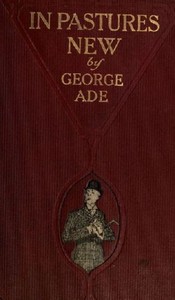
In Pastures New — Key Ideas to Explore
(0 User reviews)
868
Project Gutenberg
2011
Not confirmed
Voyages and travels -- Humor; London (England) -- Description and travel -- Humor; Egypt -- Description and travel -- Humor
Readers of public-domain and historical texts
Project Gutenberg digital edition
en
Edition facts
Words
56,925
Reading time
248 min
Text sections
7
This digital edition of In Pastures New — Key Ideas to Explore is described by source-level measurements including 56,925 words, 4 hr 8 min estimated reading time, and 7 detected text sections.
The text analysis averages about 19.6 words per sentence, while the detected sections provide another way to judge how the source is divided.
Project Gutenberg metadata also associates the work with “Voyages and travels -- Humor,” connecting these edition facts with the source record’s subject description.
Source:
Project Gutenberg record #38364
George Ade's 1906 travel letters lampoon American tourists abroad through the recurring character Mr. Peasley, who misreads gestures and haggles over mummies. The humor arises from the gap between Midwestern self-importance and foreign realities, with precise observations of language, bargaining, and cultural performance.
Read the complete public-domain text at its original source.
Read on Project GutenbergGeorge Ade's In Pastures New collects newspaper letters from his travels in London, Paris, Naples, and Cairo, first syndicated in 1906. The book's comic engine is the mismatch between American expectations and foreign actualities, embodied by the recurring figure Mr. Peasley. In one episode, Peasley watches two Neapolitans gesticulating and confidently interprets their conversation as describing a torpedo boat—only to learn they were discussing an undercooked egg. Ade uses such moments to examine how travelers impose narratives onto what they cannot understand.
The Mr. Peasley Lens
Mr. Peasley is not a fully drawn character but a narrative device: the American who mistakes surface for substance. In Naples, he reads a stranger's arm-waving as a battle sequence, when the actual topic is breakfast. The head waiter translates: “He is describing the egg.” Peasley's bafflement—“Why does he hop up and down, side step and feint?”—highlights the gap between kinetic Italian conversation and his own literal-mindedness. Ade does not mock the Italians; he mocks the tourist's need to turn every foreign gesture into a dramatic plot. Peasley reappears in Cairo, where his “vivid impressions” of the Orient are filtered through the same comic misprision. The reader is invited to laugh at Peasley, but also to recognize a common impulse: to domesticate the unfamiliar by recasting it as a familiar genre—torpedo boat, melodrama, or bargain.
Haggling as Performance
Ade devotes considerable attention to the economics of tourism, especially in Egypt. He reports that mummies are sold like commodities: a Rameses or Ptolemy costs $1000; a prince or “trust magnate” brings $150; a humourist can be had for $18, and one specimen—probably a tourist—for $7.50. The joke depends on a deadpan catalogue that treats ancient titles as modern professions. Ade also notes that the Arab is “economical and abstemious” in food and clothing but “reckless” with language, using “large bales of conversation” to move a trunk a few feet. The implication is that haggling is a form of theater, not mere transaction. The American traveler, accustomed to fixed prices and efficient service, is disoriented by a world where talk is the primary currency. Ade does not moralize; he simply observes that in the Levant, “talk is one of the few things of which there is a superabundance.”
The American as Provincial Expert
The opening chapter establishes a pattern: the Midwestern captain of industry, “unquestionably IT” at home, becomes a “bewildered maverick” abroad. Ade describes the man's daily routine—the deferential trolley conductor, the hopping head waiter—to show how status is local. Once in London, the same man cannot read a menu or hail a cab. Ade's humor is sociological: he treats the American's confidence as a provincial trait that collapses on contact with foreign codes. The book does not argue for cosmopolitanism; it simply documents the comedy of misplaced certainty. The letters were written for a syndicate of newspapers, so Ade assumes an audience that shares the traveler's assumptions. By making the reader complicit in Peasley's misreadings, he turns the travelogue into a mirror held up to the American reader's own expectations.
Ade's letters resist the temptation to explain foreign cultures; instead, they dwell on the moments when explanation fails. Readers will find the most value not in descriptions of landmarks but in the gaps between what the traveler expects and what he finds. The book rewards attention to its framing devices—the newspaper origins, the recurring Peasley, the deadpan lists—rather than to any factual account of London or Cairo. Approach it as a comedy of misperception, not a guidebook.
That rainy afternoon, I drifted through George Ade’s In Pastures New—Mr. Peasley’s blundering abroad felt strangely warm, his missteps less folly than a clumsy reaching for dignity. The rain kept falling, and my mind wandered westward, to another voice wrestling with unfamiliar ground, older and quieter. That’s how I found Wau-Bun: The "Early Day" of the North-West — Key Ideas to Explore, a book that hummed with the same tender awkwardness, though no one was haggling over mummies there.
There are no reviews for this eBook.
There are no comments for this eBook.
Reader reflection
Before you leave, reflect on the book
Use these questions to collect your thoughts before moving on.
Your progress
0
/
10
2
How did the book work for you overall?
3
Would you pass this book on to a friend?
4
Did the language feel accessible?
5
What did you appreciate most?
6
How much did the book move you?
7
Is this a title worth rereading?
8
How original did the book feel?
9
What is the main idea you are taking away?
10