1

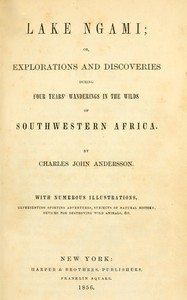
Lake Ngami — A Closer Reading
(0 User reviews)
341
Project Gutenberg
2024
Not confirmed
South Africa -- Description and travel; Hunting -- South Africa; Natural history -- South Africa; Andersson, Charles John, 1827-1867; Ngami, Lake (Botswana); South Africa -- Social life and customs -- 19th century
Readers of public-domain and historical texts
Project Gutenberg digital edition
en
Edition facts
Words
173,007
Reading time
753 min
Text sections
49
This digital edition of Lake Ngami — A Closer Reading is described by source-level measurements including 173,007 words, 12 hr 33 min estimated reading time, and 49 detected text sections.
The text analysis averages about 22.0 words per sentence, while the detected sections provide another way to judge how the source is divided.
Project Gutenberg metadata also associates the work with “South Africa -- Description and travel,” connecting these edition facts with the source record’s subject description.
Source:
Project Gutenberg record #73758
Andersson's narrative of two expeditions in southwestern Africa (1850-1854) reveals his authorial choices in diction, dialogue, and description, from precise natural history observations to diplomatic negotiations with Namaqua tribes.
Read the complete public-domain text at its original source.
Read on Project GutenbergCharles John Andersson opens Lake Ngami with a preface that immediately signals his authorial stance: he will begin his narrative from the start, not where his companion Francis Galton left off, to provide a connected account. This decision shapes the book's structure, as Andersson alternates between detailed natural history and tense diplomatic encounters. His descriptive style is evident in passages such as the account of locust larvae—'packed in layers several inches in thickness'—where he combines precise measurement with vivid simile, comparing the insects to 'clusters of rich fruit.' Such choices in diction ground the reader in the physical reality of the African landscape.
Diction and the Naturalist's Eye
Andersson's vocabulary reflects his dual role as explorer and naturalist. He uses scientific Latin names (e.g., gryllus devastator) alongside colloquial Boer terms like 'voet-gangers,' creating a layered lexicon. His descriptions of the locust swarm employ both exact quantification—'myriads were crushed'—and metaphorical language: 'a dark continuous cloud.' This blend of empirical detail and literary flourish is characteristic. When describing the Red Nation's stronghold, he notes the etymology of 'Kaikhous' (large ridges), showing an interest in indigenous nomenclature that extends beyond mere observation.
Dialogue and Diplomatic Voice
Andersson reports his own speech in direct or indirect discourse, revealing his rhetorical strategies. When addressing the Red Nation, he 'reproached them for their bad behavior' and explained 'the impolicy of such conduct,' using a formal, almost legalistic tone. His choice of words—'impolicy,' 'injurious to their own interest'—reflects an attempt to reason with the tribe in terms of trade and self-interest. The response is reported only through outcome: 'My efforts in bringing about a thorough good understanding were successful.' This selective reporting shapes the reader's perception of Andersson as a capable negotiator.
Description of People and Place
Andersson's descriptions of indigenous groups are terse and often comparative. He notes that the Red Nation 'look upon Jonker and his people ... not only with jealousy, but with something akin to contempt.' The phrase 'something akin to' introduces a careful qualification, typical of his cautious ethnographic observations. His description of the Kubakop River 'forcing its passage through a very remarkable range of mountains' uses personification to animate the landscape. Such choices in description—combining topographical precision with subtle judgment—characterize his narrative voice throughout the excerpts.
Structure and Selection of Detail
Andersson structures his account by alternating between broad geographical description and specific incidents. The passage on the locust larvae moves from general statement ('justly dreaded by the colonists') to specific anecdote (crossing rivers by drowning) to a quoted authority. This layered structure—general claim, concrete example, external corroboration—is a recurring pattern. His choice to include the etymology of tribal names ('Kaikhous' vs. 'Kharikhous') alongside the grim detail that prisoners were 'coolly shot down' shows a deliberate juxtaposition of cultural information and violent reality, avoiding simplistic characterization.
Andersson's authorial choices—his precise diction, diplomatic dialogue, and structured descriptions—create a narrative that is both informative and personal. Readers attentive to his vocabulary and selection of detail will find a work that reveals as much about the observer as about the observed. The book rewards those who read for the craft of exploration writing, not merely for adventure.
Reading Andersson’s careful negotiations with the Namaqua, I found myself missing that same unhurried patience in my own life lately. There is a particular quiet ache in watching someone try so hard to be understood across a vast, silent distance. That feeling returned, strangely, while flipping through Some Experiences of a New Guinea Resident Magistrate — Reading Companion, which lingers on a different sort of solitude, equally far from home.
There are no reviews for this eBook.
There are no comments for this eBook.
Reader reflection
What did you think of this book?
Answer a few questions and save a private reflection on this device.
Your progress
0
/
10
2
Did this book hold your interest?
3
Would you recommend this book to another reader?
4
How easy was the book to follow?
5
Could you follow the author’s main argument?
6
Which aspect of the book did you value most?
7
Did the book offer a fresh perspective?
8
Would this book work well in a reading group?
9
What changed or sharpened your thinking?
10