1

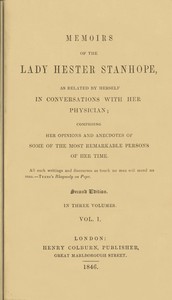
Memoirs of the Lady Hester Stanhope, as related by herself in conversations with her physician, vol. 1 (of 3) — Story, Setting & Ideas
(0 User reviews)
102
Project Gutenberg
2023
Not confirmed
Middle East -- Description and travel; Stanhope, Hester, Lady, 1776-1839; Eccentrics and eccentricities -- Great Britain -- Biography; Nobility -- Great Britain -- Biography; British -- Middle East -- History -- 19th century; Women travelers -- Middle East -- Biography
Readers of public-domain and historical texts
Project Gutenberg digital edition
en
Edition facts
Words
89,765
Reading time
391 min
Text sections
23
Memoirs of the Lady Hester Stanhope, as related by herself in conversations with her physician, vol. 1 (of 3) — Story, Setting & Ideas can be approached with a clearer sense of reading commitment from its source measurements: 89,765 words, 6 hr 31 min estimated reading time, and 23 detected text sections.
The text analysis averages about 24.8 words per sentence, while the detected sections provide another way to judge how the source is divided.
Project Gutenberg metadata also associates the work with “Middle East -- Description and travel,” connecting these edition facts with the source record’s subject description.
Source:
Project Gutenberg record #72165
This first volume of Lady Hester Stanhope's memoirs, as recorded by her physician, presents her conversations on politics, religion, and society, structured around her movements between England and the Levant, with recurring imagery of blood, prophecy, and rugged paths.
Read the complete public-domain text at its original source.
Read on Project GutenbergThe structure of this volume is shaped by the movement between two worlds: the drawing-rooms of British statesmen and the rugged paths of Mount Lebanon. Lady Hester Stanhope’s voice emerges not in a continuous narrative but in fragments of conversation, recorded by her physician, Charles Lewis Meryon. The text shifts abruptly from a preface defending against critics to chapters that mix political anecdote with apocalyptic prophecy. A recurring image is that of blood—Lady Hester speaks of wading “up to here” in blood during a coming revolution—and of paths, both literal and figurative, that are difficult to traverse.
Conversational Fragments and Editorial Framing
The volume’s primary material is not a diary or letter collection but reported speech, filtered through Meryon’s editorial hand. The preface reveals a defensive posture: Meryon responds to critics who misrepresented a letter from Lady Hester to the Duke of Wellington, insisting on the accuracy of his transcriptions. This framing alerts the reader that the conversations are contested documents. Within the chapters, Lady Hester’s remarks are often triggered by Meryon’s reading—for instance, when he reads Wraxall’s Memoirs, she interrupts to correct a point about Mr. Pitt’s refusal to marry. The effect is a layered text where the physician’s presence is felt as a silent interlocutor, and the reader must weigh the reliability of each reported utterance.
Prophecy, Mares, and the Coming Messiah
One of the most striking sequences in the volume concerns Lady Hester’s belief in an imminent Messiah. She explicitly denies the rumor that she kept two Arabian mares for the second advent, but her own words are ambiguous: she describes a world in revolution, kings driven from thrones, and herself as a refuge for “hundreds and thousands of distressed persons.” The image of wading in blood recurs, and she challenges the French writer Lamartine on a biblical passage. The structure here is associative rather than linear—she moves from the Messiah to Lord P**********’s suicide to the Saint-Simonians, linking disparate figures through a shared obsession with hidden knowledge. The mares, whether literal or symbolic, become a focal point for readers’ skepticism, yet the text refuses to settle the matter.
Movement Between Europe and the Levant
The volume’s geography mirrors its mental shifts. Chapter VI begins with Lady Hester in Mount Lebanon, then follows Meryon’s journey to Cyprus and Europe. The catalog of place names—Sayda, Larnaka, the marine villa—creates a sense of dislocation. Lady Hester’s defiance of consular authority and her confidence in “her own resources” contrast with the physician’s precarious position, as he describes “intimidation exercised over the Author’s household.” The rugged paths of Lebanon are both a physical setting and a metaphor for the difficulty of extracting a coherent story from a woman who speaks in oracles. The reader is left to navigate between the exoticized setting and the political gossip that ties her to London.
Recurring Details: Names, Secrets, and Silences
Throughout the excerpts, certain patterns emerge: the use of initials or dashes for names (Lord P**********, Mr. E***), the invocation of secret societies, and the mention of manuscripts that cannot be deciphered. Lady Hester claims that the Duc de Saint-Simon “knew a great deal” but that his followers could not understand his papers. This motif of hidden or illegible knowledge mirrors the reader’s own position—the memoirs promise revelation but deliver fragments. The volume also contains a preface that quotes a letter from the Earl Stanhope denying a claim, creating a meta-textual argument about what is true. These details suggest that the work is as much about the difficulty of knowing as about Lady Hester herself.
Readers approaching this volume should attend to the gaps and silences as much as to the spoken words. Meryon’s editorial choices—what he includes, how he frames disputes, and where he inserts footnotes—shape the portrait of Lady Hester. The work is best read as a collaboration and a contest between two voices, set against a backdrop of political upheaval and personal exile. The second and third volumes may resolve some of the ambiguities introduced here, but this first volume stands as a deliberately unstable document.
There’s a certain loneliness in Lady Hester’s bold prophecies and rocky paths, a restlessness that feels familiar. That same wild, unmeasured landscape hums quietly through the Yucatán in The American Egypt: A Record of Travel in Yucatan — Text and Context, where ruins wait without needing an audience. I found myself thinking of her stubborn, solitary gaze. Some places simply keep their secrets well.
There are no reviews for this eBook.
There are no comments for this eBook.
Reader reflection
What did you think of this book?
Answer a few questions and save a private reflection on this device.
Your progress
0
/
10
2
How much did you enjoy the reading experience?
3
Would you pass this book on to a friend?
4
Did the language feel accessible?
5
Did the book deliver what you hoped for?
6
Would this book work well in a reading group?
7
Could you see yourself revisiting this book?
8
How much did the book move you?
9
What is the main idea you are taking away?
10