1

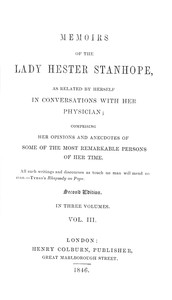
Memoirs of the Lady Hester Stanhope, as related by herself in conversations with her physician, vol. 3 (of 3) — A Closer Reading
(0 User reviews)
101
Project Gutenberg
2023
Not confirmed
Middle East -- Description and travel; Stanhope, Hester, Lady, 1776-1839; Eccentrics and eccentricities -- Great Britain -- Biography; Nobility -- Great Britain -- Biography; British -- Middle East -- History -- 19th century; Women travelers -- Middle East -- Biography
Readers of public-domain and historical texts
Project Gutenberg digital edition
en
Edition facts
Words
84,486
Reading time
368 min
Text sections
19
Before opening Memoirs of the Lady Hester Stanhope, as related by herself in conversations with her physician, vol. 3 (of 3) — A Closer Reading, the edition data offers a quick orientation: 84,486 words, 6 hr 8 min estimated reading time, and 19 detected text sections.
The text analysis averages about 21.8 words per sentence, while the detected sections provide another way to judge how the source is divided.
Project Gutenberg metadata also associates the work with “Middle East -- Description and travel,” connecting these edition facts with the source record’s subject description.
Source:
Project Gutenberg record #72167
This third volume of Lady Hester Stanhope's memoirs, edited by her physician Charles Lewis Meryon, presents her conversations and correspondence from the 1830s, revealing her sharp opinions on European visitors, Ottoman politics, and daily life in Syria, with a distinctive voice that blends aristocratic disdain, superstitious ritual, and theatrical storytelling.
Read the complete public-domain text at its original source.
Read on Project GutenbergLady Hester Stanhope’s voice dominates this third volume of her memoirs, recorded by her physician Charles Lewis Meryon. The text is built around her conversations, letters, and Meryon’s own travel narratives, creating a layered account of life in 1830s Syria. Stanhope’s opinions are delivered with characteristic force: she dismisses Prince Pückler Muskau’s writings, mocks English servants, and recounts a scene where she won over a duke’s critics by mimicking their complaints. The volume also includes Meryon’s hurried journey to Beyrout during a plague outbreak, a sequence that contrasts Stanhope’s rigid weekly seclusion with the urgency of medical crisis.
A Voice of Performative Authority
Her authority extends to superstition. Meryon notes that every Wednesday from sunset to sunset she was “invisible,” a rule so strict that when a letter arrived about a dying woman, he had to leave without consulting her. The vigil of Wednesday commenced at sunset on Tuesday, and from that hour she could “neither see me, nor admit of any message.” This blend of theatricality and rigid ritual shapes the volume’s texture.
Tensions of Travel and Quarantine
Meryon’s own narrative provides a counterpoint to Stanhope’s monologues. In Chapter VII, he receives an urgent plea from an English merchant at Beyrout: his wife is alarmingly ill. Meryon sets off at three in the morning on an ass, taking eleven hours, only to find she has died. The plague has struck the town. A friend warns him: “Touch nobody; the plague is in the town: it has taken us by surprise.” The English consul is already in quarantine, receiving Meryon at his doorway. The juxtaposition is stark: Stanhope’s controlled world of conversation and ritual versus the chaotic, deadly reality of epidemic. Meryon’s understated prose—he notes the innkeeper’s “copious repasts” before learning of the plague—heightens the unease.
Opinions on People and Politics
The volume is thick with Stanhope’s judgments on contemporaries. She discusses Lord Byron, Mehemet Ali, and the Emir Beshýr, though the excerpts offer only fragments. Her letters, such as those to Lord Ebrington and the Duke of Bavaria, reveal a woman engaged with European and Ottoman power structures. She also comments on local customs: Syrian surgeons, the severity needed with Eastern servants, and the folly of education. Her views are rarely neutral. She dismisses Prince Pückler Muskau’s writing style and mocks Dr. Bowring. These opinions are not systematic but erupt through conversation, giving the volume a spontaneous, gossipy energy. Meryon’s editorial hand is light, letting Stanhope’s voice dominate even when her claims are contradictory or exaggerated.
Readers should approach this volume as a curated performance rather than a straightforward autobiography. Meryon’s framing—his own journeys, his dilemmas, his role as audience—shapes how Stanhope’s words land. Pay attention to the gaps: what she does not say about her finances, her isolation, or the political upheavals around her. The volume rewards those who read for voice and tension, not for factual completeness.
There’s something strangely intimate about Lady Hester’s sweeping judgments from her Syrian hilltop, so certain of her own world. Reading her, I find myself craving open air, the way she must have stared at horizons. That’s when I stumbled upon A Book-Lover's Holidays in the Open — Key Ideas to Explore, which feels like a gentler, rambling echo of that same longing for distance and quiet. Odd, how two such different books can share one ache.
There are no reviews for this eBook.
There are no comments for this eBook.
Reader reflection
How will you remember this book?
Save your reaction, strongest insight, and memorable passage.
Your progress
0
/
10
2
How much did you enjoy the reading experience?
3
Would you pass this book on to a friend?
4
What was the reading difficulty like?
5
Would you read this book again?
6
How valuable was this book for your own interests?
7
How strong was your personal connection to the text?
8
How would you rate its originality?
9
In one sentence, what did you learn?
10