1

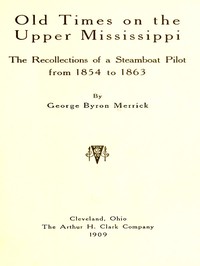
Old Times on the Upper Mississippi The Recollections of a Steamboat Pilot from 1854 to 1863 — Key Ideas to Explore
(0 User reviews)
2104
Project Gutenberg
2014
Not confirmed
Mississippi River -- Description and travel; Mississippi River Valley -- Social life and customs -- 19th century; Frontier and pioneer life -- Mississippi River Valley; Mississippi River Valley -- Description and travel; Merrick, George Byron; River life -- Mississippi River -- History -- 19th century; River boats -- Mississippi River -- History -- 19th century; Pilots and pilotage -- Mississippi River -- Biography; Steam-navigation -- Mississippi River -- History -- 19th century; Mississippi River -- Social life and customs -- 19th century
Readers of public-domain and historical texts
Project Gutenberg digital edition
en
Edition facts
Words
102,854
Reading time
448 min
Text sections
12
This digital edition of Old Times on the Upper Mississippi The Recollections of a Steamboat Pilot from 1854 to 1863 — Key Ideas to Explore is described by source-level measurements including 102,854 words, 7 hr 28 min estimated reading time, and 12 detected text sections.
The text analysis averages about 17.9 words per sentence, while the detected sections provide another way to judge how the source is divided.
Project Gutenberg metadata also associates the work with “Mississippi River -- Description and travel,” connecting these edition facts with the source record’s subject description.
Source:
Project Gutenberg record #47262
Merrick's memoir of steamboat piloting on the Upper Mississippi (1854–1863) offers firsthand accounts of river life, from engine-room labor to the wildcat banking schemes that fueled frontier speculation.
Read the complete public-domain text at its original source.
Read on Project GutenbergGeorge Byron Merrick began his river career as a "cub" pilot in 1854, and his recollections, published in 1909, preserve the texture of steamboat life on the Upper Mississippi before the Civil War. The book’s dedication to his chiefs—an engineer, a clerk, and a pilot—signals the apprenticeship structure that organized work aboard the boats. Merrick’s narrative moves from early impressions of Indians and dugouts to the precise mechanics of steering and the social world of the levee. The table of contents alone, with chapters on wooding up, river menus, gamblers, and racing, suggests a memoir that balances technical detail with anecdotal breadth.
Apprenticeship and the Pilot’s Craft
Merrick frames his experience through the hierarchy of the steamboat. He dedicates the book to his chiefs—Hamilton, Hargus, and Burns—and credits them with teaching him "something that has made life better worth living." The chapters on pilots and their work, knowing the river, and the art of steering indicate that the memoir treats piloting as a learned skill, not mere adventure. In the excerpt on wildcat money, Merrick shifts to a different kind of expertise: the financial schemes that paralleled river commerce. He describes how "five or six persons desirous of benefitting their fellow men" would print bank bills and swap them to create the illusion of currency. This juxtaposition of practical river knowledge and frontier economics is a distinctive feature of the book.
Wildcat Money and Frontier Finance
Chapter XXII, "Wild-cat Money and Town-sites," offers a detailed exposé of banking fraud in the 1850s Northwest. Merrick explains that "the money that was handled on the river" had little backing, and he traces the process by which promoters printed bills, signed them with fictitious names, and circulated them in embryo cities. The passage is notable for its concrete language: a man would arrive with "an iron box costing twenty-five dollars" containing "ten, twenty, or thirty thousand 'dollars' in new bank bills." Merrick’s tone is sardonic but factual, and he ties the scheme to the broader pattern of speculation that accompanied settlement. This chapter, like others on gambling and steamboat racing, shows the memoir’s interest in the informal economies of the river.
Structure and Scope of the Recollections
The book’s thirty chapters move from early impressions to war-time service, with appendices listing steamboats, navigation openings, and distances. Merrick does not claim to cover every aspect of river life; instead, he selects episodes that illustrate the pilot’s perspective. The chapter on "Wooding Up" and the one on "The 'Mud' Clerk" suggest a focus on labor and routine, while "Steamboat Bonanzas" and "A Stray Nobleman" hint at the unusual characters he encountered. The excerpts do not reveal the full narrative arc, but the table of contents indicates a chronological structure within a topical framework. Readers should expect a memoir that values specific observation over sweeping generalization.
Merrick’s recollections are best read as a practitioner’s account, not a comprehensive history. He writes from the pilot house, not the archive, and his authority comes from having worked the river before the war. The appendices—lists of boats, distances, and navigation data—supplement the narrative with reference material. For those interested in the material culture of steamboating or the economic history of the frontier, this memoir offers primary evidence filtered through a single, informed perspective.
I often think of Merrick, gripping his wheel through the shifting Upper Mississippi, and then I remember that other wanderer, his sea-soaked confessions in hand. Both men charted restless waters, chasing hazy banks and islands. There is a quiet kinship there, a shared, hard-earned understanding of how wild speculation and solitary labor shape a life adrift. The Sailor and beachcomber Confessions of a life at sea, in Australia, and amid the islands of the Pacific — Text and Context holds that same lonely patience.
There are no reviews for this eBook.
There are no comments for this eBook.
Reader reflection
How did this book work for you?
Your answers remain private and are stored only in this browser.
Your progress
0
/
10
2
Was reading this book enjoyable?
3
Would you pass this book on to a friend?
4
Did the language feel accessible?
5
Was the book easy to understand?
6
What did you think about the pace?
7
Did you relate to its people, ideas, or situations?
8
Did the book deliver what you hoped for?
9
What did this book teach you most?
10