1

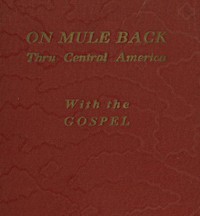
On Mule Back Thru Central America with the Gospel — Edition Insights
(0 User reviews)
38
Project Gutenberg
2018
Not confirmed
Central America -- Description and travel; Missionaries -- United States -- Biography; Crawford, Mattie; Missions -- Central America; Missionaries -- Central America -- Biography
Readers of public-domain and historical texts
Project Gutenberg digital edition
en
Edition facts
Words
36,321
Reading time
158 min
Text sections
5
This digital edition of On Mule Back Thru Central America with the Gospel — Edition Insights is described by source-level measurements including 36,321 words, 2 hr 38 min estimated reading time, and 5 detected text sections.
The text analysis averages about 20.2 words per sentence, while the detected sections provide another way to judge how the source is divided.
Project Gutenberg metadata also associates the work with “Central America -- Description and travel,” connecting these edition facts with the source record’s subject description.
Source:
Project Gutenberg record #57432
Mattie Crawford's 1922 memoir recounts missionary travels by mule through Central America, blending vivid descriptions of landscape and poverty with a narrative voice that shifts from practical observation to spiritual exhortation, punctuated by hymns and scriptural allusions.
Read the complete public-domain text at its original source.
Read on Project GutenbergMattie Crawford's On Mule Back Thru Central America with the Gospel (1922) opens with a preface and table of contents that immediately signal a hybrid work: part travelogue, part missionary testimony, part revivalist tract. The narrative voice is consistently personal, yet it shifts register between plain-spoken observation—dust clouds, bamboo huts, alligators in swimming holes—and impassioned spiritual rhetoric. Crawford often breaks into verse or prayer, as when she writes of being a 'whirlwind coming against the devil.' The book's structure follows a chronological journey from Los Angeles to Nicaragua and Panama, but the pacing is uneven: long stretches of detailed travel description alternate with compressed summaries of evangelistic work. This editorial note examines how Crawford's language, narrative voice, and changes in pace shape the reader's experience of a text that is at once a geographical record and a religious testimony.
A Voice That Shifts Between Reporter and Preacher
Crawford's narrative voice is not uniform. In passages describing travel logistics—loading mules, finding food, navigating roads—she writes in a straightforward, almost journalistic style: 'Arising at two o’clock the next morning we went over the road on which the robbers were supposed to be, through a dense forest, but saw nor heard nothing except the many parrots and birds, screeching and singing.' The concrete details (parrots, screeching) ground the account in sensory reality. But when she turns to the spiritual purpose of her journey, the register rises into homiletic cadence: 'Souls were at stake. They were being held in prison, behind bars of iron, but their cries had reached Heaven and God had sent some of His messengers with the glad news of freedom.' The shift is abrupt, often within the same paragraph. This dual voice—reporter and preacher—creates a tension between documenting the world as it is and interpreting it as a stage for divine action. Crawford also uses first-person plural ('we') to include her family and, by extension, the reader in the mission, reinforcing a sense of collective purpose.
Pace as a Marker of Spiritual Urgency
The pacing of the narrative varies markedly. Early chapters move slowly, with extended descriptions of preparation, home-leaving, and sea voyages. Once the family reaches Nicaragua, the tempo quickens: days are compressed into single sentences, and geographical movement is summarized in leagues traveled. For instance, Crawford writes, 'We made seventeen leagues that day, crossing mountains and plains, stopping at noon at a little hut by the roadside.' The rapid enumeration of leagues, mountains, and plains conveys the physical demands of the journey while also suggesting a spiritual urgency—time is short, souls are waiting. Conversely, when Crawford describes a domestic scene (a woman grinding gourd seeds, piglets under a table), the pace slows, allowing the reader to linger on ethnographic detail. These changes in tempo are not accidental; they reflect Crawford's priorities. Travel is a means to an end, and the narrative accelerates when the end—preaching the Gospel—is in sight. The result is a rhythm that mimics the missionary's own experience: long stretches of hardship punctuated by moments of intense spiritual engagement.
Recurring Imagery and Its Thematic Weight
Certain images recur throughout the excerpts, forming a visual and thematic lexicon. Dust is one: 'The dust was very deep in the roads... It rolled up about us in a great cloud. Many times we could not see each other a few feet away.' Dust becomes a metaphor for obscurity and opposition, but also for the missionary's visibility—'a miniature whirlwind coming down the road.' Another recurring motif is the contrast between poverty and spiritual hunger. Crawford repeatedly describes homes with 'bamboo covered house, its walls composed of a few sticks,' 'beds were merely a few sticks covered with a rawhide,' and 'a black smutty pile of rocks was the stove.' Yet she insists that the inhabitants 'listened to the Gospel story' with eagerness. This juxtaposition of material lack and spiritual receptivity is central to Crawford's argument for the mission. She also uses natural threats—alligators, volcanoes, robbers—to demonstrate divine protection, as when she notes that the swimming hole contained 'large Alligators' but 'He is the same as when He stopped the lions’ mouths for Daniel.' The imagery is consistent with the book's subtitle, 'A Thrilling Missionary Story,' and reinforces the idea that faith overcomes physical danger.
Readers approaching On Mule Back Thru Central America with the Gospel should be prepared for a text that does not conform to modern expectations of memoir or travel writing. Crawford's shifts in voice and pace are not flaws but features of a work that sees itself as both record and sermon. Pay attention to the moments when the narrative slows—those are where Crawford finds meaning in the mundane. And note the hymns and scriptural quotations that punctuate the prose; they are not decorative but structural, marking the rhythm of a life lived in constant reference to the divine.
That rainy afternoon, Mattie Crawford’s mule plodding through mud and scripture became a strange comfort, her exhaustion and hymns settling into my own quiet room. When I finally set it down, I drifted, half-remembering how she noticed every bird and trail’s bend. That’s what led me to A Book-Lover's Holidays in the Open — Key Ideas to Explore, another voice simply watching the wild pass by, unhurried.
There are no reviews for this eBook.
There are no comments for this eBook.
Reader reflection
How did this book work for you?
Your answers remain private and are stored only in this browser.
Your progress
0
/
10
2
What was your overall reaction to the book?
3
Is this a title you would suggest to others?
4
How easy was the book to follow?
5
How closely did the book connect with your experience?
6
Did you gain anything practical from the text?
7
Was the book what you thought it would be?
8
What was the strongest part of the book?
9
What is the main idea you are taking away?
10