1

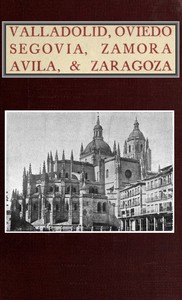
Valladolid, Oviedo, Segovia, Zamora, Avila & Zaragoza An Historical & Descriptive Account — Background and Themes
(0 User reviews)
2350
Project Gutenberg
2021
Not confirmed
Architecture -- Spain; Art -- Spain; Valladolid (Spain) -- Description and travel; Oviedo (Spain) -- Description and travel; Segovia (Spain) -- Description and travel; Zamora (Spain) -- Description and travel; Avila (Spain) -- Description and travel; Zaragoza (Spain) -- Description and travel; Spain -- Pictorial works
Readers of public-domain and historical texts
Project Gutenberg digital edition
en
Edition facts
Words
43,564
Reading time
190 min
Text sections
10
The catalog record for Valladolid, Oviedo, Segovia, Zamora, Avila & Zaragoza An Historical & Descriptive Account — Background and Themes provides practical reading context through 43,564 words, 3 hr 10 min estimated reading time, and 10 detected text sections.
The text analysis averages about 21.6 words per sentence, while the detected sections provide another way to judge how the source is divided.
Project Gutenberg metadata also associates the work with “Architecture -- Spain,” connecting these edition facts with the source record’s subject description.
Source:
Project Gutenberg record #64970
Albert F. Calvert's 1908 guide to six Spanish cities blends architectural description, local legend, and historical narrative, tracing the nation's development through Oviedo, Zamora, Segovia, Avila, Valladolid, and Zaragoza, with 413 illustrations.
Read the complete public-domain text at its original source.
Read on Project GutenbergAlbert F. Calvert's Valladolid, Oviedo, Segovia, Zamora, Avila & Zaragoza (1908) moves from city to city not as a simple itinerary but as a layered historical argument. Each chapter treats its subject as a stage in Spain's national development: Oviedo as the cradle of the monarchy, Zamora as the heroic age of ballad and folklore, Segovia and Avila as towns of the Reconquest. The book's structure is itself a kind of journey through time, with the reader passing from the shadowy warriors of Oviedo to the tall knight of history, and finally to Valladolid and Zaragoza, where the modern nation takes shape.
Recurring Images of Walls and Siege
Throughout the excerpts, walls are not mere fortifications but active participants in the narrative. Zamora is described as "still encircled with massive walls, strengthened with numerous round towers," and the siege of 1072 is recounted in vivid detail: the secret postern, the assassination of King Sancho, the five duels. The walls of Avila and Segovia are similarly invoked as wardens against the Moor, their "grass-grown streets" still echoing with the tramp of armed men. This recurring image of enclosure and defense ties the physical fabric of each city to its historical role.
Movement Between Cities as Historical Progression
Calvert's preface explicitly frames the six cities as a sequence: "each town illustrating a different stage of a great nation's development." The reader moves from Oviedo, "the cradle of the monarchy," through Zamora's "heroic age," to Segovia and Avila as "towns of the Reconquest," and finally to Valladolid and Zaragoza as capitals of a unified Spain. This progression is not merely geographical but chronological and thematic, with each city embodying a distinct phase of Spanish history. The structure thus mirrors the very narrative of national formation it describes.
The Interplay of Legend and Documented History
Calvert weaves together chronicle, folklore, and ballad. In the Zamora section, he recounts the story of Bellido Dolfos, the Cid's forgotten spurs, and the verses from the Romancero addressed by Princess Urraca to the Cid. He notes that the site of the assassination is marked by a "tiny hermitage" and a "battered cross," while the postern and the Cid's house are still pointed out. This blending of physical landmarks with legendary material gives the text a texture that is part guidebook, part historical romance, without ever fully endorsing the legends as fact.
Architectural Detail as Historical Evidence
Calvert's descriptions of buildings are precise and functional. He notes the "massive walls" and "round towers" of Zamora, the "bust of Princess Urraca" with its defaced inscription, and the castle at the western extremity of the town. These details are not mere decoration; they serve as evidence for the historical events he recounts. The house called Urraca's Palace, the postern through which Dolfos escaped, the hermitage marking the assassination—all are treated as tangible links to the past, allowing the reader to see history embedded in the stones of the present.
Readers approaching this work should attend to the way Calvert uses physical landmarks—walls, gates, palaces, hermitages—as anchors for historical narrative. The book rewards those who read it as a series of interconnected essays rather than a conventional travelogue, and who are willing to follow the author's movement between legend and documented fact. The 413 illustrations, though not reproduced here, are integral to this method, offering visual evidence for the architectural and historical claims made in the text.
Calvert's Spain feels like wandering through quiet courtyards where centuries of legend still linger, each pillar and plaza carrying a weight of memory. That same unhurried sense of distance and place fills his journey from the Arctic Ocean to the Yellow Sea, a different geography but the same ache of passing time. I often return to those pages when I miss the roads I haven't taken—From the Arctic Ocean to the Yellow Sea — Text and Context holds that particular loneliness of travel, and it stays with you.
There are no reviews for this eBook.
There are no comments for this eBook.
Reader reflection
How will you remember this book?
Save your reaction, strongest insight, and memorable passage.
Your progress
0
/
10
2
How much did you enjoy the reading experience?
3
Is this a title you would suggest to others?
4
Did the language feel accessible?
5
Would you like to discuss this book with someone?
6
What did you appreciate most?
7
Did anything about the book feel genuinely new?
8
How did the reading compare with what you expected?
9
What is the main idea you are taking away?
10